Adult incontinence products are a growing second market. A diaper is a complex product: fluff pulp and superabsorbent polymer (SAP) in the core, non-woven top sheet and acquisition layer, a breathable back sheet, elastic leg cuffs and waist, and fastening tapes or a pull-up design, so it needs an automatic line. Most materials are imported, and large brands dominate supermarket shelves, so new makers usually compete on value packs, private label, regional distribution and institutional supply. Absorbent hygiene products are currently outside the EPR product lists, but the draft strategy proposes measures for their waste.
Step 1: baby or adult?
| Baby nappies | Adult nappies and pads | |
|---|---|---|
| Market | Large, steady, highly competitive | Smaller, growing with an ageing population and care homes |
| Products | Tape nappies, pull-ups, sizes newborn to junior | Tape-type briefs, pull-ups, pads and underpads |
| Buyers | Retail, wholesalers, spaza shops, private label | Pharmacies, care homes, hospitals, home care |
| Line | High speed, many size changes | Lower speeds, larger product |
| Competition | Large brands, imports | Fewer local makers |
Many new manufacturers start with one product family and a few sizes, then add more.
Step 2: materials
A nappy line consumes fluff pulp, SAP, non-wovens (spunbond and hydrophilic top sheet, acquisition layer), breathable PE back sheet or non-woven laminate, elastic spandex, hot-melt glues, frontal tape and fastening tapes or elastic waist bands, wetness indicator, and polybags and cartons. Most of these are imported. Materials are the largest part of the cost, so choose suppliers carefully, agree lead times and keep several weeks of stock.
Step 3: equipment
| Line | Output | Indicative price (2026) |
|---|---|---|
| Baby nappy line | About 300–500 pieces a minute | About US$400,000–900,000 |
| Adult nappy line | About 150–400 pieces a minute | Quoted per configuration; listings range widely |
| Packing | Stacker, bagger, cartoner | Priced with the line |
| Utilities | Compressed air, dust extraction, chiller for glue systems | Priced per configuration |
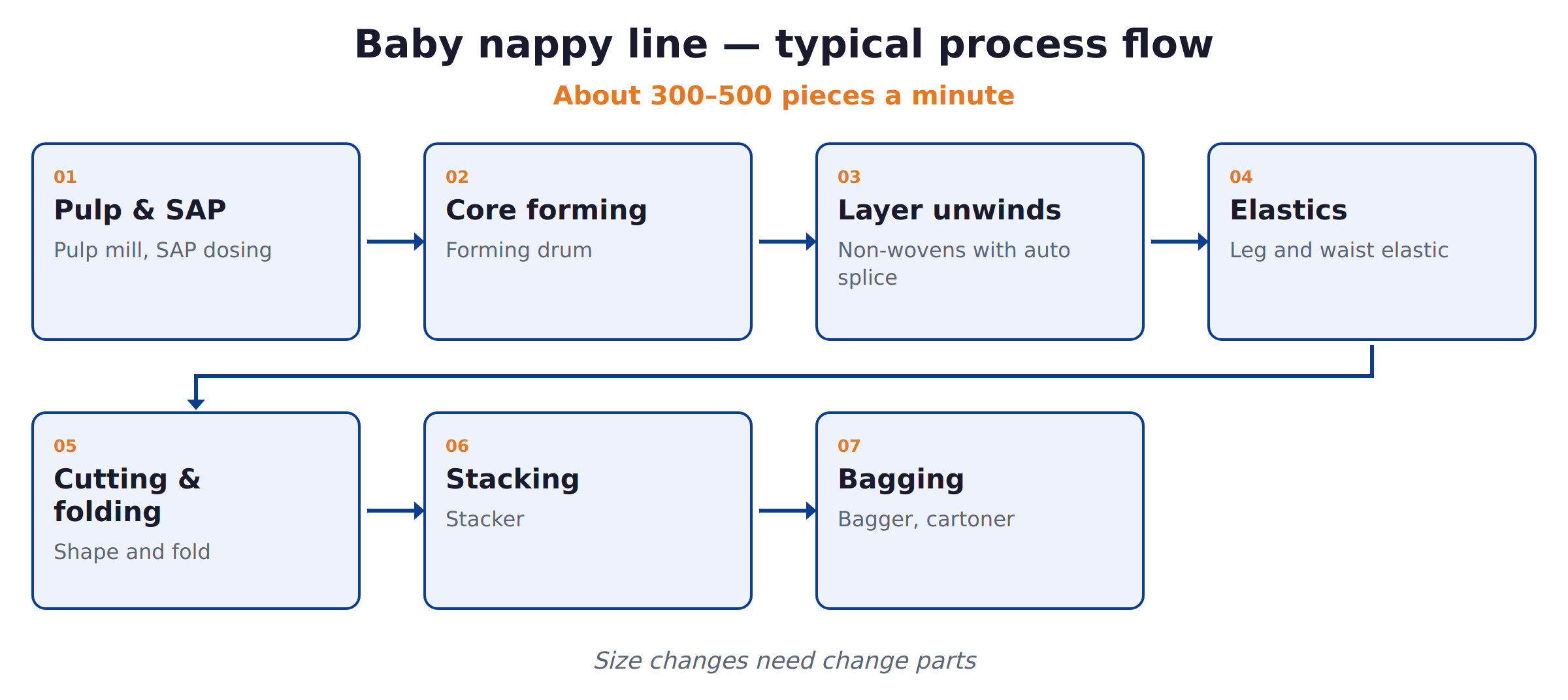
A line includes a pulp mill and forming drum, SAP dosing, layer unwinds with automatic splicing, elastic application, cutting, folding, stacking and bagging. Size changes need change parts. Our hygiene product line cost guide shows the related bands. Machines of this type under headings 8479.89 and 8422.40 generally enter duty-free.
Step 4: quality and testing
Buyers judge nappies on absorbency, rewet (dryness), leakage, fit and skin comfort. Set up a laboratory for absorbency and rewet checks, weigh cores during production, keep retained samples, and record material lots. Retail and institutional buyers will ask for test reports and may audit your factory. Packs must show the count and size, in line with the Legal Metrology markings rules (SANS 289).
Step 5: competing with large brands
Large brands spend heavily on marketing and win supermarket shelf space. New local makers usually win with:
- Value packs at lower prices for spaza shops and wholesalers.
- Private label for retailers and wholesalers.
- Regional distribution with fast, reliable delivery.
- Institutional supply: care homes, hospitals, clinics, government procurement.
Step 6: waste and regulation
The draft strategy on absorbent hygiene products, published by the Department of Forestry, Fisheries and the Environment on 11 April 2025, estimates that about 630,000 tonnes of wet diapers are disposed of in South Africa every year and notes that these products are currently excluded from the product lists in the Extended Producer Responsibility notices, so producers do not yet run an EPR scheme or pay an EPR fee. The strategy proposes ways to reduce, collect and treat this waste. Follow its progress, because EPR obligations could follow.
Step 7: premises and registration
A nappy factory needs a clean, dust-controlled production hall, a large dry store for materials and finished packs, three-phase power with backup, compressed air, and loading docks. Register your company with CIPC, register for tax and VAT, and consider product liability insurance.
Worked example: an adult care product start-up
A healthcare distributor in Gauteng supplies imported adult nappies to care homes and pharmacies. It plans a local adult pull-up and brief line of about 200 pieces a minute, with change parts for three sizes, a laboratory for absorbency and rewet tests, and three months of imported material stock. It keeps importing baby nappies while it builds its adult range and signs supply agreements with two care home groups before ordering the line. The figures are illustrative.
Common mistakes
- Starting with too many sizes and products.
- No material stock plan.
- Weak testing: leakage complaints lose customers fast.
- Competing head-on with big brands in supermarkets.
- Underestimating space: finished packs are bulky.
Sizes and range planning
Baby nappies sell in several sizes, from newborn to junior, and each size needs change parts and adjustment of core and elastics. Most new makers start with the two or three sizes that sell most and add others later. Adult products are fewer sizes but larger, and care homes often want briefs and pull-ups in medium and large plus underpads.
Distribution
Nappies are bulky and light, so transport costs are high per rand of sales. Plan distribution around regional wholesalers and depots, deliver full trucks, and use packs and cartons that stack well. For care homes and hospitals, agree regular delivery schedules.
Financing the start-up
A nappy line, imported materials and stock tie up a large amount of capital before the first sale. Plan finance for the line and at least three to four months of materials and stock, and test your plan at lower sales volumes. Development finance institutions and banks will want to see signed customers or letters of intent.
Staffing
A nappy line needs trained operators, a mechanical and an electrical technician who understand servo drives and glue systems, quality checkers and warehouse staff. Train technicians during commissioning, because line downtime is the largest hidden cost in this business.
Quality reputation
Parents and care staff switch brands quickly after leaks or rashes. Track complaints by batch and size, investigate every one, and fix the cause in materials or settings. A record of steady quality is what lets a local brand win shelf space next to well-known names.
Fire and storage
Pulp, non-wovens and finished packs are flammable and bulky. Store them in a dry, well-ventilated warehouse with fire detection and extinguishers, keep aisles clear, and stack within safe heights.
Where CISH fits
We supply complete baby and adult diaper lines with packing, from audited factories in China, sized to your products and output. CISH ships, clears, installs and commissions the line on your materials, and trains your operators and technicians. For tabletop or semi-automatic machines, a local seller is usually the better choice, but they do not make retail-quality nappies.
Frequently asked questions
How much does a diaper making machine cost?
As an indication for 2026, a baby nappy line of about 300–500 pieces a minute costs about US$400,000–900,000. Adult lines are quoted per configuration.
How big is the diaper market in South Africa?
A 2025 draft government strategy cites market estimates of about 3 billion diaper units sold each year.
What raw materials are used to make diapers?
Fluff pulp, SAP, non-woven fabrics, PE or laminated back sheet, elastics, hot-melt glues and fastening tapes.
Are diapers covered by EPR in South Africa?
Not yet. Absorbent hygiene products are currently excluded from the EPR product lists, but a 2025 draft strategy proposes measures for their waste.
Can a small business make diapers?
Diapers need an automatic line and significant working capital. Smaller businesses often start by distributing or private-labelling before manufacturing.
Does CISH supply diaper lines?
Yes, complete baby and adult lines with commissioning and training.