Imported sugar confectionery carries 37% general duty, which helps local makers, while confectionery machinery is duty-free. Sugar is the main raw material, and white sugar averaged R67.81 per 2.5 kg at retail in July 2026. Countertop candy floss machines and shop equipment are outside the scope of this page.
Sweets line prices in 2026
| Line | Output | What is included | Indicative price (2026) |
|---|---|---|---|
| Small depositing or semi-automatic line | About 100–300 kg/h | Dissolving and cooking, depositor, moulds, cooling tunnel, demoulding | About US$15,000–60,000 ex-works |
| Automatic depositing or die-forming line | About 300–800 kg/h | Automatic weighing and dissolving, vacuum cooker, servo depositor or rope-sizer and die-former, cooling | About US$50,000–120,000 ex-works |
| Complete plant with wrapping | Per product mix | Above plus twist wrap, flow wrap or bagging, cartoning | Quoted per configuration |
These are ex-works prices from Chinese factories' listings, not quotes. Freight, installation, a building, a boiler or heat source, cooling water and working capital for sugar, glucose and packaging come on top. Machines tend to account for about 35–55% of a confectionery project, not all of it.
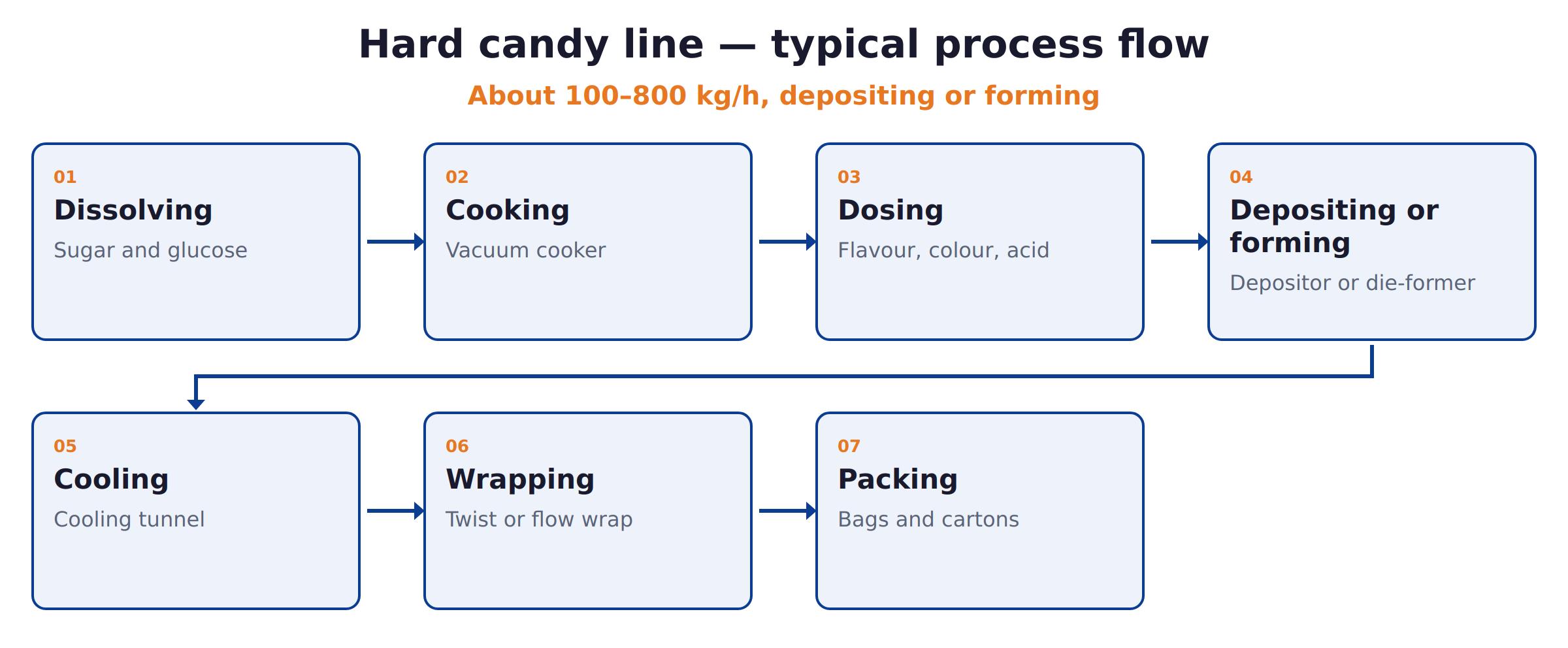
Where the price differences come from
| Factor | Effect on price |
|---|---|
| Output in kg per hour | Larger cookers, depositors and longer cooling tunnels |
| Depositing or die-forming | Depositing suits clear hard candy, jellies and centre-filled sweets; die-forming suits pressed and pulled shapes |
| Number of products | Each shape needs moulds or dies; centre-filled and striped sweets need extra heads |
| Automatic weighing and dissolving | Consistent batches; higher price |
| Vacuum cooking | Clearer, drier hard candy; higher price |
| Servo control | Accurate deposits; easier changeovers |
| Wrapping | Twist and flow wrappers are often a large share of the total |
| Stainless grade | Food-contact parts should be stainless steel suited to sugar and acids |
Hard candy, lollipops and jellies: one line or several?
- Hard candy and lollipops are made by cooking sugar and glucose to a high temperature, often under vacuum, adding colour, flavour and acid, then depositing into moulds or forming from a rope. Lollipop lines add stick insertion.
- Jellies and gummies use gelatine, pectin or starch with sugar, cooked to a lower temperature, deposited into moulds and left to set or dried in a starch mogul on larger lines.
- Toffees and chews need a different cooker and often a pulling machine and cut-and-wrap machine.
Many depositing lines can make hard candy and jellies with a change of cooker settings and moulds, but not always at the same speed. Tell the supplier every product you plan to make, with its recipe type.
A cheap machine versus a line that ships product
A low-priced depositor alone will not make sellable sweets. You also need a reliable way to dissolve and cook sugar to the same temperature every batch, cooling that sets the sweets before demoulding, humidity control in the packing area because hard candy absorbs moisture and goes sticky, and wrapping that keeps up with the depositor. When comparing a cheap machine with a line, list every step from sugar bag to packed carton.
Landed cost: what else to budget
| Item | Notes |
|---|---|
| Equipment | From the table above |
| Freight and insurance | Usually several containers for a full line |
| Clearing and import VAT | VAT at 15% on customs value plus duty plus 10%; machinery itself carries no general duty |
| Installation and commissioning | Engineer days on site; trial batches on your recipes |
| Building and utilities | Hygienic finishes, steam or thermal oil, cooling water, compressed air, air conditioning in packing |
| Moulds and spares | Extra moulds for each shape |
| Working capital | Sugar, glucose, flavours, colours, wrappers, cartons |
Choosing by scenario
- New sweets business: start with a small depositing line for one or two products, with semi-automatic wrapping or bagging, and test the market.
- Adding a line to a food business: a depositing line that shares your packing area and boiler.
- Replacing an old line: an automatic line with servo depositing and automatic weighing gives more consistent weight and lower waste.
How to compare quotes and choose a supplier
- Product list with recipes, sizes and wrap type.
- Output in kg per hour for each product, not depositor strokes.
- Cooker type: batch, continuous or vacuum.
- Mould and die count included, and the price of extra sets.
- Cooling tunnel length and temperature control.
- Wrapping included, and its speed per minute.
- Utilities: steam or thermal oil, power, cooling water and air.
- Installation, commissioning on your recipes, and training.
- Spares for depositor pistons, seals and moulds.
- References: a factory running the same line on similar products.
Rules, duty and raw materials in South Africa
- Food premises. A sweets plant is a food premises under R638 of 2018 and needs a Certificate of Acceptability from the municipality.
- Labelling. Pre-packed sweets must be labelled under R146 of 2010, with ingredients, allergens where relevant, net quantity and dates.
- Colours and additives. Use only permitted colours and additives, and declare them on the label.
- Import duty on sweets. Sugar confectionery not containing cocoa (1704.90) carries 37% general duty, 25% from the EU and UK, and none from SADC countries.
- Duty-free machinery. Confectionery machinery (8438.20) carries no general duty.
- Sugar levy. The Health Promotion Levy applies to sugary drinks, not to sweets.
- Sugar supply. Local sugar is produced by the cane industry represented by the South African Sugar Association; white sugar averaged R67.81 per 2.5 kg at retail in July 2026. Ask about bulk prices from refiners or distributors for your volume.
Worked example: a first lollipop and hard candy line
Imagine a food business that wants to supply lollipops and hard-boiled sweets to wholesalers and spaza shops. It starts with a small depositing line of about 150 kg an hour, with two sets of moulds, a batch dissolver and cooker, a short cooling tunnel and a stick inserter for lollipops. Wrapping is done by a semi-automatic twist wrapper at first, with bagging by hand, because a fully automatic wrapper would cost as much as the line. The building needs a dry, air-conditioned packing room, since hard candy absorbs moisture within hours on a humid day.
In the first months, most problems come from the cooking, not the depositor: sugar boiled a few degrees too low makes sticky sweets, and too high makes them yellow. Recording the temperature and time of every batch, and testing moisture regularly, solves most of it. Once orders are steady, the business adds a second wrapper and more moulds, and only later moves to a faster automatic line. The order matters: secure customers, get one product right, then add speed.
Common mistakes
- Buying a depositor without a proper cooker. Batches vary, and sweets go cloudy or sticky.
- No humidity control in packing. Hard candy picks up moisture.
- Too few moulds. Changeovers stop the line.
- Wrapping as an afterthought. Hand wrapping limits output.
- Ignoring cooling. Sweets deform when demoulded warm.
Where CISH fits
We supply complete sweets lines, from sugar dissolving and cooking to forming, cooling and wrapping, from audited factories in China, matched to your products and kilograms an hour. CISH ships and clears the line, installs and commissions it with output demonstrated on your recipes, and trains your operators. For a single small machine for a shop, a local dealer is usually the better choice.
Frequently asked questions
How much does a sweets making machine cost in South Africa?
As an indication for 2026, a small depositing line for about 100–300 kg an hour costs about US$15,000–60,000 ex-works, and an automatic line for about 300–800 kg an hour about US$50,000–120,000. Complete plants with wrapping are quoted per configuration.
Can one line make hard candy and jellies?
Many depositing lines can, with different cooker settings and moulds, but output may differ by product. List every product when you ask for quotes.
Is there import duty on sweets in South Africa?
Sugar confectionery not containing cocoa carries 37% general duty, 25% from the EU and UK, and none from SADC. Confectionery machinery is duty-free.
Does the sugar tax apply to sweets?
No. The Health Promotion Levy applies to sugary beverages.
What licence do I need to make sweets?
A Certificate of Acceptability for the food premises under R638, and labels that meet R146.
Does CISH sell candy floss or small sweet machines?
No. We supply complete sweets production lines.