Choose the supplier who commits to tonnes per hour of clean crumb at your size, with steel and fibre separated, and who understands the waste licensing your site needs.
Four kinds of tyre recycling supplier
| Supplier type | What they sell | Price | Who answers for output | Best fit |
|---|---|---|---|---|
| Local shredder or machinery builder | Shredders, bead wire removers, cutters, conveyors; repairs and knife sharpening | Moderate | The builder, machine by machine | Collectors and pre-processors |
| Dealer of imported shredders | Primary shredders, granulators from one or two brands | Moderate to high | The dealer | Operators adding capacity |
| Chinese factory, direct | Complete crumb lines: debeading, shredding, rasping, granulating, magnetic and fibre separation, sieving | Lowest on the quote | You, after delivery | Buyers with their own plant engineers |
| Turnkey line company | Tyre intake to bagged crumb, installed and commissioned, with dust and fire safety designed in | Between local and direct | The turnkey company, at agreed tonnes per hour and crumb size | New crumb producers and processors moving up from shredding |
Know which product you are making
- Shred or chips for tyre-derived fuel or civil uses: a primary shredder and screening.
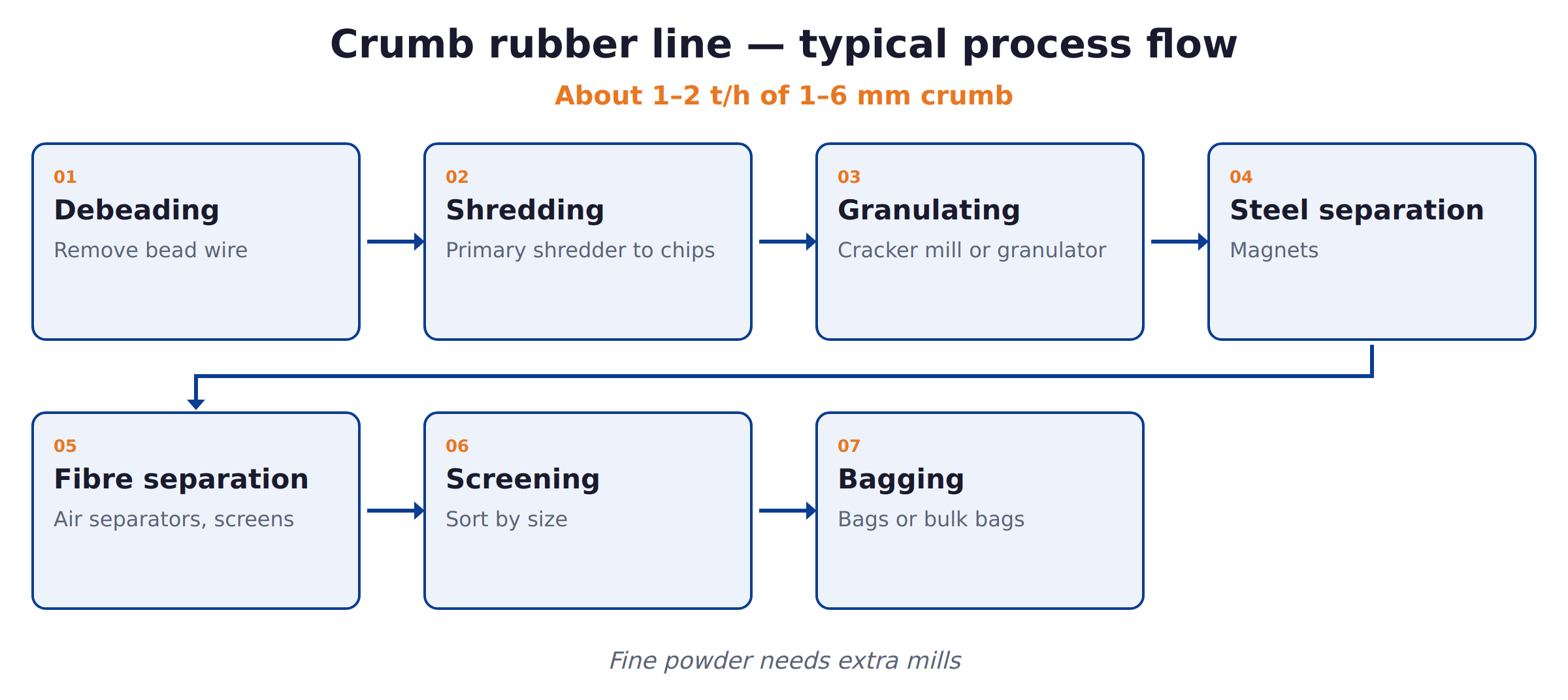
- Crumb rubber of 1–6 mm for sports surfaces, moulded products and asphalt: shredding, rasping, granulating, steel and fibre separation, sieving.
- Fine powder of 40–80 mesh: a further milling stage; quoted separately.
- Pyrolysis to oil and char: a thermal process with a different licence regime. CISH does not supply it.
Three tests for a tyre recycling supplier
Output of clean crumb, not tyres fed
A line rated at "2 t/h" may mean tyres fed, not crumb out. Ask for tonnes per hour of crumb at your target size, with residual steel and fibre content stated, demonstrated on your tyre mix of car and truck tyres.
Steel and fibre separation
Crumb with steel or fibre in it is worth little. Ask how many stages of magnetic separation and fibre removal the line has, and what purity it achieves.
Wear parts and knives
Tyres destroy knives and screens. Ask what the knives are made of, how many tonnes they last, how they are sharpened or replaced, and what that costs per tonne of crumb.
Where to find tyre recycling suppliers
- The Waste Management Bureau, which supervises waste tyre management in the interim under the Waste Tyre Regulations, keeps registers of waste tyre participants; registered processors are references for equipment.
- Recycling and waste management shows in Johannesburg and Cape Town feature shredding equipment; check current dates with organisers.
- Existing processors: visit a crumb plant and ask about knife life, dust and downtime.
- China: most crumb rubber lines sold in Africa are built in China; use our supplier audit checklist first.
We do not name or rate suppliers.
How to choose: a 10-point checklist
- Product: shred, crumb size range, or powder, stated.
- Output in tonnes per hour of finished crumb, on your tyre mix.
- Truck tyres: debeading and pre-cutting capacity for large tyres.
- Separation: magnetic and fibre stages, with purity stated.
- Sieving and bagging: size fractions, bulk bags or small bags.
- Wear parts: knife and screen life, and cost per tonne.
- Dust, noise and fire safety: extraction, enclosures, detection and suppression.
- Power: connected load and peak demand.
- Installation, commissioning and training in the price.
- Support: knife sharpening and replacement, gearbox and motor service.
Planning the business? See how to start a tyre recycling business in South Africa, licences first.
Ten questions to ask
- What output of crumb, at what size, will you guarantee on my tyres?
- Can the line take truck tyres, and what pre-processing do they need?
- What residual steel and fibre content does the crumb have?
- How long do the knives last, and what do replacements cost?
- What is the connected electrical load?
- How is dust controlled, and what fire protection is included?
- Is bagging included?
- Is installation, commissioning and training included?
- What does the warranty cover?
- Which plant runs this line, and may I visit?
Comparing crumb rubber quotes
| Section | What each quote should state |
|---|---|
| Intake and pre-processing | Debeader, sidewall cutter, conveyor |
| Primary shredding | Shredder model, capacity, knife material |
| Secondary rasping and granulating | Stages, target size, capacity |
| Separation | Magnetic separators, fibre removal, aspiration |
| Sieving and bagging | Fractions, bagging station |
| Dust and fire | Extraction, enclosures, detection and suppression |
| Wear parts | Knives, screens and their expected life |
| Freight, installation, commissioning | Incoterm, clearance, test on your tyres |
| Training and documents | Days, manuals |
| Owner's scope | Building, slab, power connection, licences |
Compare totals with what each quote leaves out; our same-scope comparison explains the method.
Common mistakes
- Confusing tyres fed with crumb produced. Ask for output at the end of the line.
- Ignoring truck tyres. They need debeading and heavier shredders.
- Underpricing knives. Wear parts are a large part of the operating cost.
- No market for the crumb. Secure buyers for your size range before you size the line.
- Starting before the licence. Sorting, shredding and grinding of waste at larger facilities, and storing waste tyres over certain areas, are regulated waste activities.
Tyre recycling equipment prices in 2026
Indicative, in USD, from our crumb rubber plant cost guide:
| Purchase | Capacity | Indicative price (2026) |
|---|---|---|
| Semi-manual crumb set | About 0.3–1 t/h, mainly car tyres | US$20,000–150,000 |
| Automatic crumb rubber line, equipment | About 1–2 t/h of 1–6 mm crumb, car and truck tyres | US$200,000–600,000 |
| Automatic crumb rubber line, landed | As above | US$400,000–1,200,000 |
| Fine powder add-on | 40–80 mesh | Quoted per configuration |
| Tyre pyrolysis | Thermal conversion | Not supplied by CISH |
South African facts that shape the decision
- The waste tyre plan. Approval of the industry waste tyre management plan was withdrawn in June 2025 for review, with interim collection and processing arrangements continuing. In June 2026 the Waste Management Bureau called for nominations to an interim industry advisory committee, and no new plan had been approved by that notice.
- Interim supervision. Under the Waste Tyre Regulations, 2017, the Waste Management Bureau facilitates, supervises and controls waste tyre management in the interim, and participants must register with it.
- The tyre levy. An environmental levy of R2.30 per kilogram applies to tyres under Schedule 1 Part 3E of the customs tariff, in force since 1 February 2017.
- Waste licensing. The list of waste management activities (GN 921 of 2013, amended by GN 1094 of 2017) covers storage of waste tyres over certain areas and the sorting, shredding, grinding and screening of general waste at facilities of 1,000 m² and more, which require registration or licensing depending on the category.
- Pyrolysis is separate. Thermal treatment of waste is a listed activity under GN 893 of 2013 for all installations treating 10 kg a day or more, which is one reason CISH confines itself to mechanical crumb production.
- Import duty. Crushing, grinding and screening machinery (8479.82) and machinery for working rubber (8477.80) are free of general duty in SARS's 2026 tariff; import VAT of 15% applies and is claimable by VAT vendors; see our import duty guide.
Where CISH fits
CISH is a turnkey line company. We specify crumb rubber lines from audited factories in China against your tyre mix and target crumb size, ship and clear them, and install and commission the line with output and purity demonstrated on your tyres, dust and fire protection included, and your operators trained. We suit new crumb producers and shredding operators moving to crumb. We do not supply pyrolysis plants. For a single shredder, a local dealer may serve you better.
Frequently asked questions
Who sells tyre recycling machines in South Africa?
Local shredder and machinery builders, dealers of imported shredders, Chinese factories selling complete crumb lines direct, and turnkey line companies. Shredding is often local; complete crumb lines are usually imported.
How much does a tyre recycling plant cost?
As an indication for 2026, a semi-manual crumb set of about 0.3–1 t/h costs US$20,000–150,000, and an automatic 1–2 t/h crumb rubber line about US$200,000–600,000 in equipment, or US$400,000–1,200,000 landed and installed.
Do I need a licence to recycle tyres?
Waste tyre processors register with the Waste Management Bureau under the Waste Tyre Regulations, and shredding, grinding or storing waste tyres at larger facilities falls under the list of waste management activities, which requires registration or a licence depending on the category. Confirm the category with the environmental authority before you build.
What happened to the waste tyre plan?
Approval of the industry waste tyre management plan was withdrawn in June 2025 for review. Interim arrangements continue under the Waste Management Bureau, which called for nominations to an interim advisory committee in June 2026.
Is there import duty on tyre recycling machines?
Crushing, grinding and screening machinery and machinery for working rubber are free of general duty in SARS's 2026 tariff. Import VAT of 15% applies.
Does CISH supply tyre pyrolysis plants?
No. We supply mechanical crumb rubber lines only. Pyrolysis is a thermal process with its own licensing and is outside our scope.