Operators who collect, store or pre-process waste tyres must register under the Waste Tyre Regulations, 2017; since the industry waste tyre plan's approval was withdrawn in June 2025, the Waste Management Bureau manages waste tyres in the interim. Recycling general waste at a site with an operational area over 500 m², or recovering 10–100 tonnes a day, needs a basic assessment and a waste management licence; a 1 t/h line running two shifts is already above 10 tonnes a day. Tyre makers and importers pay SARS an environmental levy of R2.30 per kg on new tyres, but that levy is not paid to recyclers.
Step 1: the business model
A tyre recycling business earns from two sides: gate fees or collection payments for taking tyres, where they exist, and sales of crumb, granules, steel and sometimes fibre. In South Africa, how tyres are collected and who pays for it has changed several times, so build your plan on crumb sales and treat any collection income as a bonus until you have it in writing. The strongest businesses either use crumb themselves in products they make and sell, such as rubber pavers and mats, or have firm buyers for a specific crumb size.
Step 2: secure tyre supply
Talk to tyre dealers, fitment centres, fleet operators, mines and transport companies about how many tyres they produce, in what condition, and whether they will deliver or you collect. Car tyres are lighter and easier to process; truck tyres give more rubber per tyre but need heavier equipment. Agree supply in writing. Remember that tyre dealers and collectors also have registration duties under the regulations.
Step 3: registration and licences
- Registration: the Waste Tyre Regulations, 2017 (GN R.1064) require tyre dealers, collection points, depots, transporters, storage sites and pre-processors to register. Since the industry plan's approval was withdrawn on 2 June 2025, the Waste Management Bureau facilitates and supervises waste tyre management until a new plan is approved. In June 2026 the department called for nominations to an interim advisory committee; check the current position before you start.
- Waste management licence: under the NEMWA list of waste management activities (GN 921 of 2013), recycling general waste at a facility with an operational area over 500 m², or recovering 10–100 tonnes of general waste a day, are Category A activities needing a basic assessment and a waste management licence; above 100 tonnes a day is Category B, with a full environmental impact assessment.
- Municipal approvals: zoning, building plans and fire safety. Tyre stockpiles burn fiercely, so storage limits, spacing and fire equipment matter.
Ask the licensing authority before you sign an equipment order.
Step 4: equipment and the process
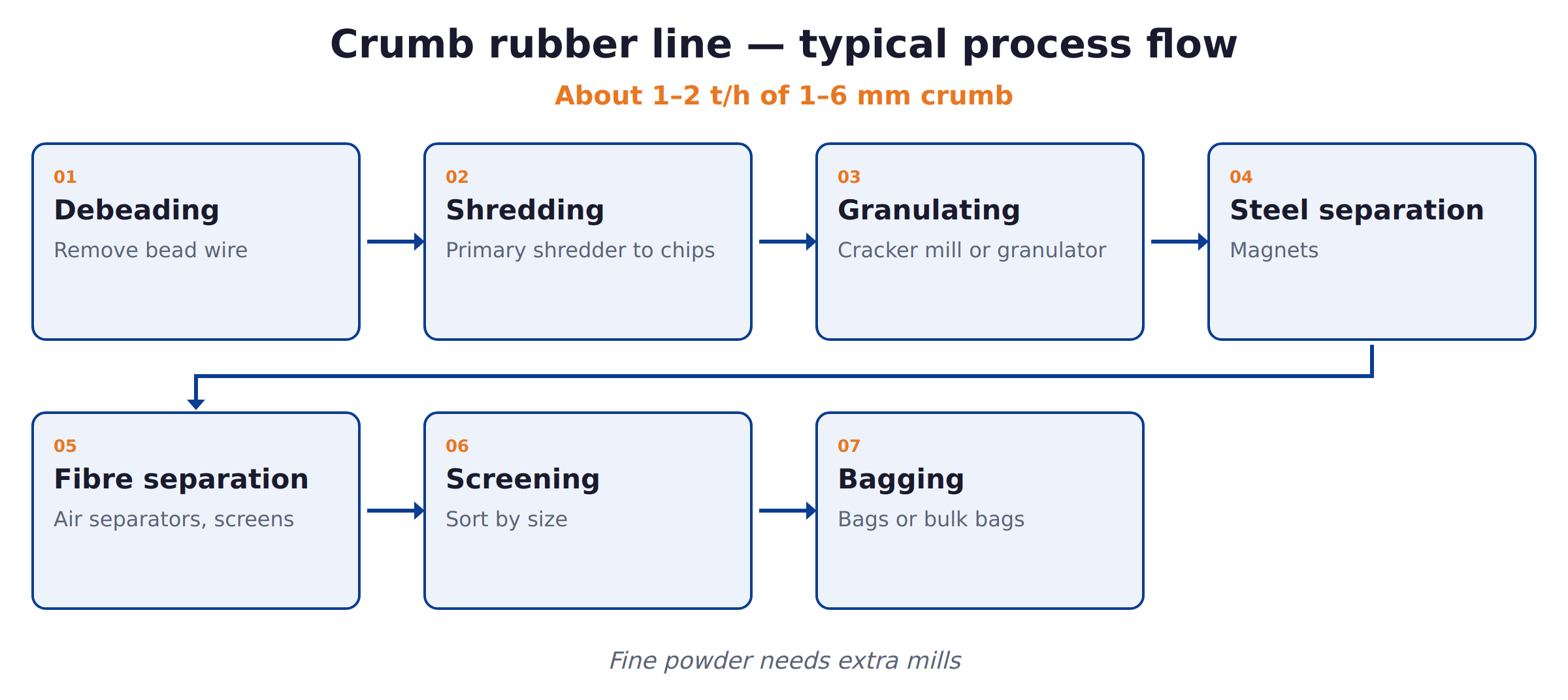
- Debeading and cutting: remove bead wire and cut tyres into strips or blocks.
- Shredding: a primary shredder reduces whole tyres to chips.
- Granulating: a cracker mill or granulator reduces chips to crumb.
- Separation: magnets remove steel; air separators and screens remove fibre.
- Screening and bagging: crumb is sorted by size, often 1–6 mm, and bagged.
- Fine powder (optional): extra mills make 40–80 mesh powder for some uses.
Step 5: costs
| What you buy | Capacity | Indicative price (2026) |
|---|---|---|
| Semi-manual crumb set | About 0.3–1 t/h, mainly car tyres | About US$20,000–150,000 ex-works |
| Automatic crumb line, equipment | About 1–2 t/h, car and truck tyres | About US$200,000–600,000 |
| Automatic crumb line, landed | As above | About US$400,000–1,200,000 |
| Fine powder add-on | 40–80 mesh | Quoted per configuration |
Landed costs add freight, clearing, civils, power, dust control, installation and training. Our tyre recycling plant cost guide explains each tier.
Step 6: who buys crumb
- Rubber pavers, tiles and mats for farms, playgrounds, gyms and walkways.
- Sports surfaces and synthetic turf infill.
- Moulded products such as speed bumps, wheel chocks and dock bumpers.
- Flooring and underlay.
- Road and construction uses where specifications allow.
Each use wants a different crumb size and cleanliness. Steel and fibre left in the crumb lowers its value, so separation quality matters as much as output. Making your own rubber pavers or mats from crumb is a common way to capture more value; our guide to starting a paving business covers the yard side.
Step 7: the numbers
Revenue is crumb sales by size, plus steel sold as scrap, plus any collection fees. Costs include tyre collection and transport, electricity (shredders and granulators are heavy users), blades and screens, labour, licences and compliance, insurance, fire protection and finance. Blade wear is a major running cost; ask suppliers for blade life on your tyre mix.
Worked example: a crumb and paver yard
A small business in Gauteng registers with the Waste Management Bureau, obtains the required waste licence for its site, and installs a semi-manual crumb set for car tyres. It collects tyres from fitment centres in its area, sells steel to a scrap dealer, and uses most of its crumb to make rubber pavers and gym mats that it sells to schools, farms and gyms. Later, with steady crumb buyers, it plans an automatic line. The figures are illustrative.
Fire safety and storage
Tyre fires are hard to put out and produce toxic smoke. Keep stockpiles small and spaced, separated from buildings and boundaries, with clear access for fire engines, water supply and fire-fighting equipment. Keep crumb dry and stored safely, control dust in the plant, and train staff in emergency procedures. Your insurer and fire department will set requirements.
Why we do not supply pyrolysis
Tyre pyrolysis heats tyres without oxygen to make oil, char and steel. It is a different business, with an Atmospheric Emission Licence on top of waste licensing, emissions control and oil buyers, and is best handled by specialists. CISH supplies mechanical crumb rubber lines only.
Common mistakes
- Buying a shredder before licences.
- No crumb buyers for the sizes you make.
- Poor steel and fibre separation.
- Underestimating blade costs and power.
- Large tyre stockpiles without fire planning.
Where CISH fits
We supply crumb rubber lines, from debeading and shredding to granulating, steel and fibre separation, screening and bagging, from audited factories in China, sized to your tyre mix and crumb buyers. CISH ships, clears, installs and commissions the line on your tyres, and trains your team. Registration and licences stay with you as the operator; we design the plant so it can meet them. For a single small tyre cutter, a local supplier is usually the better buy.
Frequently asked questions
Do I need a licence to recycle tyres in South Africa?
You must register under the Waste Tyre Regulations, and sites above the NEMWA thresholds need a waste management licence.
Who manages waste tyres now?
Since the industry plan's approval was withdrawn in June 2025, the Waste Management Bureau manages waste tyres in the interim.
How much does a tyre recycling plant cost?
As an indication for 2026, semi-manual crumb sets cost about US$20,000–150,000 ex-works, and automatic lines about US$400,000–1.2 million landed.
Who buys crumb rubber?
Makers of rubber pavers, mats, flooring, sports surfaces and moulded products.
Do recyclers get the tyre levy?
No. The R2.30 per kg levy is paid to SARS by tyre makers and importers.
Does CISH supply tyre pyrolysis plants?
No. We supply mechanical crumb rubber lines only.