A yoghurt line receives and standardises milk, homogenises and pasteurises it at a higher temperature than drinking milk, cools it to fermentation temperature, adds culture, ferments it in tanks (stirred yoghurt) or in the cup (set yoghurt), cools it, and fills and seals it into cups, buckets or bottles, which then go into cold storage. Shop frozen yoghurt machines are outside the scope of this page.
Yoghurt line prices in 2026
| Purchase | Capacity | What is included | Indicative price (2026) |
|---|---|---|---|
| Small yoghurt line | About 200–1,000 L of milk an hour | Reception tank, homogeniser, plate or tubular pasteuriser, fermentation tanks, cooling, small filler | About US$20,000–90,000 ex-works |
| Cup filling and sealing machine | Hundreds to about 8,000 cups an hour | Rotary or inline cup filler, foil sealing, date coding | About US$3,000–30,000 ex-works |
| Milk pasteurising line (HTST, small) | Per configuration | Milk line that a yoghurt section can share | About US$50,000–125,000 FOB; about US$95,000–250,000 landed |
| Industrial yoghurt plant | Several tonnes a day and up | CIP, automatic fermentation, multiple fillers, cold store | Quoted per configuration |
Ex-works listing prices, and company figures for the milk line; freight, installation, building, refrigeration, CIP, steam and working capital are extra. For a dairy project, budget on the equipment being about 35–55% of the full cost.
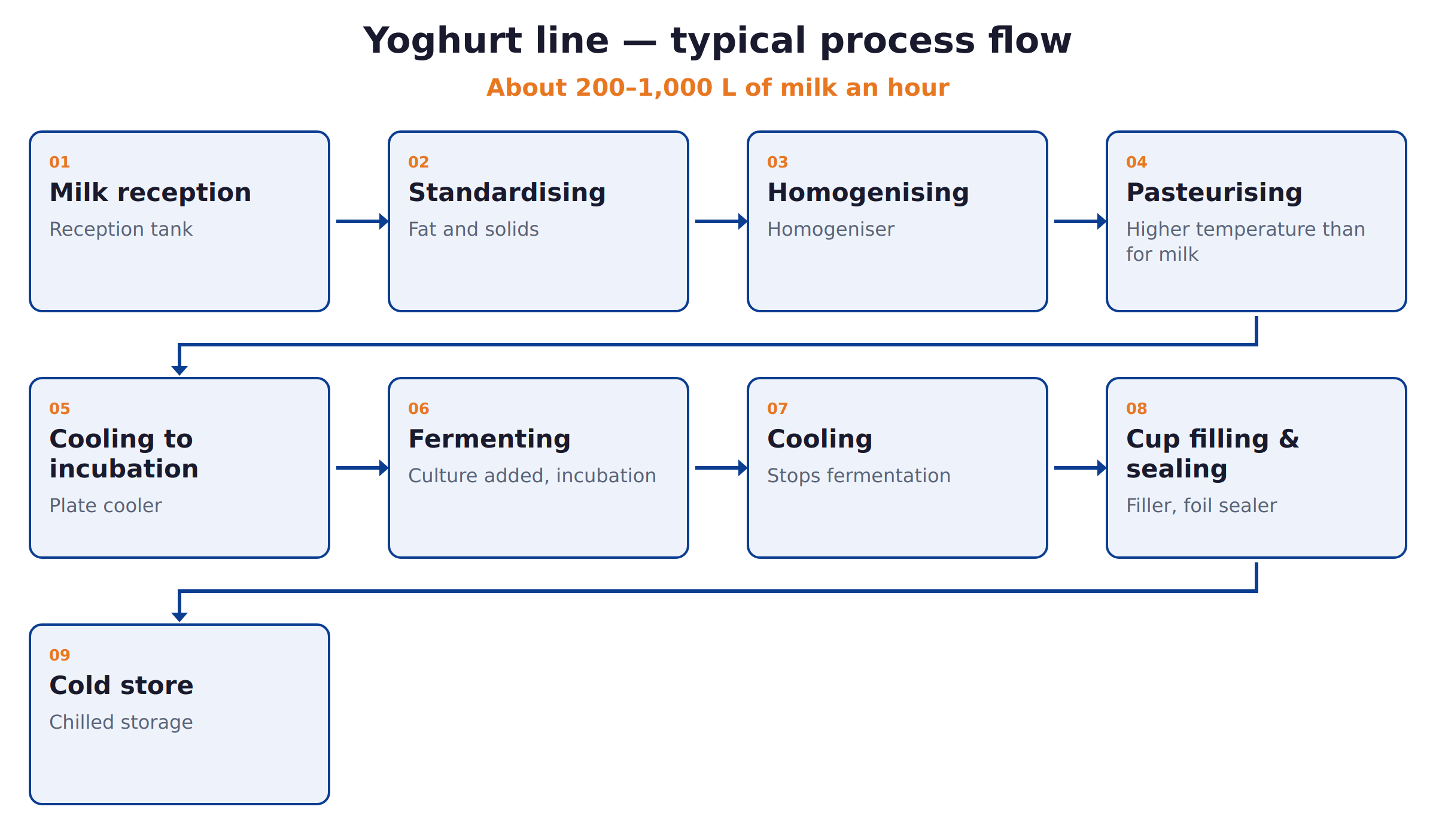
How yoghurt is made
- Milk reception and testing. Milk is tested, cooled and stored.
- Standardisation. Fat and solids are adjusted; milk powder or concentrated milk may be added for body.
- Homogenisation. Fat globules are broken down for a smooth texture.
- Heat treatment. Milk is heated more than for drinking milk, which improves texture.
- Cooling and inoculation. Milk is cooled to fermentation temperature and culture is added.
- Fermentation. For stirred yoghurt, in a tank until the target acidity; for set yoghurt, in the cup in a warm room.
- Cooling and flavouring. Stirred yoghurt is cooled, fruit or flavour is added, and it is pumped to the filler.
- Filling and sealing. Cups, buckets or bottles are filled, sealed and coded.
- Cold storage and dispatch. Product is kept chilled to the shelf.
What drives the price
- Milk volume per day and batch size.
- Pasteuriser type: batch vat for very small plants; plate or tubular continuous pasteurisers for larger ones.
- Fermentation tanks: number, size, jacketed heating and cooling.
- Set or stirred yoghurt, or drinking yoghurt; each needs different filling.
- Filling and sealing speed, pack formats and fruit dosing.
- CIP system for cleaning tanks and pipes.
- Refrigeration for cooling, the cold store and ice water.
- Automation of temperatures, times and acidity.
Set, stirred and drinking yoghurt
| Type | Where it ferments | Filling |
|---|---|---|
| Set yoghurt | In the cup, in a warm room | Filled warm with culture, then fermented and cooled |
| Stirred yoghurt | In a tank | Filled cold after fermentation, often with fruit |
| Drinking yoghurt | In a tank, then thinned | Bottled cold |
| Maas and other cultured milks | In a tank or the pack | Bottles, sachets or tubs |
A line for one type can often be extended to others with extra tanks and fillers. Tell the supplier every product you plan.
Choosing by scenario
- Farm dairy adding yoghurt: a small line of a few hundred litres an hour, with a batch or small continuous pasteuriser, two or three fermentation tanks and a semi-automatic cup filler.
- Small processor scaling up: a continuous pasteuriser, more fermentation tanks, an automatic cup filler with fruit dosing, CIP and a cold store.
- Milk processor adding yoghurt: a yoghurt section sharing the milk reception and pasteurising line.
Landed cost: what else to budget
| Item | Notes |
|---|---|
| Building | Hygienic dairy finishes, drains, separation of raw and finished areas |
| Steam or hot water | Boiler or electric heating |
| Refrigeration | Ice water, cooling and cold store |
| CIP | Tanks, pumps and chemicals for cleaning |
| Laboratory | Acidity, fat, solids and microbiological testing |
| Packaging | Cups, lids, foil, labels, cartons |
| Working capital | Milk, cultures, fruit preparations and packaging |
Dairy machinery (8434.20) and filling and sealing machinery (8422.30) carry no general import duty.
How to compare quotes
- Litres of milk per hour, and finished cups per hour, for each product.
- Pasteuriser type, holding time and temperature control.
- Fermentation tank volume, number and jacketing.
- Homogeniser pressure and capacity.
- Filler: cup sizes, speed, sealing and fruit dosing.
- CIP included or not.
- Stainless grade and sanitary fittings.
- Installation, commissioning on your milk and recipes, and training.
- Spares: gaskets, seals, homogeniser valves.
- References of dairies running similar lines.
Rules and duty in South Africa
- Food premises. A yoghurt plant needs a Certificate of Acceptability under R638 of 2018, with hygiene, water and pest control.
- Labelling. Yoghurt must be labelled under R146 of 2010, and dairy products also follow the regulations on classification, packing and marking of dairy products. A second draft revision of those regulations was published in August 2025, as listed by the Dairy Standard Agency; check the current status.
- Additives. Use only permitted additives and declare them.
- Cold chain. Keep yoghurt chilled through storage, transport and display.
- Import duty. Yoghurt (0403.20) carries no general duty, so local makers compete with imports on price, freshness and brand.
- Industry bodies. SAMPRO represents milk processors and publishes market information; the Dairy Standard Agency works on dairy safety and compliance.
Worked example: a farm dairy adding yoghurt
Consider a dairy farm that sells raw milk to a processor at a price it cannot control. The owners want to turn part of their milk into stirred fruit yoghurt and plain set yoghurt for local stores. A small line of a few hundred litres an hour fits: a reception and standardising tank, a homogeniser, a small plate pasteuriser, three jacketed fermentation tanks, an ice water system, a rotary cup filler with foil sealing and date coding, and a walk-in cold room.
In practice the fermentation tanks set the daily output, because each batch occupies a tank for several hours. Running two shifts lets the farm make several batches a day without buying more tanks at first. Cleaning takes as much planning as production: a small CIP set with hot caustic and acid cleaning between batches keeps the yoghurt's shelf life reliable. Before supplying stores, the farm obtains a Certificate of Acceptability, designs labels that meet the labelling and dairy product regulations, and sets up chilled delivery. Later it can add a drinking yoghurt filler using the same tanks.
Common mistakes
- Underheating the milk. Thin, weak yoghurt.
- No CIP. Contamination and short shelf life.
- Too few fermentation tanks. Output limited by fermentation time.
- Filling warm stirred yoghurt. Texture breaks down.
- Weak cold chain.
Where CISH fits
We supply complete yoghurt lines, from milk reception and pasteurising to fermentation, filling and cold storage, from audited factories in China, sized to your milk and products. CISH ships and clears the line, installs and commissions it with output demonstrated on your recipes, and trains your team. For a shop frozen yoghurt machine, a catering dealer is the right place to buy.
Frequently asked questions
How much does a yoghurt making machine cost in South Africa?
As an indication for 2026, a small yoghurt line for about 200–1,000 litres of milk an hour costs about US$20,000–90,000 ex-works. Cup filling and sealing machines cost about US$3,000–30,000.
What equipment do I need to make yoghurt?
Milk reception and standardising, a homogeniser, a pasteuriser, fermentation tanks, cooling, a filler and sealer, CIP and a cold store.
What is the difference between set and stirred yoghurt?
Set yoghurt ferments in the cup; stirred yoghurt ferments in a tank and is filled cold, often with fruit.
What licence do I need to make yoghurt?
A Certificate of Acceptability for the food premises under R638, labels that meet R146 and the dairy product regulations, and a reliable cold chain.
Is there import duty on yoghurt?
Yoghurt carries no general import duty in South Africa.
Does CISH sell frozen yoghurt machines?
No. We supply yoghurt production lines for dairies and processors.