Profit depends on keeping the plant and trucks busy, on securing cement and aggregates at a steady price, and on delivering within the time the concrete stays workable, which limits how far you can sell. Contractors expect concrete to meet the strength ordered, so mix designs, cube testing and delivery records are part of the product; SANS 878 covers ready-mixed concrete.
What a ready-mix business includes
| Part | What it does | Notes |
|---|---|---|
| Batching plant | Weighs and mixes cement, aggregates, water and admixtures | Stationary or mobile; sized in m³ per hour |
| Cement silos | Store bulk cement | Usually two or more for different cements |
| Aggregate bins and stockpiles | Store sand and stone by size | Covered or drained to control moisture |
| Truck mixers | Carry and keep concrete turning to site | The biggest share of capital and running cost |
| Loader | Feeds aggregates into bins | |
| Water and admixture system | Dosing water and chemicals | Water recycling where possible |
| Laboratory | Slump tests, cube moulds, curing tank, crushing or outside testing | Proves strength |
| Dispatch office | Orders, tickets, scheduling | Software helps once volume grows |
Step 1: Find your market and radius
Ready-mix is sold close to the plant, because concrete must arrive and be placed before it stiffens. How far you can deliver depends on traffic, mix design, weather and admixtures, so think in terms of driving time rather than distance. Map the contractors, builders, developers and civil works within that time, what they buy each month, and who supplies them now. Housing, commercial building and civil works all use ready-mix; Human Settlements' 2026/27 budget was R26.972 billion, much of it spent through contractors who buy concrete.
Step 2: Secure materials
Cement, sand and stone are most of the cost of a cubic metre. Before building:
- Agree cement supply in bulk, with prices and delivery for your expected volume.
- Secure aggregates of consistent grading, from a quarry or supplier you trust; changes in sand affect water demand and strength.
- Plan stockpiles that keep sizes separate and drain well, since wet sand changes the mix.
- Choose admixtures for workability and setting time, especially in hot weather or on long deliveries.
Step 3: Choose the plant
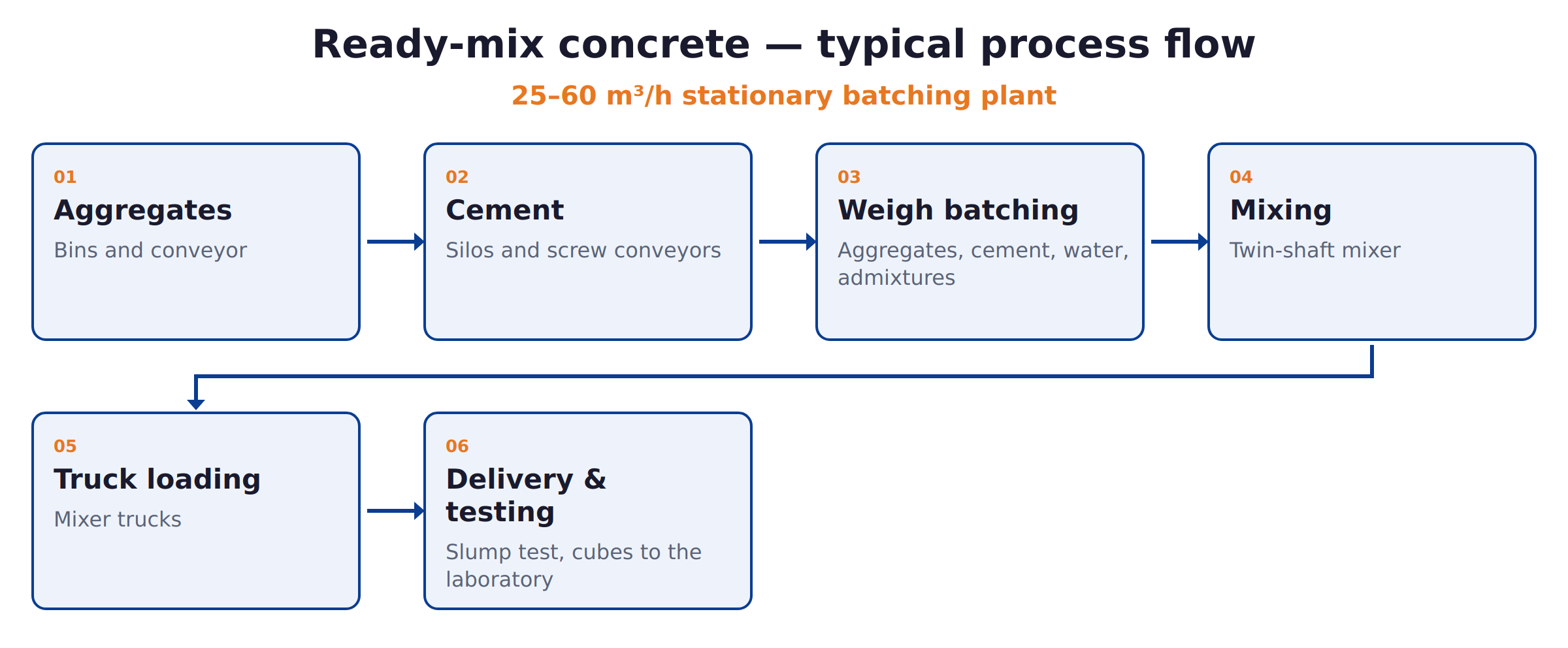
| Plant type | Typical output | Fits |
|---|---|---|
| Small stationary plant (HZS25 class) | About 25 m³/h | Start-ups, small towns, precast yards |
| Medium stationary plant (HZS35–60 class) | About 35–60 m³/h | Commercial ready-mix with several trucks |
| Mobile plant | Varies | Project sites, mines, roads |
| Larger plants | 90 m³/h and up | Busy urban markets, major projects |
Indicative, in USD, from our batching plant cost guide: a stationary batching plant of 25–60 m³/h costs about US$20,000–60,000 ex-works. Concrete mixing machinery carries no general import duty. Foundations, silos, aggregate bins, electrical work and the laboratory are often priced separately.
Step 4: Size the truck fleet
A plant that can batch 35 m³ an hour is only as busy as its trucks. Count:
- Truck capacity, often 6 m³ or 8 m³ per load.
- Round-trip time: loading, driving, waiting on site, discharging, washing and returning.
- Loads per truck per day from that round-trip time.
- Peak demand: large pours need several trucks arriving in sequence.
As an example, an 8 m³ truck on a 2-hour round trip can deliver about 4 loads, or 32 m³, in an 8-hour day. To supply 150 m³ a day you would need about five trucks, plus spare capacity for breakdowns and big pours. Trucks are priced per vehicle, and a fleet usually costs far more than the batching plant itself.
Step 5: Quality: what you are really selling
Contractors order concrete by strength class and workability. To deliver it:
- Mix designs for each strength class, tested on your materials.
- Weigh-batching with calibrated scales, checked regularly.
- Moisture correction for wet sand.
- Slump tests at the plant and on site.
- Cube tests: cast cubes from deliveries, cure them and crush them at 7 and 28 days; SANS 5863 sets out the compressive strength test.
- Delivery tickets recording mix, volume, time batched and time arrived.
SANS 878 covers ready-mixed concrete. Larger contractors will ask for your quality system and test records before they order.
Step 6: Site, permits and safety
- Zoning for industrial use, with access for heavy vehicles.
- Water for mixing and washing; settling ponds to recycle wash water.
- Dust control at cement silos and aggregate handling.
- Noise and hours if near homes.
- Safety: batching plants, conveyors and truck mixers are driven machinery under the Driven Machinery Regulations, 2015; guarding, lock-out and training are required.
Step 7: The money
| Cost | Notes |
|---|---|
| Batching plant | From the price above, plus foundations and erection |
| Truck mixers | Per vehicle; usually the largest capital item |
| Loader and yard | Loader, concrete yard, bins, drainage |
| Laboratory | Cube moulds, curing tank, slump cones, testing |
| Materials | Cement, sand, stone and admixtures for weeks of sales |
| Working capital | Contractors often pay 30 days or later |
| Insurance and licences | Vehicles, plant, public liability |
Late-paying customers are a bigger risk to a ready-mix business than the plant. Check credit before the first delivery.
Mobile, stationary or both?
New ready-mix businesses often ask whether to start with a mobile plant. A mobile batching plant can be moved to large project sites, such as roads, mines or a housing development, and set up close to the pour, which cuts truck round trips and lets you bid for remote work. It usually has smaller aggregate bins and less storage, and moving it costs time and money. A stationary plant suits a town or city market with many small and medium orders every day, with larger bins, more silos and a fixed yard. Some operators start with a stationary plant for the local market and add a mobile plant when they win a project contract that justifies it. Whichever you choose, the controls, scales and quality routines should be the same, so every cubic metre is batched and recorded the same way.
Common mistakes
- Buying a large plant with too few trucks.
- No moisture correction. Strength varies with sand moisture.
- Skipping cube tests. You cannot defend a claim.
- Delivering too far. Concrete stiffens before it is placed.
- Weak wash water handling.
- Extending credit without checks.
Where CISH fits
We supply complete batching plants, with silos, aggregate bins, conveyors, water and admixture dosing, and controls, from audited factories in China, sized to your market and fleet. CISH ships and clears the plant, installs and commissions it with output demonstrated, and trains your operators. We do not supply truck mixers or run concrete operations.
Frequently asked questions
How much does it cost to start a ready-mix concrete business?
As an indication for 2026, a stationary batching plant of 25–60 m³ an hour costs about US$20,000–60,000 ex-works. Truck mixers, a loader, a laboratory and working capital usually cost more than the plant.
How many truck mixers do I need?
Divide your daily volume by what each truck can deliver in a day, based on its capacity and round-trip time, and add spare capacity. For example, five 8 m³ trucks on 2-hour round trips deliver about 150 m³ a day.
Which standard applies to ready-mixed concrete in South Africa?
SANS 878 covers ready-mixed concrete. Compressive strength is tested on cubes under SANS 5863.
How far can ready-mix concrete be delivered?
It depends on traffic, weather, mix design and admixtures. Plan in driving time, and use admixtures for longer deliveries.
What size batching plant should I buy?
Size it to your expected daily volume and truck fleet. Many start-ups begin with a 25–35 m³ an hour plant.
Does CISH supply truck mixers?
No. We supply complete batching plants, installed and commissioned.