Start with tonnage: clamping force is roughly the projected area of the part and runners multiplied by a factor for the material, plus a safety margin; most South African general moulders work between about 150 and 500 tonnes. Then choose the drive: a servo-hydraulic machine is the usual value choice, cutting energy use against a plain hydraulic machine; all-electric machines are more precise and efficient for thin-wall, medical and fast-cycle parts but cost more; hybrids sit between. Machines enter South Africa duty-free under 8477.10.
The short answer: four drive types
| Drive type | Energy use | Precision and repeatability | Price level | Best fit |
|---|---|---|---|---|
| Plain hydraulic (fixed pump) | Highest; the pump runs all the time | Good | Lowest | Old installed base; rarely the best new buy |
| Servo-hydraulic | Typically much lower than fixed-pump | Good | Moderate | Most general moulding: crates, caps, housewares, preforms |
| All-electric | Lowest | Highest, very repeatable | High | Thin-wall packaging, medical, precision technical parts |
| Hybrid (electric injection, hydraulic clamp) | Low | High | Above servo-hydraulic | Fast cycles with heavy clamp needs |
For most South African moulders, a servo-hydraulic machine of the right tonnage is the best balance. Choose all-electric when cycle time, precision or clean-room work pays for the higher price.
Size the tonnage first
- Projected area: measure the area of the part (and runners) seen from the direction the mould opens, in cm².
- Material factor: multiply by the clamping pressure your material needs, typically about 0.2–0.8 tonnes per cm² depending on the plastic and wall thickness.
- Margin: add about 10–20%.
- Check the shot: the shot weight of the part plus runners should be about 20–80% of the machine's shot capacity.
- Check the mould fit: mould dimensions must fit between the tie bars, and the opening stroke must release the part.
Our tonnage guide works through examples. A machine that is too small flashes parts; one that is far too large wastes energy and floor space and makes small shots hard to control.
Match the machine to your situation
Starting a moulding business
Buy for the moulds you have orders for. A 150–250 tonne servo-hydraulic machine covers many caps, closures, household items and technical parts. Budget for a dryer, chiller, mould temperature controller, granulator and an auto-loader with each machine.
Adding capacity
Match tonnage to the moulds you will move, and keep the same control family across machines where you can, so operators and maintenance staff can work on all of them.
Limited budget
A good servo-hydraulic machine and a well-made mould beat a cheap machine with a cheap mould. Most moulding problems start in the mould. Imported used machines need an ITAC import permit before shipment.
Packaging or contract moulding for brand owners
Brand owners audit for repeatable quality, records and clean production. Thin-wall packaging may need all-electric or high-speed machines with robots.
Electricity: the running cost that decides drive type
Eskom's standard tariff rose 8.76% for 2026/27. A moulding machine runs for thousands of hours a year, so energy per kilogram of product matters more than a few thousand dollars on the purchase price. Ask each supplier for measured energy use on a comparable mould, in kWh per kilogram, and add heating bands, chillers and dryers to the calculation.
Chinese, European and Japanese machines
We do not rate brands. In general:
| Chinese machines | European and Japanese machines | |
|---|---|---|
| Price | Low to moderate | High |
| Typical drives | Servo-hydraulic dominant; electric available | Strong in all-electric and hybrid |
| Lead time | Short | Longer |
| Service in South Africa | Varies by supplier; check | Usually through an agent; check |
A machine is only as good as the support behind it.
How to check after-sales service
- Ask for three customers in South Africa running the same model, and call them.
- Ask who services the machine: company staff, an agent or a third party, and where they are based.
- Ask for the spares list and which parts are held in South Africa: heater bands, thermocouples, check rings, seals, valves, servo drive parts.
- Ask for response time in writing.
- Ask about control software: language, access to parameters and whether a local technician can work on it.
What a wrong choice costs
- Too little tonnage: flash, short shots, damaged moulds.
- Too much tonnage: higher price, more energy, poor control of small shots.
- Plain hydraulic on long runs: high electricity costs every month.
- No auxiliaries: wet material, long cycles, scrap.
- No local support: weeks of downtime for a simple fault.
Five things to confirm before you decide
- Part and mould: projected area, shot weight, mould size and stroke.
- Material: PP, HDPE, PET, ABS, PC or others, and whether it needs drying.
- Cycle time target and parts per month.
- Power: supply capacity and expected energy per kilogram.
- Service: who, where and how fast.
The South African market
Plastics SA reported national plastics consumption of about 2.06 million tonnes in 2025 and a recycling rate of about 30.1%. Recycled material use and the EPR regulations are pushing brand owners to ask moulders about recyclate content and design for recycling. Injection moulding machines enter duty-free under tariff heading 8477.10, and injection moulds under 8480.71 are also free.
Worked example: choosing for a crate mould
A moulder in Gauteng has an order for a vegetable crate with a projected area of roughly 2,000 cm² in PP. At a clamping pressure of about 0.35 tonnes per cm² that gives about 700 tonnes, plus a margin, so a machine of roughly 800 tonnes is needed, well above the general 150–500 tonne class. The shot weight of about 1.8 kg must also sit within 20–80% of the machine's shot capacity. The moulder compares a servo-hydraulic machine and a hybrid. The crate runs on a cycle of under a minute for most of the year, so energy per kilogram is the deciding cost; the servo-hydraulic machine wins on price with acceptable energy use, and the money saved goes into a better mould cooling circuit, which cuts cycle time more than the hybrid would. The figures are illustrative; your part, material and mould decide the real numbers.
The auxiliaries buyers forget
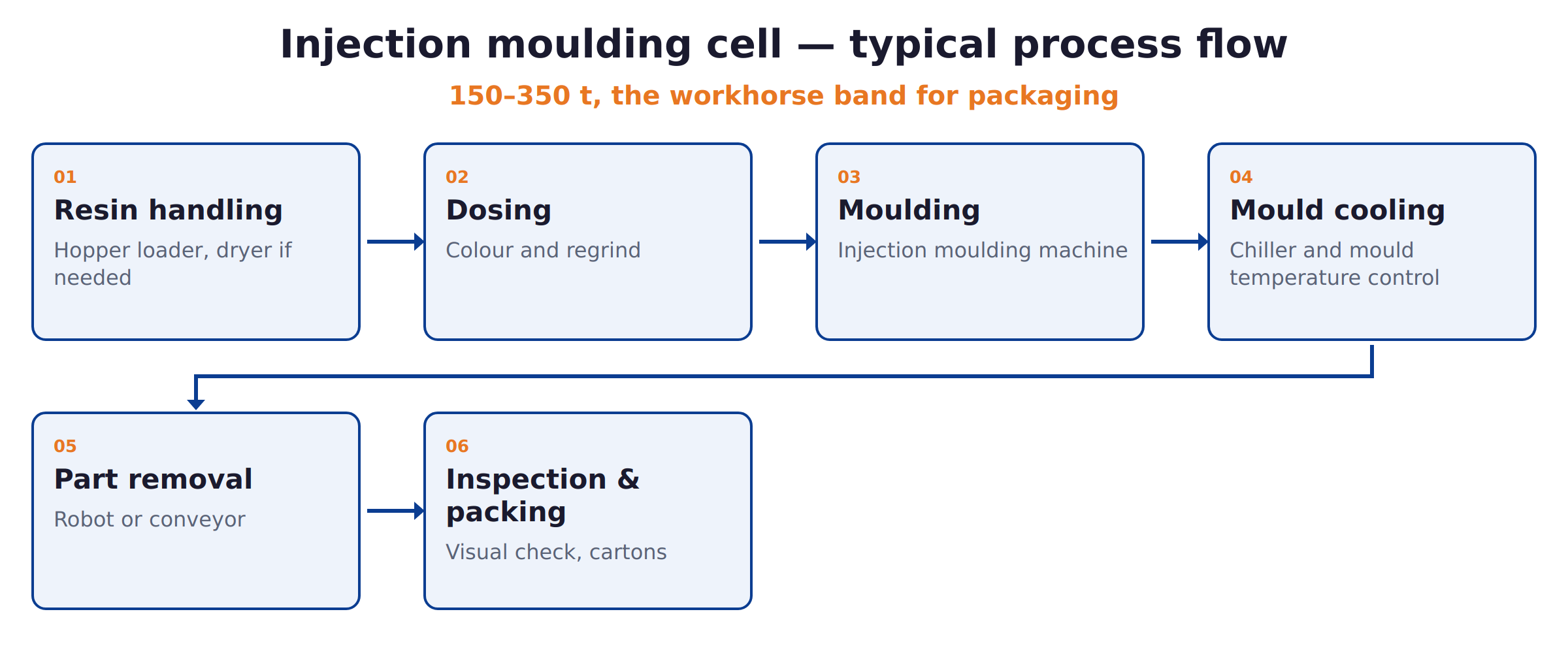
A moulding machine is one part of a cell. Hygroscopic materials such as PET, PC and nylon need a dryer; most moulds need a chiller and a mould temperature controller; a granulator recovers sprues and rejects; a vacuum loader keeps the hopper full; and a robot or picker removes parts on fast cycles. Budget for them with the machine.
How CISH helps you choose
We start from your part, mould and volumes. We size the tonnage, choose the drive, and specify the dryer, chiller, mould temperature controller, granulator, conveying and, where needed, the mould itself, as one cell. CISH supplies it from audited factories in China, ships and clears it, installs and commissions it on your mould to an agreed cycle and part quality, and trains your setters. For a single used machine, a local dealer is often the better choice.
Not sure injection moulding is the right process? Compare extrusion, injection and blow moulding by product.
From a delivered project: A Johannesburg injection moulding cell about to buy a fifth machine first spent about R280,000 on a three-week visibility retrofit; the data showed scrap on two products, night-shift cycle drift and one mould running 14% slow, and fixing them recovered about 17 points of OEE, so the fifth machine was deferred. Read the OEE retrofit case study.
Frequently asked questions
Which type of injection moulding machine is best?
For most general moulding, a servo-hydraulic machine. All-electric machines are best for precision, thin-wall and fast-cycle parts.
How do I choose the right tonnage?
Multiply the projected area of the part and runners by the clamping pressure for your material, add 10–20%, then check shot weight and mould fit.
How much does an injection moulding machine cost?
As an indication for 2026, industrial 150–300 tonne machines cost about US$30,000–75,000 ex-works, and 400–500 tonne machines from about US$100,000.
Is there import duty on injection moulding machines?
No. Injection moulding machines under 8477.10 enter South Africa duty-free; VAT still applies.
Are all-electric machines worth the extra cost?
When precision, cycle time or energy savings over long runs pay for the higher price, yes.
Does CISH sell single injection moulding machines?
We supply complete moulding cells with auxiliaries and commissioning. For a single used machine, a local dealer is usually better.