As an indication for 2026, a complete roller maize mill with packing for about 30 tonnes a day costs about US$250,000–400,000, about 60 tonnes a day US$700,000–1.1 million, and 240 tonnes a day US$2.0–3.5 million. Fortified grades must also meet the fortification regulations. Choose the plant for the grade, then the size for your sales. CISH supplies, installs and commissions complete maize milling plants.
The short answer: four classes of maize mill
| Class | Output | Meal it makes | Indicative investment (2026) | Labour | Best fit |
|---|---|---|---|---|---|
| Hammer mill (single machine) | 0.5–3 t/h of meal or feed | Unsifted meal, feed | A small part of a plant budget | 1–2 people | Service milling, farms, feed |
| Hammer mill with dehuller and sifter | 5–20 t/day | Sifted and some special meal | Above a single mill; quoted to the set | 3–5 people | Rural mills selling locally |
| Complete roller plant, small | About 30 t/day | Super, special, sifted, samp, by-products | US$250,000–400,000 with packing | 3–6 per shift | Regional brands, wholesalers |
| Complete roller plant, medium to large | 60–240 t/day | All grades at scale | US$700,000–1.1 million (60 t/day) to US$2.0–3.5 million (240 t/day) | 8–14+ per shift | Established millers, supermarket supply |
The price of the machine is only part of the plant. A 30 t/day mill also needs a building of about 150–250 m², grain storage, a power supply sized for the motors, and working capital for grain, which often costs more than the machinery.
What each grade needs
GN R.63 of 2016 grades maize meal by fat and fibre content:
| Grade | Fat | What it takes to make it |
|---|---|---|
| Super | Below 2.0% | Degerming, roller milling, fine sifting |
| Special | 2.0% to below 3.0% | Degerming, roller milling, sifting |
| Sifted | 3.0% to below 4.0% | Partial degerming or bran removal, sifting |
| Unsifted | 3.5% to below 4.5% | Whole-grain milling; a hammer mill does it |
Super, special, sifted and unsifted meal sold in South Africa must also be fortified with the vitamins and minerals set in the fortification regulations, so a commercial plant needs a micro-dosing feeder for the premix.
Match the mill to your situation
Starting a new mill
If your buyers are households and spaza shops in your area, start with the grade they buy. Many rural mills begin with a hammer mill and a dehuller, selling unsifted and sifted meal and milling grain for farmers at a fee. If you plan to sell branded super or special meal to retailers, plan a small roller plant from the start; a hammer mill cannot grow into one.
Expanding an existing mill
If you already run hammer mills and sell out, the next step is a degerming and roller section that adds special and super grades and lets you sell germ and bran as by-products. The step from 30 to 60 tonnes a day usually means a second shift first, then more milling capacity.
Limited budget
Size the plant for one shift of the volume you can sell, with space to add a second roller mill later. Buying a larger plant and running it part-time ties up cash in machinery and grain.
Supplying supermarkets or tenders
Retail and institutional buyers ask for consistent grade, fortification, food safety certification and reliable delivery. That needs a roller plant with automatic packing, a laboratory for fat, moisture and fortification checks, and a premises with a Certificate of Acceptability under R638.
Local, imported or European?
| Locally made hammer mills | Imported complete plants (China) | European plants | |
|---|---|---|---|
| Strength | Price, quick repairs, local spares | Complete plant at moderate price | High automation, long track record |
| Watch | Screen and hammer wear, motor quality | Roll quality, sifter design, controls, commissioning | Price, lead time, spares cost |
| Fits | Unsifted meal, feed | Graded meal, 20–240 t/day | Large mills with high budgets |
Our hammer mill vs roller mill guide explains how each machine grinds.
Power and running costs
Maize mills are heavy electricity users. Eskom's standard tariff rose 8.76% for 2026/27, and municipal tariffs follow. A roller plant uses less power per tonne than hammer milling the same grain to the same fineness, but has more motors to start. Check your supply capacity before you order, and plan for load shedding or outages with the right backup for the critical motors and the packing line.
What a wrong choice costs
- A hammer mill bought to make super meal: it cannot reach the fat limits, so the product is downgraded or unsellable as a branded grade.
- A plant too large for the market: grain and cash tied up, motors idling.
- No grain storage: you buy at the worst prices and run out in the off-season.
- No fortification feeder: graded meal cannot be sold legally.
- No commissioning on your maize: extraction rates fall short and the by-products take too much good meal.
Five things to confirm before you decide
- The grades you will sell and their share of sales.
- Tonnes a day you can sell in the first year, and in the third.
- Grain buying: where and when you will buy, and how much storage you need.
- Power: the capacity of your supply and your backup plan.
- Packing: bag sizes (from 1 kg to 80 kg), automatic weighing and the labels your buyers want.
Grain supply
South Africa is a large maize producer; the Crop Estimates Committee publishes production forecasts through SAGIS every month, and grain prices move with harvests, the exchange rate and exports. Millers buy from farmers, co-operatives, traders or silo owners. Plan storage for at least several weeks of milling, and a moisture and quality check at intake.
How CISH helps you choose
We start with the grades you will sell and the tonnes a day. For hammer mills and small service mills, a local supplier is usually the better buy, and we will say so. For a roller plant we specify cleaning, degerming, roller mills, sifting, fortification dosing and packing for your grades, supply it from audited factories in China, ship and clear it, install and commission it on your maize to agreed extraction and grade, and train your miller. Our maize mill sizing guide shows what each size needs in space, staff and power.
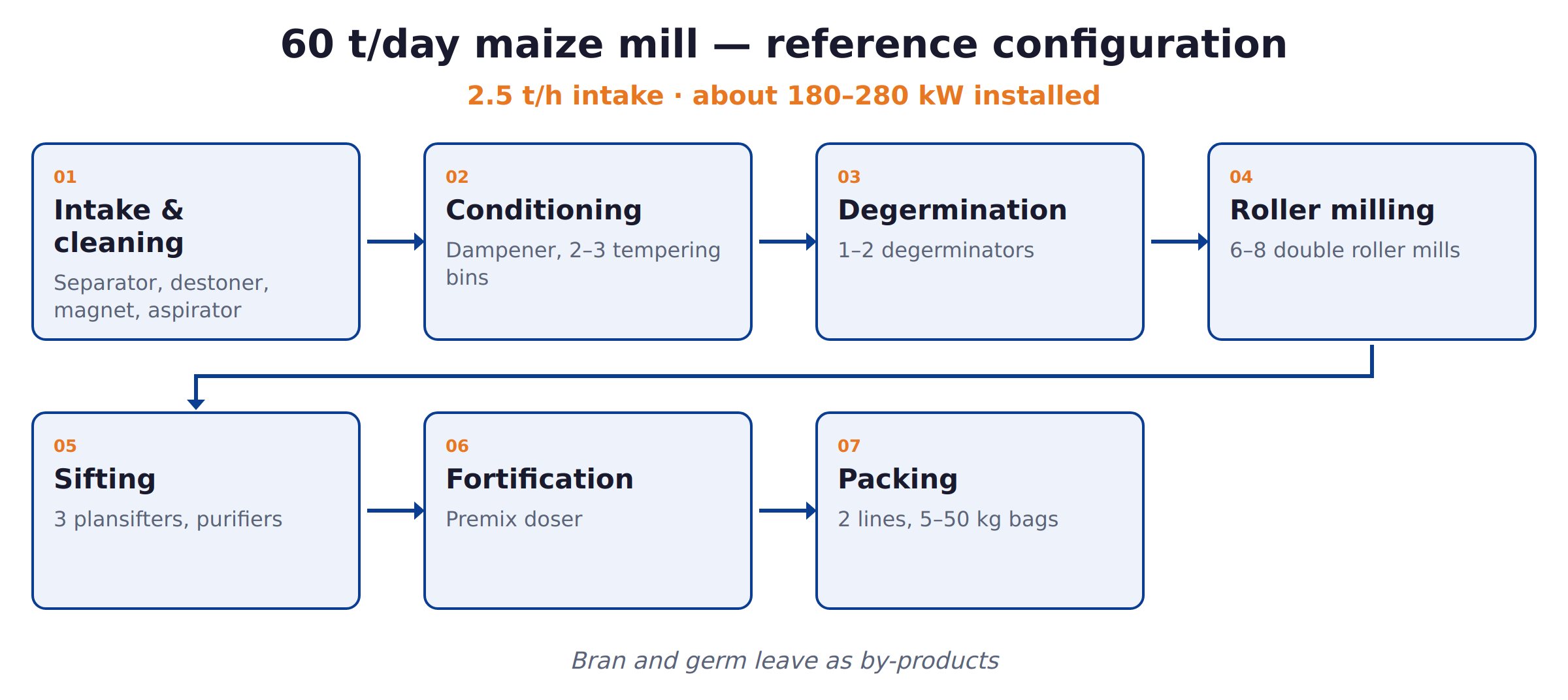
From a delivered project: On a delivered 60 t/day super-fine maize mill more than six hours from the nearest engineering hub, the mill itself was the easy part: extra pre-cleaning for maize at 11–16% moisture, an on-site critical-spares buffer and a year of support took the plant to about 85% of nameplate by month four. Read the maize mill case study.
Frequently asked questions
What is the best maize milling machine for a small business?
For unsifted meal and service milling, a hammer mill. For sifted and graded meal, a dehuller and sifter, or a small roller plant.
Can a hammer mill make super maize meal?
No. Super and special grades need degerming and roller milling to reach the fat and fibre limits in GN R.63 of 2016.
How much does a complete maize milling plant cost?
As an indication for 2026, about US$250,000–400,000 for 30 tonnes a day with packing, US$700,000–1.1 million for 60 tonnes a day, and US$2.0–3.5 million for 240 tonnes a day.
Does maize meal have to be fortified?
Yes. Super, special, sifted and unsifted maize meal sold in South Africa must be fortified under the fortification regulations.
Is VAT charged on maize meal?
No. Maize meal is zero-rated for VAT.
Does CISH sell single hammer mills?
No. We supply complete maize milling plants. For a single hammer mill, a local supplier is usually better.