Hammer mills are cheap, simple and forgiving, and make whole-grain meal and animal feed well, but they cannot separate the germ and bran, so they make unsifted maize meal, not super or special. Roller mills, used with degerming and sifting, make the graded meal and wheat flour that supermarkets sell, at much higher investment.
The short answer by product
| You want to make | Buy | Why |
|---|---|---|
| Animal feed (mash or pellets) | Hammer mill | Fine, even grind of mixed raw materials; low cost |
| Unsifted or whole-grain maize meal | Hammer mill | Whole grain milled through a screen |
| Sifted maize meal | Hammer mill with degerming and sifting, or small roller plant | Needs bran and some germ removed |
| Special or super maize meal | Roller-mill plant with degerming | Grades need low fat and fibre |
| Wheat flour (cake, bread) | Roller-mill plant | Flour grades need gradual reduction and sifting |
| Sorghum or millet meal | Dehuller plus hammer or roller mill | Depends on the product and fineness |
How each mill works
Hammer mill
A rotor carries rows of swinging steel hammers. Grain falls into the grinding chamber, the hammers strike it at high speed, and the particles are thrown against the casing until they are small enough to pass through a perforated screen. Change the screen and you change the fineness. Everything that goes in comes out, mixed together: germ, bran and endosperm.
Roller mill
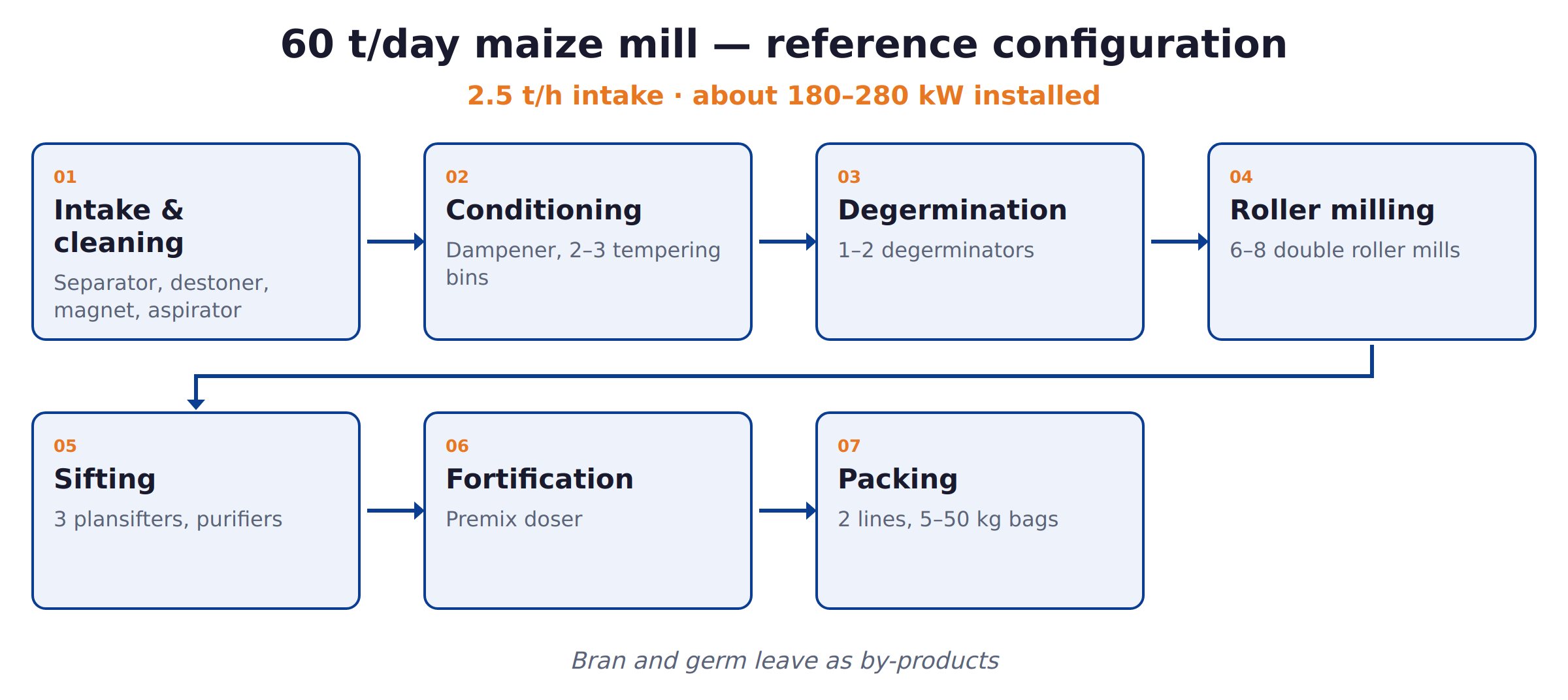
Grain or stock passes between two rollers turning at different speeds. Grooved (fluted) rollers break the grain open and scrape the endosperm from the bran; smooth rollers reduce the endosperm into fine meal or flour. A roller mill works in passes: after each pass, sifters separate the stock by size and send each fraction to the next pair of rollers or out as product. With a degerminator in front, a roller plant can take out the germ and bran and make the low-fat, low-fibre grades.
Side by side
| Factor | Hammer mill | Roller-mill plant |
|---|---|---|
| Products | Feed, whole meal, unsifted meal | Graded maize meal, wheat flour, semolina |
| Separation of germ and bran | No | Yes, with degerming and sifting |
| Particle size control | By screen; wider spread of sizes | Narrow, controlled by roll gap and sifting |
| Investment | Low | Much higher; a plant, not a machine |
| Power per tonne | Higher | Lower for the same fineness |
| Heat in product | More | Less |
| Wear parts | Hammers and screens, replaced often | Rolls refluted or reground less often |
| Skill to run | Low | Trained miller needed |
| Space | Small | Several floors or a tall building on larger plants |
| Dust and noise | High | Lower, with closed conveying |
Maize meal grades: why the hammer mill stops at unsifted
South Africa's maize products regulations (GN R.63 of 2016) define the grades by fat and fibre content:
- Super maize meal: fat below 2.0%, fibre no more than 0.8%.
- Special maize meal: fat from 2.0% up to 3.0%.
- Sifted maize meal: fat from 3.0% up to 4.0%.
- Unsifted maize meal: fat from 3.5% up to 4.5%, with fibre above 1.2% and up to 2.5%.
The fat sits mostly in the germ, so the lower the fat, the more germ must be removed. A hammer mill grinds the whole kernel, so its meal falls naturally into unsifted. Making sifted meal needs bran and some germ removed; making special and super needs a degerminator and a roller mill with sifting. All of these grades must also be fortified with the compulsory vitamin and mineral premix. Our guide to how maize meal is made walks through each step.
Animal feed: the hammer mill's home
In a feed mill, the hammer mill grinds maize, sorghum, wheat bran and other ingredients before mixing and pelleting. Fineness matters: a finer grind usually gives better pellet quality and digestibility for poultry and pigs, while ruminant feed is often ground coarser. Feed mills choose screen sizes by species. Roller mills are sometimes used to crack or flake grain for dairy cattle and horses, but the hammer mill is the standard grinder. Every farm feed sold must be registered under Act 36 of 1947, which applies to the product, not the mill.
What each costs
Single hammer mills are sold in a wide range of sizes and qualities, from small farm units to heavy industrial machines, and the machine itself is a small part of what a feed or meal business costs. A roller maize mill is always a plant. Indicative, in USD:
| Purchase | Capacity | Indicative price (2026) |
|---|---|---|
| Roller maize mill with packing | 30 t/day | About US$250,000–400,000 |
| Roller maize mill with packing | 60 t/day | About US$700,000–1.1 million |
| Large roller maize mill | 240 t/day | About US$2.0–3.5 million |
| Small feed mill with hammer mill, mixer and pellet mill, landed and commissioned | 1–3 t/h | About US$60,000–150,000 |
Grain processing machinery (8437.80) carries no general import duty; 15% import VAT applies.
Power, wear and running cost
Hammer mills use more energy per tonne, especially at fine grinds, and turn part of it into heat. Hammers and screens wear and need regular replacement; running with worn hammers wastes power and lowers output. Roller mills use less power per tonne for the same fineness, but the rolls need periodic refluting or regrinding, and the plant needs sifters, conveying, aspiration and a skilled miller. When comparing quotes, ask for kWh per tonne at your target fineness, not motor size alone.
Chosen a hammer mill? Next decide the drive: diesel vs electric hammer mills compared on running cost.
Questions to ask before you buy
- Which product and grade will I sell, and to whom?
- What fineness do I need, and with what screen or roll setting?
- What output per hour at that fineness, on my grain?
- What kWh per tonne?
- How often are hammers and screens, or rolls, replaced, and what do they cost?
- Is degerming included, if I want sifted, special or super meal?
- How is dust controlled?
- Is fortification dosing included for maize meal?
- Who installs, commissions and trains my miller?
- Where can I see one running on similar grain?
Common mistakes
- Buying a hammer mill to make super maize meal. It cannot reach the grade.
- Comparing motor sizes instead of output at your fineness.
- No dust control. Hammer mills create fine dust that is a fire and health risk.
- Skipping fortification. Graded maize meal must be fortified.
- Building a roller plant for a market that buys unsifted meal.
Where CISH fits
CISH specifies complete milling plants: hammer-mill feed and meal plants, and roller maize mills with degerming, sifting, fortification and packing, from audited factories in China against your grain and product. We ship and clear the plant, install it, commission it with output and grade demonstrated, and train your miller. For a single hammer mill for a farm, a local dealer is usually the better buy.
Frequently asked questions
What is the difference between a hammer mill and a roller mill?
A hammer mill smashes grain with spinning hammers until it passes through a screen. A roller mill crushes and shears grain between pairs of rollers in several passes, with sifting between them.
Can a hammer mill make super maize meal?
No. Super and special maize meal need the germ and bran removed, which takes a degerminator and a roller mill with sifting. A hammer mill makes unsifted meal.
Which mill is better for animal feed?
A hammer mill. It grinds mixed feed ingredients evenly and cheaply, and is the standard grinder in feed mills.
Does a roller mill use less power than a hammer mill?
Usually, for the same fineness, a roller mill uses less energy per tonne. Ask suppliers for kWh per tonne at your target grind.
How much does a roller maize mill cost?
As an indication for 2026, a 30 t/day roller maize mill with packing costs about US$250,000–400,000.
Does CISH sell single hammer mills?
No. We supply complete milling plants. For a single hammer mill, a local dealer is usually the better route.