Wire nail machines are built for a range of lengths and wire gauges: small machines for short nails of roughly 10–50 mm, medium machines for 50–100 mm, and heavy machines for the longer, thicker nails used in roofing and construction. Around them you need a wire drawing machine if you buy rod rather than drawn wire, and a polishing drum to clean the nails. Wire nail machines enter South Africa duty-free. CISH supplies, installs and commissions complete nail and wire-product workshops.
The short answer: choose by nail size
| Nail range | Typical uses | Machine class | Output per 8-hour shift | Indicative price (2026) |
|---|---|---|---|---|
| About 10–50 mm, thin wire | Panel pins, small wire nails, clout nails | Small high-speed machine | About 0.5 t | Within US$2,000–15,000 per machine |
| About 50–100 mm | General wire nails, roofing nails | Medium machine | About 0.7–1.2 t | Within US$2,000–15,000 per machine |
| About 100–150 mm and up | Construction, pallets, timber framing | Heavy machine | About 1–1.5 t | Upper end of the band |
| A starter workshop | 2–4 machines covering best sellers | Mixed | About 2–4 t | About US$15,000–50,000 |
The output per shift depends on nail length and wire diameter: a machine making long nails produces more weight per hour but fewer pieces. Ask suppliers for output in kilograms and pieces for your exact sizes.
The machines around the nail machine
| Machine | Why you need it | When to buy |
|---|---|---|
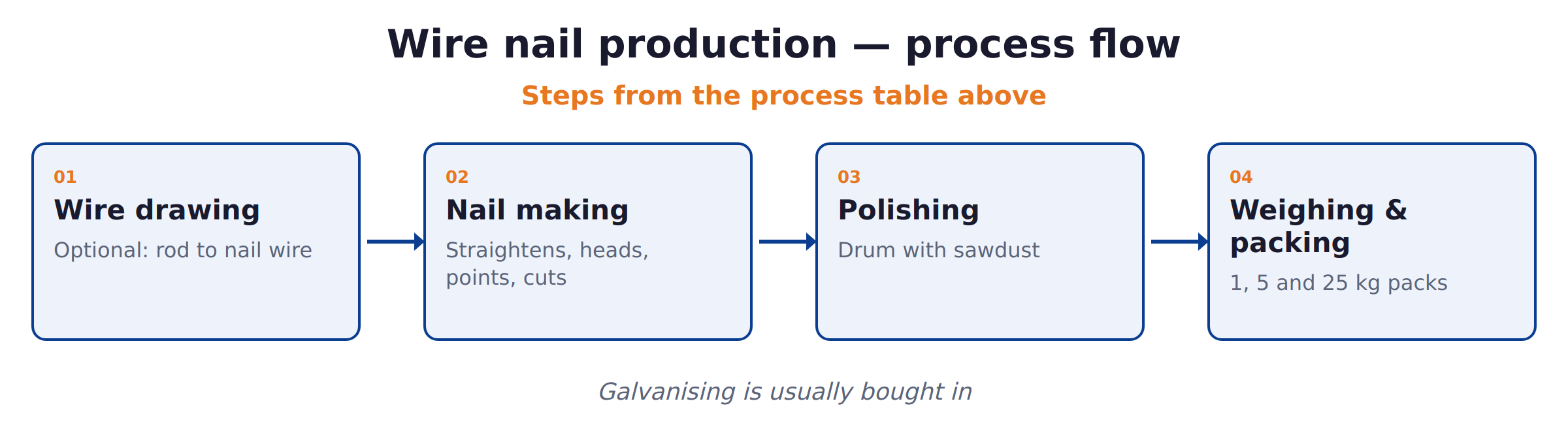
| Wire drawing machine | Draws wire rod (for example 5.5 or 6.5 mm) down to nail wire | If you buy rod instead of drawn wire |
| Polishing drum | Removes oil and burrs, gives a bright finish | Always |
| Packing scale and bags or boxes | 1 kg, 5 kg and 25 kg packs | Always |
| Die and cutter grinding machine | Keeps tools sharp and saves downtime | From the start, or arrange local regrinding |
| Galvanising | Galvanised roofing nails | Usually bought-in, or later; hot-dip galvanising needs an atmospheric emission licence |
Buying drawn wire is simpler for a new workshop. Drawing your own wire from rod saves money at volume but adds a large machine, power and skill.
Match the machines to your situation
Starting a nail workshop
Count the sizes your local hardware stores and builders' merchants sell most. Buy machines for the top three or four sizes, a polishing drum and a packing scale. Keep a set of spare dies, punches and cutters for each machine.
Adding capacity
Add a second machine for your best-selling size before buying machines for slow sizes. Consider a wire drawing machine once you use several tonnes of wire a week.
Selling to merchants and pallet makers
Merchants want consistent heads and points, clean nails, correct counts and reliable supply. Pallet makers want large volumes of a few sizes. Both reward a workshop that never runs out.
Limited budget
Two well-built machines and good tooling earn more than four cheap machines that keep stopping. The punch, cutter and die steel decide uptime.
What separates a good nail machine
- Frame and crankshaft: heavy cast frame and a forged crankshaft for long life.
- Tooling: hardened dies, punches and cutters, and a stock of spares.
- Speed: pieces per minute stated for your sizes.
- Wire straightener and feed: smooth feed sets nail length accurately.
- Guarding and noise: nail machines are loud and fast; guards and hearing protection are needed under the OHS Act and the Driven Machinery Regulations.
Wire supply
Wire is most of your cost. You can buy drawn wire from local wire mills or merchants, or buy rod and draw it yourself. The Steel and Metal Fabrication Master Plan notes that the wire industry is a large part of the local steel sector and recorded about 10,032 tonnes of nail imports (HS 7317) worth about R141.6 million in 2019, a sign of room for local production. Lock in a wire price and keep stock for a few weeks.
Chinese, European and local machines
We do not rate brands. Most nail machines sold in South Africa come from Chinese factories, at moderate prices and in a wide range of sizes. Some older European machines circulate second-hand; check spares before buying. Imported used machines need an ITAC import permit before shipment. Local engineering shops can regrind tools and make some parts.
What a wrong choice costs
- Machines for the wrong sizes: stock of slow sellers, empty shelves for best sellers.
- No spare tooling: a broken punch stops the machine for weeks.
- No polishing: oily nails that merchants refuse.
- Rod without a drawing machine plan: wire costs higher than expected.
- No guarding: injury risk and inspector action.
Five things to confirm before you decide
- Nail sizes and gauges your buyers order, with monthly volumes.
- Wire: drawn wire or rod, supplier and price.
- Packs: pack sizes, boxes or bags, labels.
- Site: three-phase power, floor space, noise control.
- Tooling: spare sets and who will grind them.
Worked example: a three-machine workshop
A small engineering business in the Free State looks at what its local builders' merchants sell: 75 mm and 100 mm wire nails make up most of the volume, with 50 mm and 40 mm clout nails next. It buys two medium machines for 75 and 100 mm, one small machine for 40–50 mm, a polishing drum and a packing scale, and buys drawn wire from a local supplier. With about 1 tonne a shift from each medium machine and less from the small one, the workshop makes roughly 2.5 tonnes a shift. It holds two spare sets of dies, punches and cutters per machine and has them reground locally. After a year, using several tonnes of wire a week, it adds a wire drawing machine and buys rod. The figures are illustrative.
Noise, safety and the neighbours
Nail machines are among the loudest machines in a light industrial area. Plan a building with solid walls, fit the machines on proper bases, give operators hearing protection and keep guards closed. If the workshop is close to homes, check local zoning and noise rules before you sign a lease.
How CISH helps you choose
We start from the sizes you sell and your wire supply. We specify the nail machines, wire drawing where needed, polishing, packing and tooling as one workshop, supply it from audited factories in China, ship and clear it, install and commission it on your wire, and train your operators. For a single nail machine, a local supplier is often the better buy. Wire nail machines under tariff heading 8463 enter duty-free; VAT applies.
Frequently asked questions
What is the best nail making machine?
The machine built for the nail range you sell. Most workshops buy two to four machines covering their best-selling sizes.
How much does a nail making machine cost?
As an indication for 2026, about US$2,000–15,000 per machine, and about US$15,000–50,000 for a starter workshop of two to four machines.
How many nails does a machine make per day?
Roughly 0.5–1.5 tonnes per 8-hour shift, depending on nail size and wire diameter.
Do I need a wire drawing machine?
Only if you buy wire rod. New workshops often buy drawn wire first.
What else do I need besides the nail machine?
A polishing drum, packing scale, spare tooling and, if you buy rod, a wire drawing machine.
Does CISH supply nail machines?
Yes, as complete workshops with polishing, packing and tooling. For a single machine, a local supplier is often better.