You can buy drawn wire ready for nail making, or buy wire rod and draw it down yourself on a wire drawing machine, which saves money at volume but adds a large machine and skill. Wire is most of the cost, so your margin depends on buying wire well and selling the sizes that move. Hardware stores, builders' merchants, roofers, pallet makers and construction companies are the buyers. The Steel and Metal Fabrication Master Plan noted about 10,000 tonnes of nail imports in 2019, a sign of room for local makers.
Step 1: understand the process
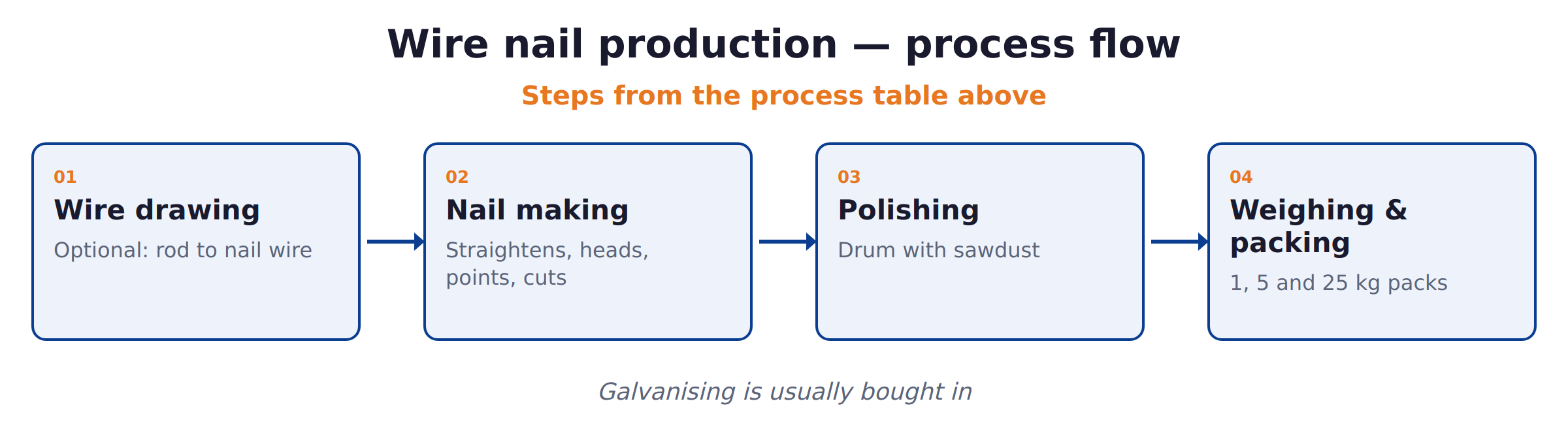
| Step | Machine | Notes |
|---|---|---|
| Wire drawing (optional) | Wire drawing machine with dies | Reduces rod (for example 5.5 or 6.5 mm) to nail wire diameters |
| Nail making | Wire nail machine | Straightens wire, forms the head, cuts the point and length |
| Polishing | Polishing drum with sawdust or similar | Cleans oil and burrs, gives a bright finish |
| Weighing and packing | Scale, bags or boxes | 1 kg, 5 kg and 25 kg packs are common |
| Galvanising (optional) | Usually bought in | Hot-dip galvanising needs an atmospheric emission licence |
Step 2: decide which nails to make
Visit hardware stores and builders' merchants in your area and ask what sells: common wire nails in 50–100 mm, clout nails, roofing nails, panel pins, masonry nails and pallet nails are typical. Each nail machine covers a range of lengths and gauges, so the sizes you choose decide the machines. Start with the three or four sizes that make most of the volume.
Step 3: secure wire supply
Wire is the largest cost. Options:
- Drawn wire from local wire producers or merchants, ready for the nail machine. Simplest for a new business.
- Wire rod from steel producers or traders, drawn in-house. Cheaper per tonne but needs a drawing machine, dies, lubricant, power and skill.
- Imported wire or rod, with longer lead times and currency risk.
The wire industry is a significant part of the South African steel sector, according to the Steel and Metal Fabrication Master Plan. Agree prices and lead times, keep several weeks of stock, and check wire tensile strength and diameter on delivery.
Step 4: equipment and costs
| Setup | What it includes | Indicative price (2026) |
|---|---|---|
| Single machine | One nail size range | About US$2,000–15,000 |
| Starter workshop | 2–4 nail machines, polishing drum, packing scale | About US$15,000–50,000 |
| Wire-products yard | Wire drawing, nails, diamond mesh, brick force, razor wire | About US$150,000–350,000 |
Our nail machine selection guide matches machines to nail sizes, and the wire, nail and mesh price guide shows the bands. Wire nail machines under heading 8463 enter duty-free; imported used machines need an ITAC permit before shipment.
Step 5: premises, power and safety
A nail workshop needs a solid building with three-phase power, a concrete floor and space for wire coils, finished stock and loading. Nail machines are loud and fast: fit guards, provide hearing protection and train operators under the OHS Act and the Driven Machinery Regulations. Check zoning and noise rules if the site is near homes. Hot-dip galvanising of any size needs an atmospheric emission licence (GN 893 of 2013), so most small makers buy galvanised wire or have nails galvanised by a licensed plant.
Step 6: packing and selling
Merchants want clean nails, correct sizes, honest weights and steady supply. Print the size, type and weight on every bag or box. Channels:
- Hardware stores and builders' merchants: the core market; supply 1 kg and 5 kg packs and 25 kg boxes.
- Roofing contractors: roofing nails and clout nails.
- Pallet and crate makers: large volumes of a few sizes.
- Construction companies and farms: bulk orders.
Step 7: the numbers
Cost per kilogram is wire cost plus drawing (if any), labour, power, tooling wear, polishing, packaging and delivery. Waste is low if machines are set well. Price per kilogram, by size: thinner nails take longer per kilogram and sell for more per kilogram than thick nails. Track output and tool life on each machine.
Worked example: a nail workshop in Mpumalanga
A metalworker in Mpumalanga supplies steelwork to builders and notices that the local merchants run out of 75 mm and 100 mm wire nails. He leases a 300 m² workshop with three-phase power, installs three nail machines for 40–50 mm, 75 mm and 100 mm, a polishing drum and a packing scale, and buys drawn wire from a supplier in Gauteng. He supplies three merchants with 5 kg packs and a pallet maker with 100 mm nails in 25 kg boxes. After a year he adds a wire drawing machine to buy rod. The figures are illustrative.
Common mistakes
- Buying machines for sizes that do not sell.
- No spare dies, punches and cutters.
- Underweight packs.
- No wire stock when prices rise.
- Galvanising without a licence.
Products beyond nails
Once the nail workshop runs well, the same wire supply and customers support other products: brick force wire for masonry, diamond mesh and welded mesh for fencing, staples, tie wire and binding wire. Each needs its own machines, but they sell through the same hardware stores and builders' merchants, which spreads your delivery costs across more products. Our wire, nail and mesh price guide shows the machine bands.
Quality checks
Check a sample of nails every hour for length, head diameter, point shape and straightness, and check that the head does not crack when bent. Weigh packs on a calibrated scale, and keep a sample from each batch. Merchants remember a box of bent nails much longer than a fair price.
Working capital
Wire is bought in coils of a tonne or more and paid for before nails are sold, and merchants usually buy on account. Plan working capital for several weeks of wire, finished stock in the main sizes and customer credit. Running out of a best-selling size loses customers faster than a small price rise.
Delivery
Nails are heavy for their volume. A small truck or bakkie with a load rating suited to boxed nails, and a weekly delivery route to merchants, keeps shelves stocked and reduces urgent orders.
Insurance and records
Insure the machines, wire stock and finished goods against fire and theft, and keep simple production records per machine: kilograms made, sizes, tool changes and stoppages. These records show which machines earn their keep and when tooling needs replacing.
Where CISH fits
We supply complete nail and wire-product workshops, wire drawing, nail making, polishing, packing and tooling, from audited factories in China, sized to your sizes and tonnes. CISH ships, clears, installs and commissions the workshop on your wire, and trains your operators. For one nail machine, a local supplier is usually the better buy.
Frequently asked questions
How much does it cost to start a nail manufacturing business?
As an indication for 2026, a starter workshop of two to four nail machines with polishing and packing costs about US$15,000–50,000, before premises and wire stock.
What raw material is used to make nails?
Low-carbon steel wire, bought drawn or drawn in-house from wire rod.
Do I need a wire drawing machine?
Not at the start. Buying drawn wire is simpler; drawing your own pays at higher volumes.
Who buys nails?
Hardware stores, builders' merchants, roofers, pallet makers, construction companies and farms.
Can I galvanise nails myself?
Hot-dip galvanising needs an atmospheric emission licence; most small makers buy galvanised wire or use a licensed galvaniser.
Does CISH supply nail workshops?
Yes, complete workshops with polishing, packing and tooling.