If you want to build houses or extensions in light steel frame, a C89-class stud-and-track machine costs about US$40,000–80,000, and a starter LGSF factory with one or two machines about US$80,000–240,000, but needs engineering design to SANS 517. Coil supply decides the margin: anti-dumping duties of 8.21–57.84% on corrosion-resistant coil from China applied from September 2026. Roll forming machines under heading 8462 enter duty-free.
The short answer: which machine for which business
| Machine | Product | Indicative price (2026) | Market | Skill needed |
|---|---|---|---|---|
| IBR roof sheet machine | IBR sheet | About US$11,000–50,000+ | Roofing merchants, builders, homeowners | Low to moderate |
| Corrugated sheet machine | Corrugated (Corro) sheet | Same band | Rural and low-cost roofing, sheds | Low to moderate |
| Double-layer machine | IBR and corrugated on one frame | Same band, upper part | Yards that sell both profiles | Moderate |
| C and Z purlin machine | Purlins, roughly 80–300 mm | About US$15,000–80,000 | Steel structures, roofing contractors | Moderate |
| LGSF stud-and-track machine | C89-class sections, punched and cut | About US$40,000–80,000 per machine | Light steel frame builders | High: needs design software and engineering |
| Door and window frame roll former | One steel frame profile | About US$6,000–15,000 per machine | Steel window and door makers | Moderate |
Match the machine to your situation
Starting a roofing business
Start with the profile your area buys. Visit the hardware stores and builders near you and count what is on the racks. In many towns that is IBR in 0.47 mm or 0.5 mm, with corrugated for outbuildings. A double-layer machine saves space and money if you sell both, but it is slower to change between profiles in practice than two machines, and both layers wear the same frame.
Adding products
After roof sheets, the most common next step is a flashings folder, a ridge cap machine or a purlin machine. Purlins sell to the same contractors and use thicker galvanised strip.
Light steel frame
LGSF is a building system, not only a machine. The machine reads a design file and punches, notches and cuts each member. You need design software, a structural engineer to sign off designs to SANS 517, trained erectors and, for housing, acceptance by the NHBRC process. SASFA runs training and publishes guidance. Buy an LGSF machine only once you have the design and building side planned.
Limited budget
A well-built single-profile machine with a hydraulic cutter and a manual decoiler is enough to start. Add a stacker, an automatic decoiler and a second profile when sales justify them.
What separates a good roll former
| Feature | What to check |
|---|---|
| Rollers | Steel grade, hardening and chrome plating; number of stations for the profile |
| Shafts and bearings | Shaft diameter and bearing quality; thin shafts flex and spoil the profile |
| Frame | Welded frame stiffness; cast iron or steel side plates |
| Cutter | Hydraulic post-cut or pre-cut; blade steel and shape matched to the profile |
| Controls | PLC with length and quantity entry; encoder accuracy |
| Coil range | Thickness and yield strength your coil suppliers sell |
| Decoiler | Manual or hydraulic, weight capacity |
Ask for a test video forming your exact profile with coil of your thickness and grade, and for drawings of the profile with tolerances.
Coil supply and anti-dumping duties
Most of the cost of a roof sheet is coil. ITAC announced anti-dumping duties of 8.21–57.84% on corrosion-resistant coated steel from China, applying from 18 September 2026, which changes the price of imported coil. Compare local and imported coil delivered to your yard, and keep enough stock for a few weeks of sales. Thickness and coating class must match what you advertise.
Chinese, European and local machines
We do not rate brands. Local workshops build and repair some roofing machines and can make rollers. Chinese factories supply most roll forming machines sold in South Africa, at moderate prices, with wide profile ranges. European machines are precise and fast, mostly for high-volume and LGSF lines, at higher prices. Check roller steel and hardness, the cutter, and spares, and confirm the profile matches your local standard dimensions.
What a wrong choice costs
- The wrong profile: your market buys IBR and you made corrugated.
- Soft rollers: the profile drifts and sheets do not overlap correctly.
- No coil plan: high prices and idle machine time.
- LGSF without design capacity: a machine that cannot be used legally for structures.
- Cutter mismatch: burrs and deformed sheet ends.
Five things to confirm before you decide
- The profile and its dimensions as your customers know them.
- Coil: thickness range, yield strength, coating and coil weight.
- Metres a day you can sell and deliver.
- Site: floor length for the machine and run-out table, three-phase power, crane or forklift for coils.
- Delivery: a truck that can carry long sheets.
The market
The Steel and Metal Fabrication Master Plan aims to replace imports with local fabrication, and steel roofing is a large local market. Roll forming machines under tariff heading 8462 enter South Africa duty-free; VAT applies.
Worked example: a roofing yard in Limpopo
A hardware business in Polokwane buys roof sheets from a distributor and waits up to two weeks for long lengths. It counts its sales over six months: about 80% IBR in 0.47 mm, the rest corrugated for outbuildings, plus a steady demand for purlins from small contractors. It buys a single IBR machine with a hydraulic cutter, an encoder for accurate lengths and a 5-tonne manual decoiler, and keeps buying corrugated sheet from the distributor. Within a year it adds a ridge cap machine and then a C and Z purlin machine, because the same customers asked for purlins. It does not buy an LGSF machine, because it has no engineer or design software. The figures are illustrative; the pattern is to start with the profile that sells most and add machines that serve the same customers.
Floor space and handling
Roll formers are long. An IBR machine with decoiler and a run-out table for 8–12 m sheets can need a building of 30 m or more in length, plus space to load trucks. Plan coil handling with a crane or a forklift rated for your coil weight, and check that your floor is level enough for the machine to stay aligned.
How CISH helps you choose
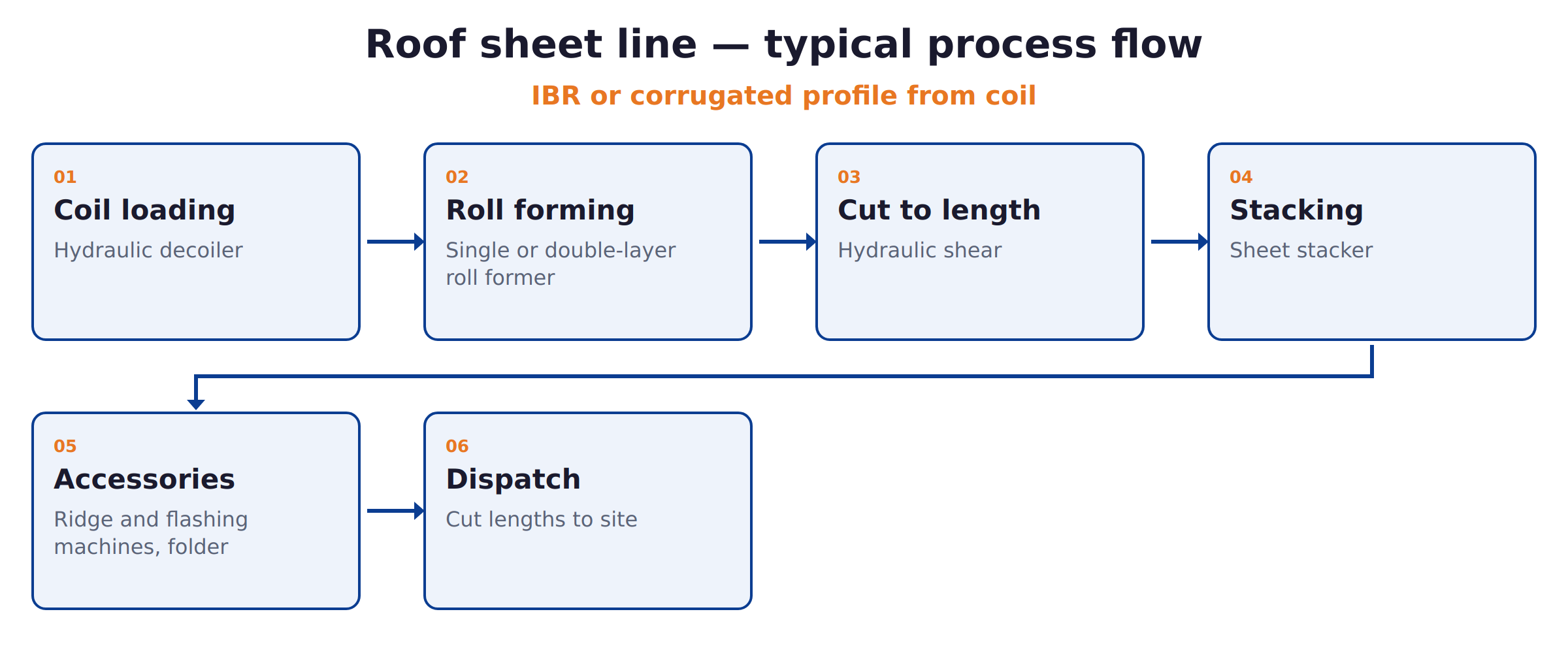
We start from the profiles your customers order and your coil supply. We specify the roll former, decoiler, cutter, controls, run-out and stacking as one line, supply it from audited factories in China, ship and clear it, install and commission it on your coil at the agreed speed and profile tolerance, and train your operators. For a single used machine, a local seller is often the better choice.
Frequently asked questions
Which roll forming machine should I buy first?
The one that makes the profile your customers order most, usually IBR roof sheet or a double-layer IBR and corrugated machine.
How much is an IBR roof sheet machine?
As an indication for 2026, about US$11,000–50,000 or more, depending on speed, cutter and decoiler.
Is a double-layer roof sheet machine a good idea?
Yes, if you sell both profiles and have limited space. Two separate machines are faster if both sell in volume.
What do I need for light steel frame?
An LGSF machine, design software, a structural engineer to sign off designs to SANS 517, and trained erectors.
How do anti-dumping duties affect roofing?
Duties of 8.21–57.84% on corrosion-resistant coil from China apply from September 2026, raising the cost of imported coil.
Does CISH supply roll forming machines?
Yes, as complete lines with decoiler, cutter, controls and commissioning on your coil.