Choose the supplier who will roll a sample of your profile from your coil grade and thickness, and who supplies the decoiler, cutting and stacking that make it a line.
Four kinds of roll forming supplier
Roofing businesses, steel merchants, light-steel-frame builders and door-frame makers all search for roll forming machines. They get offers from four different kinds of company.
| Supplier type | What they sell | Price | Lead time | Who answers for the profile | Best fit |
|---|---|---|---|---|---|
| Local machine builder or rebuilder | New and rebuilt machines for local profiles, roll changes, repairs | Moderate | Weeks to months | The builder, for their machine | Roofing yards and merchants on standard profiles |
| Coil or roofing supplier reselling machines | Machines bundled with coil supply | Varies; often tied to buying their coil | Short for stock machines | The reseller | Small roofing businesses starting out |
| Chinese factory, direct | Single and double-deck sheet machines, purlin, stud-and-track and frame machines | Lowest on the quote | Build plus shipping and clearance | You, after delivery | Buyers who can install and set rolls themselves |
| Turnkey line company | Decoiler, punching, forming, cutting, stacking and, for LGSF, design software and assembly tools, installed and commissioned | Between direct and specialist | One programme | The turnkey company, on your coil, at agreed output | Merchants and builders adding a profile line or an LGSF factory |
Start with the profile and the coil
Roll formers are built around one profile, or a family of profiles, and a range of coil thickness and strength. Before comparing suppliers, write down:
- The profile: IBR, corrugated, purlin size range, stud-and-track section, door or window frame.
- The coil: thickness, width, steel grade and coating, for example 0.75–1.2 mm high-tensile zinc-aluminium for LGSF studs, or 1.5–3 mm for purlins.
- The output: metres per minute and metres per shift you can sell.
A supplier who quotes a machine before seeing your profile drawing and coil specification is quoting a catalogue machine, which may or may not roll your section.
What separates good roll forming suppliers
They roll a sample from your coil
The surest test is a sample length of your profile rolled from the coil you will buy, checked against your drawing. Ask for it before you pay the balance, and write the profile tolerances into the contract.
They supply the line, not just the forming head
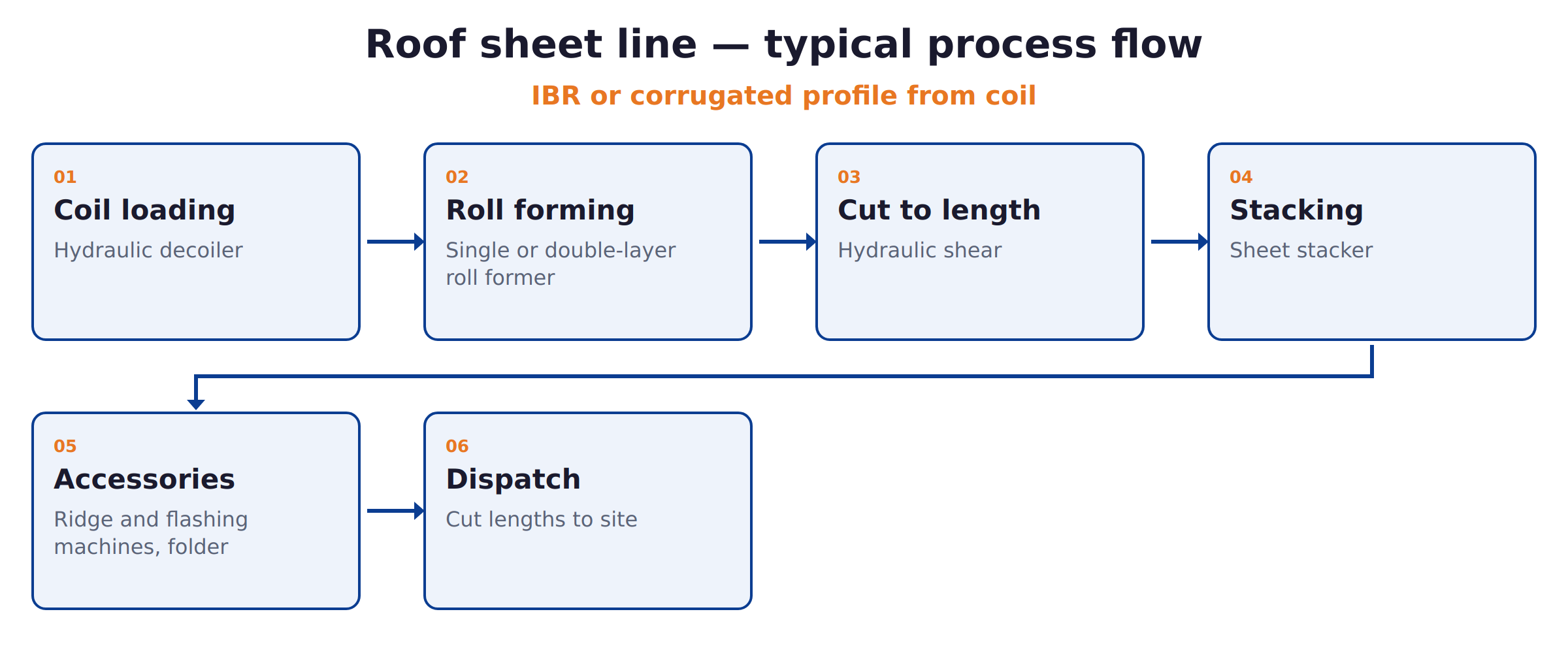
A roll forming line includes a decoiler, straightening or levelling where needed, pre-punching, the forming station, cut-off (flying or stop-to-cut), run-out table and stacking. Many quotes cover the forming head and leave the rest to you.
They understand the building rules
Light steel frame buildings in South Africa are designed under SANS 517, and a structural engineer must sign off every light-steel-frame building. A supplier of LGSF machines should provide or integrate the design software that produces punched, labelled members your engineer can approve. Steel windows and door frames have their own standard, SANS 727.
Where to find roll forming machine suppliers
- SASFA, the Southern African Light Steel Frame Building Association, runs light-steel-frame building training, including a course on SANS 517, and connects frame builders with suppliers.
- SAISC, the Southern African Institute of Steel Construction, represents the structural steel sector and its fabricators.
- Coil suppliers and merchants know which machines run well on their coil.
- Other roofing and frame businesses: ask to see a machine running the profile you want.
- China: most purlin, stud and frame machines sold in Africa are built in China; use our supplier audit checklist before paying.
This page does not name or rate suppliers.
How to choose: a 10-point checklist
- Profile drawing agreed and attached to the contract, with tolerances.
- Coil range stated: thickness, width, grade and coating the machine will roll.
- Sample rolled from your coil before the balance is paid.
- Line content: decoiler, punching, forming, cutting, run-out and stacking all listed.
- Speed in metres per minute at your profile, and the cut-length accuracy.
- Roll material and hardness stated; spare rolls or roll sets for second profiles priced.
- Controls: length and quantity programming; for LGSF, the design software link.
- Safety: guarding and emergency stops for driven machinery under the OHS Act.
- Installation, commissioning and training in the price.
- Support for hydraulics, controls and roll changes after year one.
If you are deciding which machine to buy first, read the best roll forming machine to start with.
Starting a roofing yard? Read how to start a roofing sheet business in South Africa, coil plan included.
Ten questions to ask
- Can you roll a sample of my profile from my coil before I pay the balance?
- What coil thickness, width and grade range does the machine handle?
- What is included apart from the forming head?
- What speed and cut-length accuracy will you guarantee?
- What are the rolls made of, and how long do they last?
- How long does a profile or size change take?
- For LGSF: which design software does it work with, and how are members labelled?
- Is installation, commissioning and training included?
- What does the warranty cover?
- Which business in South Africa runs this machine, and may I visit?
Comparing roll forming quotes
| Section | What each quote should state |
|---|---|
| Decoiler | Capacity in tonnes, manual or powered, coil width |
| Feeding and levelling | Straightener or leveller where needed |
| Pre-punching | Holes, slots and service holes, hydraulic or servo |
| Forming station | Number of stands, shaft diameter, roll material, drive |
| Cut-off | Flying or stop-to-cut, cut-length accuracy |
| Run-out and stacking | Table length, stacker if needed |
| Controls and software | Length programming; for LGSF the design software and labelling |
| Freight, installation, commissioning | Incoterm, clearance, setting, sample runs |
| Training and documents | Days, manuals, electrical and hydraulic drawings |
| Owner's scope | Floor, power supply, coil handling, building |
Compare totals including what each quote leaves out; our same-scope comparison explains the method.
Common mistakes
- Buying a machine for "IBR" without the exact profile. Small differences in rib height and pitch matter to customers and to the fixing system.
- Ignoring coil grade. High-tensile coil needs a stronger machine than mild steel at the same thickness.
- Leaving out punching for LGSF. Studs and tracks need service holes and fixing holes, ideally punched in line under software control.
- Forgetting coil cost. Coil price, including any anti-dumping duty, decides the business more than the machine price does.
- Buying speed you cannot sell. A fast line idle half the day costs more per metre than a slower one running all shift.
Roll forming machine prices in 2026
Indicative, in USD, from our roll forming machine price guide:
| Purchase | Specification | Indicative price (2026) |
|---|---|---|
| IBR or corrugated sheet roll former | Standard roofing profiles | From about USD 11,000 to 50,000+ |
| C/Z purlin roll former | About 80–300 mm, 1.5–3 mm steel | USD 15,000–80,000 |
| LGSF stud-and-track machine | C89 class, 0.75–1.2 mm high-tensile coated steel | USD 40,000–80,000 |
| Starter LGSF factory equipment | One or two C89/C140 machines | USD 80,000–240,000 |
| Steel door or window frame roll former | Per machine, one profile, 0.5–2 mm | USD 6,000–15,000 per machine |
| Complete frame plant | Punching, forming, welding, coating, glazing | Quoted per configuration |
South African facts that shape the decision
- Coil duties. ITAC announced in September 2026 definitive anti-dumping duties of 8.21–57.84% on certain corrosion-resistant steel coil from China, imposed from 18 September 2026. If you plan to import coated coil, price the duty into your business case.
- Machine duties. Profile forming machines (8462.22) and numerically controlled roll forming machines (8462.25) are free of general duty in SARS's 2026 tariff, but some hydraulic presses (8462.29 and 8462.61 subheadings) carry 15%. Classify punching presses supplied with a line carefully. Import VAT of 15% applies and is claimable by VAT vendors; see our import duty guide.
- Local production policy. The Steel and Metal Fabrication Master Plan targets replacing about 200,000 tonnes of imported final steel products with local manufacture, which supports local profile and frame makers.
- Building rules. Light steel frame buildings follow SANS 517 and need a structural engineer's sign-off; home builders must also be registered with the NHBRC.
- Steel doors and windows are made to SANS 727.
- Machine safety. Driven machinery falls under the Occupational Health and Safety Act and its machinery regulations, including guarding and operator training.
Where CISH fits
CISH is a turnkey line company. We specify roll forming lines from audited factories in China against your profile drawings and coil, arrange a sample run on your coil, ship and clear the equipment, and install and commission the line, from decoiler to stacker, with your operators trained. We suit merchants and builders adding a purlin, sheet or LGSF line, and frame makers setting up production. For a single used roofing machine, a local rebuilder is often the quicker route.
Frequently asked questions
Who sells roll forming machines in South Africa?
Local machine builders and rebuilders, coil and roofing suppliers who resell machines, Chinese factories selling direct, and turnkey line companies. Standard roofing profiles are well served locally; purlin, LGSF and frame lines are often imported.
How much is an IBR roll forming machine?
As an indication for 2026, IBR and corrugated sheet machines start from about USD 11,000 and run past USD 50,000 for double-deck or heavier machines, before freight and installation.
How much does an LGSF machine cost?
An LGSF stud-and-track machine of the C89 class costs about USD 40,000–80,000, and starter LGSF factory equipment with one or two machines about USD 80,000–240,000.
What standards apply to light steel frame building?
SANS 517 is the building code for light steel frame buildings, and a structural engineer must sign off each building. SASFA runs training on it.
Is there import duty on roll forming machines?
Profile forming and NC roll forming machines (8462.22 and 8462.25) are free of general duty in SARS's 2026 tariff; some hydraulic presses carry 15%. Import VAT of 15% applies.
Is there duty on imported steel coil?
From 18 September 2026, anti-dumping duties of 8.21–57.84% apply to certain corrosion-resistant steel coil from China, on top of any ordinary duty. Check the current position for your coil with ITAC and your clearing agent.
Does CISH sell single roll forming machines?
We supply complete roll forming lines, with decoiling, punching, forming, cutting and stacking, installed and commissioned. For a single standard roofing machine, a local supplier is often the better choice.