Fully automatic lines that rewind, glue, cut and pack with few people cost from the upper end of that range up to about US$1 million for high speed. The choice is really about labour: how many of the three steps you automate. A paper mill that makes the tissue itself is a different investment, quoted per configuration. CISH supplies, installs and commissions complete toilet paper converting lines.
The short answer: three classes of line
| Line class | Typical output | Indicative price (2026) | People per shift | Best fit |
|---|---|---|---|---|
| Manual or semi-automatic | A few thousand rolls per shift | US$10,000–50,000 (small line about US$25,000) | 4–8 | Start-ups, spaza and local wholesale |
| Automatic rewinder with semi-automatic cutting and packing | About 10,000–30,000 rolls per shift | Upper part of the starter band and above, by speed | 4–6 | Growing brands, wholesaler supply |
| Fully automatic line, rewind to pack | Tens of thousands of rolls per shift | Up to about US$1 million at high speed | 2–4 | Retail brands, private label, tenders |
Output depends on roll size, sheet count and ply. Ask suppliers to state output for your roll, not for a 'standard roll'.
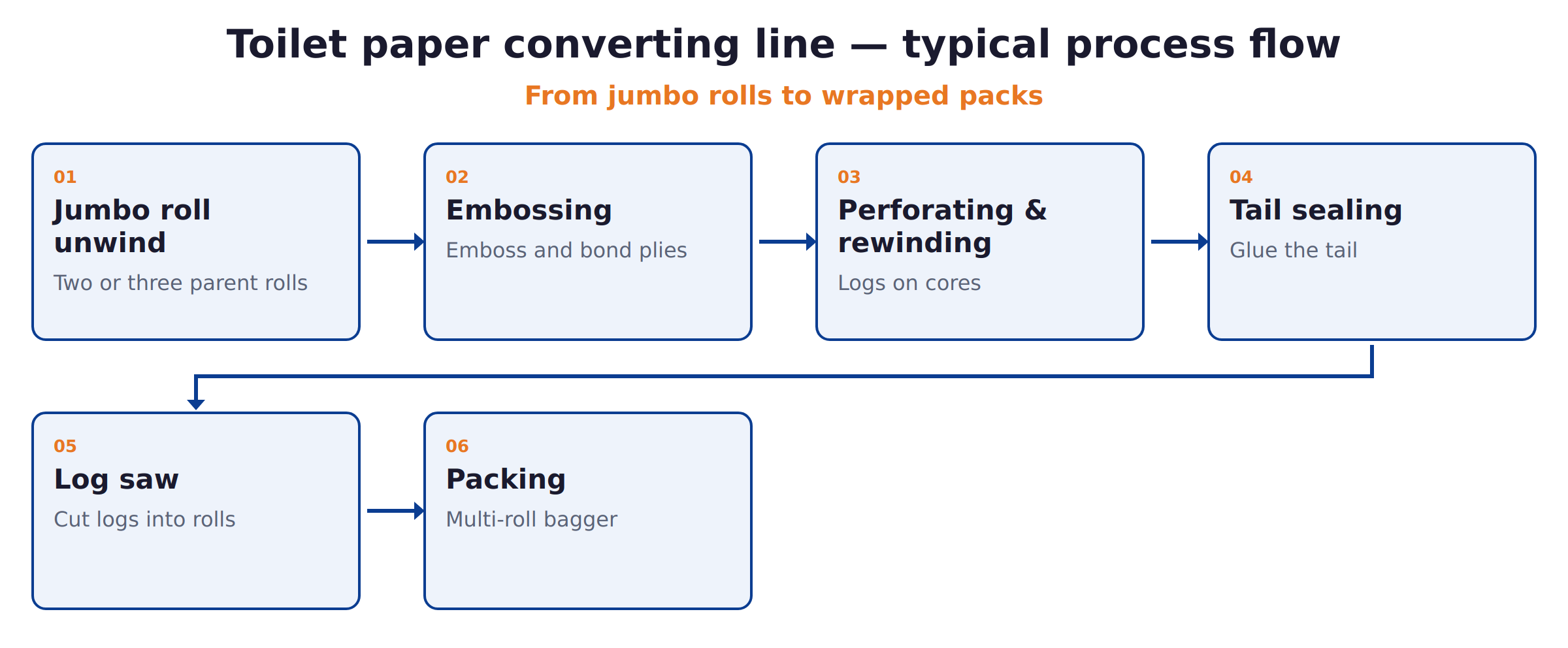
Which step to automate first
A converting line has three stages. The best order to automate is usually:
- Rewinding. The rewinder sets roll firmness, sheet count and perforation quality. An automatic rewinder with core loading and tail gluing gives consistent rolls; this is where most of the quality comes from.
- Cutting. A manual band saw is cheap but slow and less safe. An automatic log saw with a circular blade and sharpening unit cuts cleanly and keeps the roll edges neat.
- Packing. Hand packing in printed bags works at low volume. A packing machine that groups and wraps 4, 9, 10, 18 or 24 rolls saves the most labour once you pass a few thousand packs a day.
Many South African businesses start semi-automatic and add an automatic packer first, because packing takes the most hands.
Match the line to your situation
New business
Buy a reliable semi-automatic line and spend the savings on jumbo roll stock, printed packaging and a delivery vehicle. Your first challenge is selling, not making.
Existing converter
If you are running two shifts and still short, the step is an automatic rewinder and log saw, then a packer. Buying a faster rewinder alone can push the bottleneck to cutting and packing.
Limited budget
Choose a smaller line with a good rewinder over a larger line with a poor one. Loose, uneven rolls are the main reason buyers switch.
Supermarket, private label or tenders
Retail and institutional buyers want consistent sheet count, ply, roll weight and printed packs with correct quantity marking. That needs an automatic line with counting, a packing machine and quality checks at every shift.
Chinese, European and local equipment
| Local or refurbished | Chinese factory lines | European lines | |
|---|---|---|---|
| Typical offer | Used rewinders, simple saws | Manual to fully automatic complete lines | High-speed automatic lines |
| Price | Low | Low to moderate | High |
| Check | Condition, spares | Rewinder control, embossing rolls, saw safety, packer reliability | Total landed cost, lead time |
We do not rate brands. For most new South African converters, a complete Chinese line with a good rewinder and proper safety guarding offers the best balance of cost and output. Imported used equipment needs an ITAC import permit before shipment.
The raw material decides your margin
Jumbo rolls are bought locally or imported. Under Schedule 1, tissue base paper (heading 4803) carries a 5% general duty and finished toilet paper (4818.10) 20%, with EU, UK, EFTA and SADC origin free. Price per tonne, grammage, softness and whiteness all affect your product. Recycled-fibre jumbo rolls make cheaper, greyer paper; virgin fibre makes whiter, softer paper at a higher price. Lock in a supplier and keep a few weeks of stock.
Example: packs a day by line class
As an example, a semi-automatic line producing about 4,000 rolls per shift makes about 400 ten-roll packs or about 1,000 four-roll packs. An automatic line at 20,000 rolls per shift makes about 2,000 ten-roll packs. Two shifts double that. Work back from the packs you can sell and deliver, then choose the class.
What a wrong choice costs
- Too fast for your sales: jumbo rolls tied up in stock and a large loan for a half-used machine.
- Weak rewinder: loose or uneven rolls that shops return.
- No packer as volume grows: labour costs rise and packs look inconsistent.
- Unsafe saws: a manual band saw without guarding is a serious injury risk under the OHS Act.
- Wrong core and roll size: your market expects a particular roll diameter and sheet count.
Five things to confirm before you decide
- Roll specification: ply, sheet size, sheet count, core size and roll diameter.
- Packs: the pack sizes and the bags your buyers want.
- Packs a day you can sell now and in two years.
- Power and space: three-phase supply, floor area for jumbo roll storage and finished stock.
- Jumbo roll supply: source, price per tonne, lead time.
Packaging and marking
Packs must show net quantity in line with the Legal Metrology markings rules (SANS 289), usually as rolls and sheets per roll. Paper and plastic packaging fall under the EPR regulations; producers and brand owners should check their obligations under the paper and packaging scheme.
Worked example: a converter in KwaZulu-Natal
A family business near Pietermaritzburg sells two-ply ten-roll packs to spaza shops and two wholesalers. It started with a semi-automatic line, with one operator on the rewinder, two moving logs to a band saw and four packing by hand, and made about 400 packs a shift. When a wholesaler asked for twice the volume, it did not buy a faster rewinder first. It added an automatic log saw with guarding and then a semi-automatic packer, which moved three people from cutting and packing to quality checks and loading. Output rose to about 900 packs a shift with the same rewinder, and complaints about uneven roll ends stopped. A year later it replaced the rewinder with an automatic one with core loading and tail gluing. The figures are illustrative, but the order is common: fix the step that limits the packs you can sell, not the step that sounds most impressive.
Questions to ask on a factory visit
- Can I see the rewinder running my grammage and ply, with my core size?
- How long does a change of sheet count or perforation take?
- What is the measured roll weight variation over a shift?
- Which parts wear first, and what do they cost?
- Who on your team will commission the line in South Africa, and for how long?
How CISH helps you choose
We start from your roll specification and the packs a day you sell. We specify the rewinder, log saw, packer and core equipment as one line, supply it from audited factories in China, ship and clear it, install and commission it on your jumbo rolls at the agreed output, and train your operators. For a single used rewinder, a local seller is usually the better choice. Our toilet paper machine price guide lists the 2026 bands.
Frequently asked questions
What is the best toilet paper making machine for a small business?
A semi-automatic converting line with a good rewinder, a log saw and hand or semi-automatic packing, costing about US$10,000–50,000.
How much is a fully automatic toilet paper machine?
Fully automatic lines that rewind, cut and pack cost from the upper part of the starter band up to about US$1 million for high-speed lines.
Should I make my own tissue paper or buy jumbo rolls?
Most businesses buy jumbo rolls and convert them. A tissue paper mill is a far larger investment.
What is the import duty on jumbo rolls?
Tissue base paper under heading 4803 carries a 5% general duty, with EU, UK, EFTA and SADC origin free.
Which step should I automate first?
Usually rewinding for quality, then packing for labour, then cutting.
Does CISH supply single toilet paper machines?
We supply complete converting lines. For a single used machine, a local seller is usually better.