Each step has its own machine: mixer, divider, rounder, intermediate prover, moulder, final prover, oven, depanner, cooling rack or spiral cooler, slicer and bagger. CISH supplies, installs and commissions complete bread lines.
The process at a glance
| Step | What happens | Machine | Typical time |
|---|---|---|---|
| 1. Weighing | Flour, water, yeast, salt, sugar, fat and improver measured | Flour silo or bag tipping, scales, water meter and chiller | Minutes |
| 2. Mixing | Ingredients mixed and gluten developed | Spiral or high-speed mixer | About 8–15 minutes |
| 3. Dividing | Dough cut into pieces of set weight | Dough divider | Continuous |
| 4. Rounding | Pieces shaped into balls to seal the surface | Rounder | Seconds |
| 5. Intermediate proof | Dough pieces rest so they can be moulded | Intermediate (overhead) prover | About 5–10 minutes |
| 6. Moulding | Pieces sheeted, rolled and shaped into loaves | Moulder | Seconds |
| 7. Panning | Loaves placed in tins | By hand or automatic panner | Continuous |
| 8. Final proof | Dough rises in warm, humid air | Proving cabinet or room | Often 45–60 minutes |
| 9. Baking | Loaves baked | Deck, rack, tunnel or travelling oven | About 25–35 minutes for a standard loaf |
| 10. Depanning | Loaves removed from tins | By hand or depanner | Continuous |
| 11. Cooling | Loaves cooled before slicing | Racks or spiral cooler | Often 60–90 minutes |
| 12. Slicing and bagging | Loaves sliced, bagged, closed and dated | Slicer, bagger, clip or tag machine | Continuous |
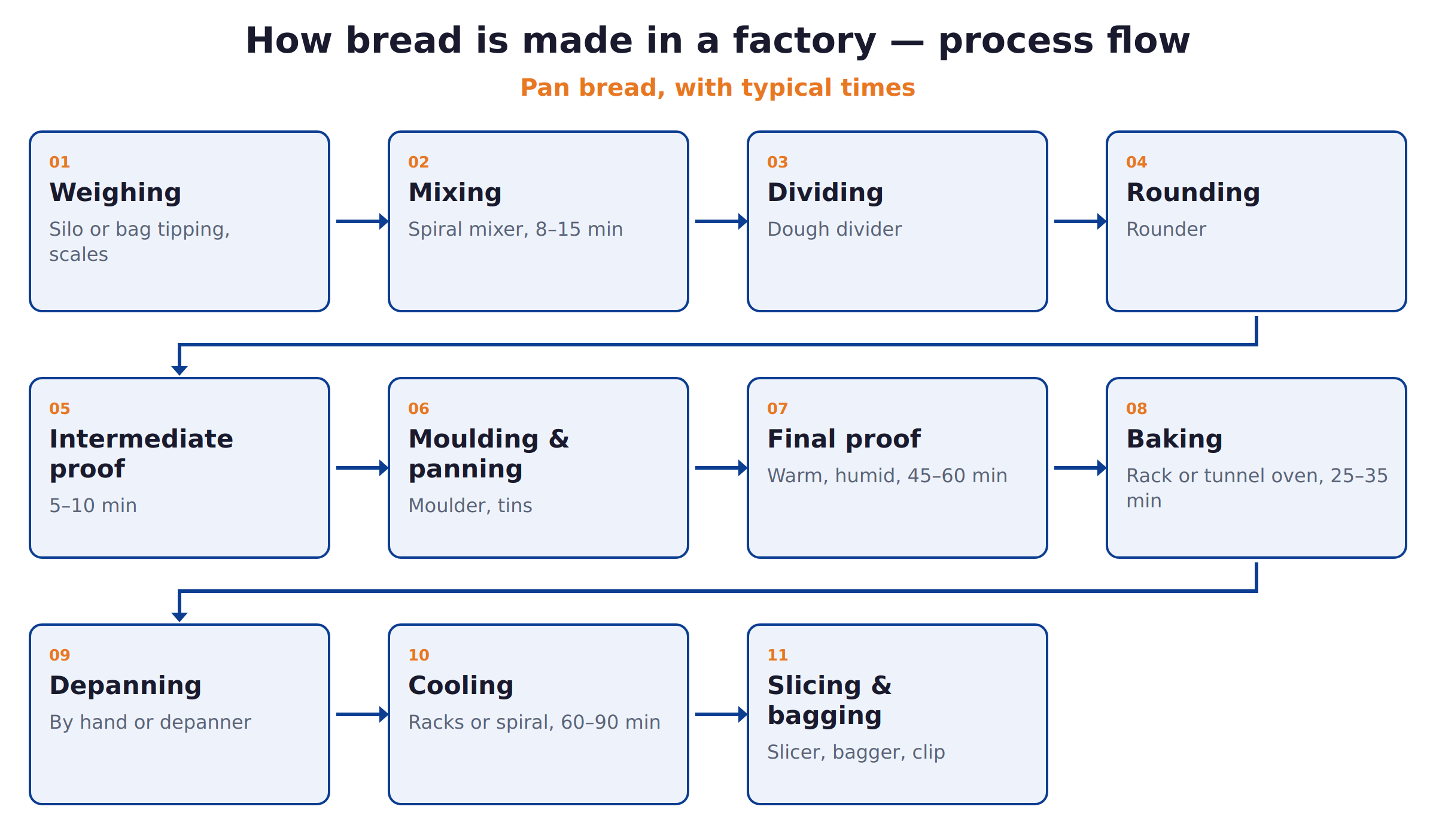
Step by step
Weighing and mixing
A bread line is only as consistent as its dough. Small bakeries weigh flour by the bag; larger plants draw flour from silos and dose it automatically. Water temperature matters: dough should leave the mixer at a controlled temperature, so many bakeries use a water chiller in summer. A spiral mixer develops the gluten that holds gas in the loaf. Many plant bakeries use a short or no-time dough process, in which improvers and intensive mixing take the place of a long bulk fermentation.
Dividing and rounding
The divider cuts dough into pieces by volume, so the dough must be consistent for the weights to hold. Checking weights regularly is how a bakery controls its cost and its pack mass. The rounder turns each piece into a ball with a smooth skin that holds gas.
Intermediate proof and moulding
After rounding, dough is tight and will tear if shaped at once. A short rest in an intermediate prover relaxes it. The moulder then sheets each piece flat, curls it and rolls it into a cylinder that fits the tin.
Panning and final proof
Loaves go into tins, singly or in straps of several tins joined together. The final prover holds them at warm temperature and high humidity until they reach the right height. Under-proved bread is dense; over-proved bread collapses. Prover capacity often decides the line's real output.
Baking
The oven sets the structure, browns the crust and drives off part of the water. Small and medium bakeries use deck or rack (rotary) ovens; large plants use tunnel or travelling tray ovens that bake continuously. Our guide on how to choose a bakery oven compares them.
Depanning and cooling
Loaves are knocked out of their tins immediately after baking. They must cool before slicing; warm bread tears in the slicer and sweats in the bag, which leads to mould. Cooling is the step most often undersized. A spiral cooler saves floor space on larger lines; racks in a clean, airy room work for smaller ones.
Slicing, bagging and dating
A band or reciprocating slicer cuts the loaf, and a bagger puts it into a printed bag, which is closed with a clip or tag carrying the date. Wheat products, including bread, are graded, packed and marked under R.405 of 2017, so your bags and closures must carry the required information.
What sets the output of a bread line
- Oven capacity. Loaves per bake multiplied by bakes per hour.
- Prover capacity. It must hold every loaf for the full proof time.
- Cooling capacity. It must hold every loaf for the full cooling time.
- Divider speed. Pieces per minute at your loaf weight.
- Slicer and bagger speed. Often the bottleneck once ovens are added.
Size all five together. A large oven with a small prover or too little cooling space gives no more bread.
Bakery machines and lines: what they cost
Indicative, in USD, from our bakery production line cost guide:
| Purchase | What you get | Indicative price (2026) |
|---|---|---|
| Set of bakery machines | Mixer, divider, moulder, prover, deck or rack oven, slicer | About US$15,000–45,000 |
| Semi-automatic bread line | Linked make-up, larger ovens, cooling, slicing and bagging | From about US$80,000 |
| Fully automatic bread line | Automatic dosing, continuous make-up, tunnel or travelling oven, spiral cooler, slicing and bagging | About US$250,000–800,000 or more |
Ex-works equipment prices; freight, installation, building, power and working capital are on top. Bakery ovens (8417.20) carry no general import duty.
Energy, water and the building
Bread making is energy-heavy. Ovens run on electricity, gas or diesel; provers need heat and steam; mixers and slicers draw power. Eskom's standard tariffs rose 8.76% for 2026/27, so fuel choice and backup power belong in the plan. The building needs washable surfaces, separation of raw and baked product, staff facilities and pest control, because a bakery is a food premises under R638 and needs a Certificate of Acceptability.
Bread in the South African market
Bread is a daily staple. NAMC's food basket report put the average price of a 700 g brown loaf at R17.72 and a white loaf at R19.61 in July 2026. Brown bread is zero-rated for VAT, white bread is not, and that difference shapes the product mix of many bakeries. The South African Chamber of Baking represents the larger bread makers.
Common mistakes
- Buying an oven before sizing the prover and cooling.
- No water chiller. Dough temperature drifts in summer.
- Ignoring divider weight checks. Under-weight loaves break the pack declaration; over-weight loaves cost money.
- Slicing warm bread. Torn loaves and mouldy bags.
- No plan for power cuts. A batch in the prover is lost when the oven cannot fire.
- Underestimating tins. Each loaf in the prover and oven needs a tin.
Where CISH fits
We specify complete bread lines, from flour dosing to bagged loaves, from audited factories in China against your loaf sizes and hourly output. We ship and clear the equipment, install it, commission the line with output demonstrated on your recipe, and train your bakers and technicians. For a few machines for a small bakery, a local catering equipment dealer is often the better route.
Frequently asked questions
What are the steps in making bread in a factory?
Weighing, mixing, dividing, rounding, intermediate proof, moulding, panning, final proof, baking, depanning, cooling, slicing and bagging.
What machines do I need for a bread factory?
A mixer, divider, rounder, intermediate prover, moulder, tins, final prover, oven, cooling racks or spiral cooler, slicer and bagger. Larger plants add flour silos, automatic dosing and depanners.
How long does it take to make a loaf of bread in a factory?
From mixing to bagging usually takes around three to four hours, most of it in proving, baking and cooling.
What limits how many loaves a bakery can make?
Oven, prover and cooling capacity, together with divider and slicer speed. All of them must be sized for the same output.
How much does a bread production line cost?
As an indication for 2026, a set of bakery machines costs about US$15,000–45,000, a semi-automatic line from about US$80,000, and a fully automatic line about US$250,000–800,000 or more ex-works.
Does CISH supply single bakery machines?
No. We supply complete bread lines, installed and commissioned. For a few machines, a local dealer is usually the better route.