Choose the supplier who commits to kilograms per hour of finished bars on your formula, and includes plodding, stamping and wrapping.
Four kinds of soap equipment supplier
Searches for a soap making machine in South Africa bring up hobby kits, local mixing tanks and full bar-soap lines on the same page. Sort the suppliers by what they can actually deliver.
| Supplier type | What they sell | Price | Who answers for output | Best fit |
|---|---|---|---|---|
| Local mixer and tank fabricator | Stainless mixing tanks, small blenders, filling tables | Moderate | The fabricator, for the vessel | Liquid soap and detergent start-ups |
| Dealer of small imported machines | Single plodders, cutters, stampers, small fillers | Low to moderate | The dealer, machine by machine | Small bar-soap businesses buying noodles |
| Chinese factory, direct | Saponification units, noodle lines, finishing lines, detergent blending and filling | Lowest on the quote | You, after delivery | Buyers with process experience |
| Turnkey line company | Mixing or saponification to wrapped, cased bars or filled bottles, installed and commissioned | Between local and direct | The turnkey company, at agreed kg/h on your formula | Manufacturers moving from batch to line production |
Decide what you will make
- Liquid soap, dishwashing liquid and household detergents: mixing tanks, transfer pumps, filling and capping. The lowest entry cost.
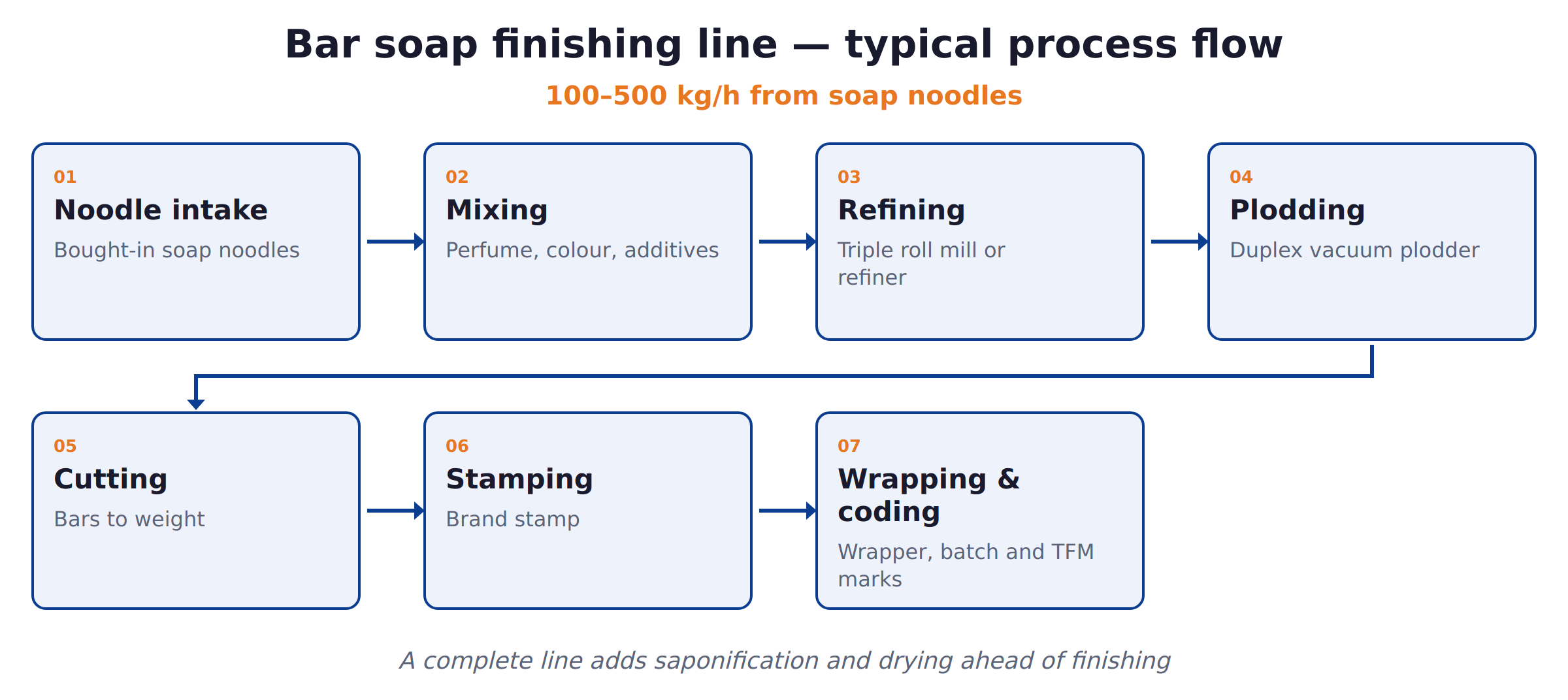
- Bar soap from bought-in noodles: a finishing line — mixer, roller mill, plodder, cutter, stamper and wrapper.
- Bar soap from oils: add saponification and drying to make your own noodles; a larger investment and a chemical process to manage.
- Washing powder: dry blending for small volumes; spray drying is an industrial project of its own.
Our soap and detergent line cost guide sets out the scales.
What separates soap equipment suppliers
Output on your formula
Bar soap behaves differently by fatty-acid blend, filler content and moisture. Ask for output in kilograms per hour of finished, stamped bars on your formula, and for a trial with your noodles before the line ships.
The finishing end
Many "complete soap lines" stop at the plodder. Cutting, stamping, wrapping and casing decide labour cost and how the product looks on the shelf. Make sure they are in the quote.
Handling caustic and hot oils
Saponification uses caustic soda, which is listed with an occupational exposure limit in the hazardous chemical agents regulations. A supplier making-your-own-noodles plant must include safe caustic handling, ventilation and operator protection.
Where to find soap equipment suppliers
- Chemical and packaging shows. Propak Africa at the Johannesburg Expo Centre (7–10 March 2028) covers filling, labelling and packaging for detergents and personal care.
- Raw material suppliers of oils, noodles, caustic and fragrances know which equipment their customers run.
- Existing producers: ask any supplier for a plant you can visit running a similar product.
- China: most mid-sized soap lines sold in Africa are built in China. Read our supplier audit checklist first.
We do not name or rate suppliers.
How to choose: a 10-point checklist
- Product and formula stated, with a trial on your noodles or oils.
- Output in kg/h of finished bars or litres per hour filled.
- Finishing: roller mill, plodder, cutter, stamper, wrapper, casing.
- Saponification (if included): batch or continuous, caustic handling, drying.
- Materials: stainless where product and caustic touch; seals suited to the chemicals.
- Moulds and dies: stamping dies for your bar shapes and logo.
- Labelling: net content marking to SANS 289 under the Legal Metrology Act.
- Safety: ventilation, eyewash and guarding.
- Installation, commissioning and training in the price.
- Support for plodder screws, cutters and wrappers after year one.
Adding lotions, creams or candles to a soap business? See cosmetic manufacturing equipment suppliers and candle making machine prices.
Before choosing a supplier, decide your level: see how to start a soap making business.
Ten questions to ask
- What output will you guarantee, in kilograms per hour of finished bars, on my formula?
- Can you run a trial with my noodles before shipping?
- Is cutting, stamping, wrapping and casing included?
- If saponification is included, how is caustic stored, dosed and handled?
- What does the line use in power, steam and water?
- How many operators does it need?
- Are stamping dies for my bar shape included?
- Is installation, commissioning and training included?
- What does the warranty cover?
- Which plant in South Africa runs this line, and can I visit?
Comparing soap line quotes
| Section | What each quote should state |
|---|---|
| Raw materials | Oil storage and heating, caustic storage and dosing, or noodle feeding |
| Saponification and drying | Process type, capacity, vacuum drying |
| Mixing and refining | Amalgamator, roller mill, refiner |
| Extrusion | Duplex or vacuum plodder, capacity |
| Cutting and stamping | Cutter, stamper, dies |
| Wrapping and casing | Wrapper type, speed, case packing |
| Liquid products | Mixing tanks, pumps, filler, capper, labeller |
| Freight, installation, commissioning | Incoterm, clearance, trial on your formula |
| Training and documents | Days, manuals |
| Owner's scope | Building, steam or hot water, power, drainage |
Compare totals including what each quote leaves out; see our same-scope comparison.
Common mistakes
- Buying a plodder and calling it a line. Without milling, cutting and stamping, bars are rough and labour-heavy.
- Starting with saponification. Making noodles from oil adds a chemical process; many start by buying noodles.
- Ignoring imports. Imported bars compete on price; plan the product and channel before the scale.
- No labelling plan. Net content and ingredient labels must be right from the first carton.
- Underestimating caustic safety. It needs proper storage, dosing and protective equipment.
Soap and detergent equipment prices in 2026
Indicative, in USD, from our soap and detergent cost guide:
| Purchase | Capacity | Indicative price (2026) |
|---|---|---|
| Washing-powder blending set | 50–500 kg batches | US$3,000–45,000 |
| Liquid detergent mixing and filling set | Batch tanks of a few hundred litres; small filler | US$20,000–60,000 |
| Soap-noodle finishing line | 100–500 kg/h | US$20,000–100,000 |
| Complete soap line | 300–1,000 kg/h | US$150,000–400,000 |
| Spray-dried washing-powder tower | Tonnes per hour | Quoted per configuration |
South African facts that shape the decision
- Product duty. Soap and soap noodles under heading 3401 carry 20% general duty in SARS's 2026 tariff, but are free from the EU and UK, EFTA and SADC, so imports from those regions compete without duty.
- Raw material duty. Palm oil (1516.20.90) carries 10% general duty and caustic soda 20%, free from SADC; ITAC Report 739 of December 2024 approved a rebate on palm oil for soap manufacture by specific permit where the oil is not available in SACU. The report also recorded a 126.6% surge in laundry soap imports in 2020.
- Equipment duty. Mixing and kneading machinery (8479.82) and filling and labelling machines (8422.30, 8422.40) are free of general duty; import VAT of 15% applies and is claimable by VAT vendors; see our import duty guide.
- Product standards. SABS publishes standards for toilet soap (SANS 2097:2025), filled bar soap (SANS 236:2019), general purpose pure soap (SANS 235:2024), liquid toilet soap (SANS 238:2024) and industrial laundry detergents (SANS 1044:2023).
- Labelling. Net content on prepackaged soap is marked to SANS 289, incorporated under the Legal Metrology Act by Notice 877 of 2018.
- Cosmetic or not. Under the Foodstuffs, Cosmetics and Disinfectants Act, a product applied to the body for cleansing is a cosmetic, while cleansing material that is not a cosmetic falls under disinfectants; the classification affects labelling.
- Worker safety. Caustic soda is listed with an occupational exposure limit in the Regulations for Hazardous Chemical Agents, 2021, under the OHS Act.
Where CISH fits
CISH is a turnkey line company. We specify bar-soap, noodle and liquid detergent lines from audited factories in China against your formula, run a trial on your materials before shipping, ship and clear the equipment, and install and commission the line from mixing to wrapped cases, with your team trained. We suit manufacturers moving from batch production to a line, and producers adding bar soap to liquids. For a single mixing tank or plodder, a local fabricator or dealer is often the better choice.
Frequently asked questions
Who sells soap making machines in South Africa?
Local mixer and tank fabricators, dealers of small imported machines, Chinese factories selling complete lines direct, and turnkey line companies. Liquid products are often equipped locally; bar-soap finishing and saponification lines are usually imported.
How much does a soap making line cost?
As an indication for 2026, a soap-noodle finishing line of 100–500 kg/h costs about US$20,000–100,000, and a complete soap line of 300–1,000 kg/h about US$150,000–400,000.
Can I start a soap factory with bought-in noodles?
Yes. Buying soap noodles and running a finishing line avoids saponification and caustic handling, and is how many producers start. Making your own noodles from oils needs a larger plant.
What standards apply to soap in South Africa?
SABS publishes SANS 2097 for toilet soap, SANS 236 for filled bar soap, SANS 235 for general purpose pure soap, SANS 238 for liquid toilet soap and SANS 1044 for industrial laundry detergents. Net content is marked to SANS 289.
Is there import duty on soap making machines?
Mixing and kneading machinery and filling and labelling machines are free of general duty in SARS's 2026 tariff. Finished soap carries 20% general duty, free from the EU and UK, EFTA and SADC.
Does CISH sell single soap machines?
No. We supply, install and commission complete soap and detergent lines. For a single machine, a local supplier is usually the better route.