Most new dairies start on a farm or with a group of farmers, processing a few hundred to a few thousand litres a day, and grow from there. Processors in the secondary dairy industry must register with Milk SA, the Dairy Standard Agency monitors compliance, and your premises need a Certificate of Acceptability under R638. As an indication for 2026, a small HTST pasteurisation line costs about US$50,000–125,000 ex-works (about US$95,000–250,000 landed), and a small yoghurt line of 200–1,000 litres an hour about US$20,000–90,000. Milk supply, the cold chain and steady customers decide the business.
Step 1: choose your products
| Product | Equipment | Notes |
|---|---|---|
| Pasteurised milk | Pasteuriser, separator, homogeniser, filler, cold room | High volume, low margin, daily delivery |
| Maas (amasi) | Pasteuriser, fermentation tanks, filler | Popular, longer shelf life than fresh milk |
| Yoghurt | Pasteuriser, fermentation tanks, cup or bottle filler | Higher margin, needs good cultures and hygiene |
| Cheese | Vats, presses, moulds, ripening room | Skilled, slower cash flow |
| Cream and butter | Separator, churn | Uses surplus fat |
| Flavoured milk | Blending, pasteurisation, filling | Sugar levy may apply |
Many small dairies start with maas and yoghurt, which earn more per litre than fresh milk.
Step 2: secure milk supply
Your own herd, neighbouring farms or a group of producers. Agree volumes, price, collection and quality testing: fat, protein, bacteria counts and antibiotic residues. Milk must be cooled quickly on farm and kept cold until processing. Seasonal swings in supply affect what you can make.
Step 3: the rules
- Pasteurisation: R1555 allows the batch (holder) method at 63–65.5 °C for 30 minutes, or HTST at 72 °C for 15 seconds, with immediate cooling below 5 °C. Cream and sweetened products need higher conditions. HTST systems must be mechanically controlled and calibrated monthly, and temperature charts must be kept for at least four weeks. Pasteurised milk must pass the phosphatase test.
- Registration: register with Milk SA under statutory measure 1397 of 2017.
- Compliance: the Dairy Standard Agency checks dairy products and premises.
- Premises: R638 food premises with a Certificate of Acceptability.
- Labels: R146 and the dairy product rules.
Our comparison of batch and HTST pasteurisers explains which suits your volume.
Step 4: equipment and costs
| Purchase | Capacity | Indicative price (2026) |
|---|---|---|
| Batch pasteurising vat | A few hundred litres | A fraction of an HTST line |
| Small HTST line | Small dairy | About US$50,000–125,000 ex-works; about US$95,000–250,000 landed |
| Medium HTST line | Larger dairy | About US$125,000–310,000 ex-works; about US$250,000–560,000 landed |
| Small yoghurt line | 200–1,000 L/h | About US$20,000–90,000 ex-works |
| Cup fill-seal machine | Hundreds to 8,000 cups an hour | About US$3,000–30,000 |
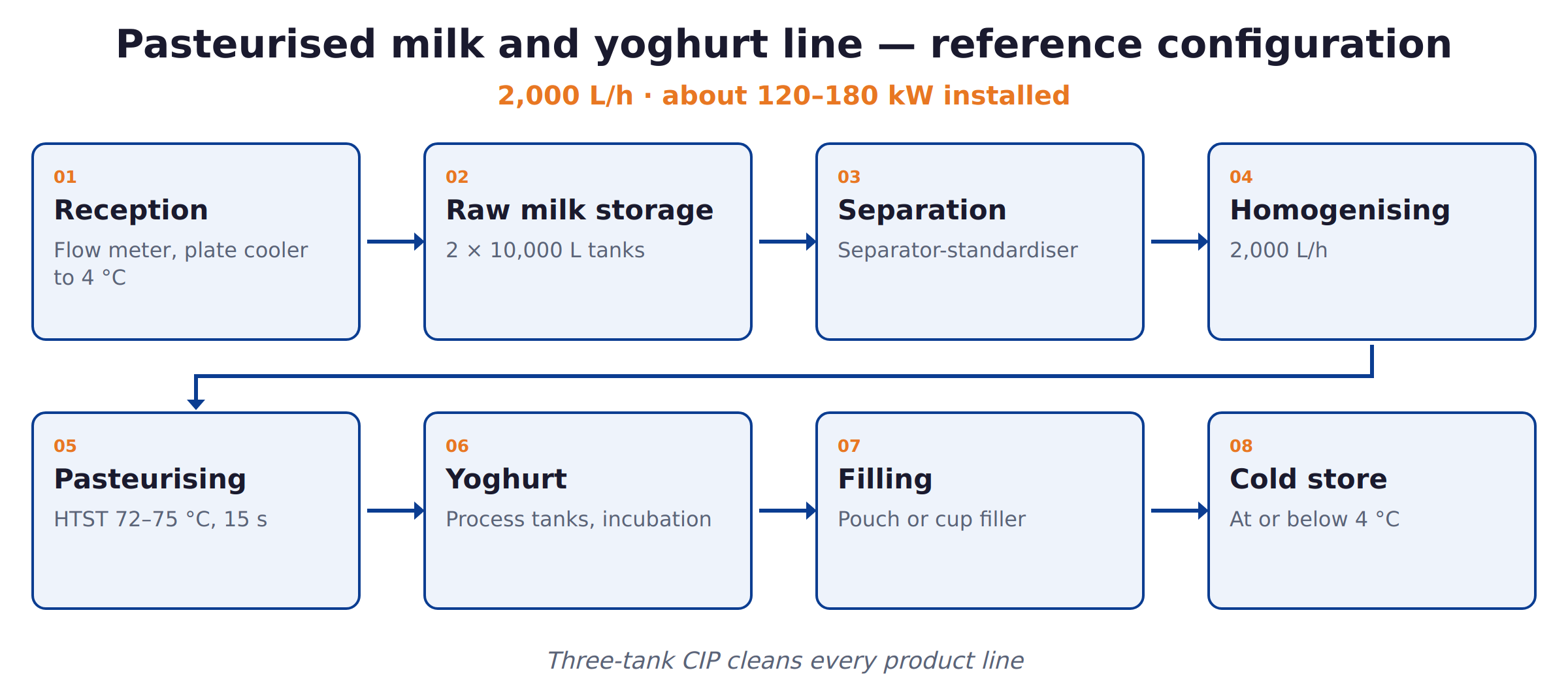
Add reception, cooling, a separator, homogeniser, cleaning (CIP), cold rooms and a laboratory. Our dairy processing line guide covers HTST, ESL and UHT bands.
Step 5: utilities and the building
Dairies need lots of clean water, hot water or steam, refrigeration, drainage that handles milk-rich wastewater, and reliable power with backup for cooling. Floors and walls must be washable, with separate raw and processed areas.
Step 6: cold chain and sales
Fresh dairy must stay cold from the dairy to the shop fridge. Plan cold rooms, refrigerated vehicles and delivery routes. Channels include farm shops, spaza shops for maas, independent supermarkets, schools, hospitals and coffee shops. Large retailers ask for food safety certification and consistent supply.
Step 7: the numbers
Margin per litre depends on the product mix: milk earns least, maas and yoghurt more, cheese most but slowest. Add milk price, packaging, cultures, energy, labour, testing, distribution, levies and finance. Waste from short shelf life can wipe out margins, so match production to orders.
Worked example: a farm dairy in KwaZulu-Natal
A dairy farmer in KwaZulu-Natal sells raw milk to a processor at a low price. He builds a small dairy in a converted shed, installs a 500 litre batch pasteuriser with a chart recorder, fermentation tanks and a semi-automatic pouch filler for maas and a cup filler for yoghurt, registers with Milk SA, and gets his Certificate of Acceptability. He sells maas to spaza shops and yoghurt to independent stores in two towns, keeping the remaining milk for the processor. The figures are illustrative.
Laboratory and records
Test incoming milk for antibiotics and quality, check pasteurisation with the phosphatase test, test finished products for bacteria, and keep temperature charts and batch records. Inspectors and buyers will ask for them, and they protect you when a customer complains.
Common mistakes
- No temperature recorder on the pasteuriser.
- Weak cold chain after the dairy.
- No Milk SA registration.
- Too many products at the start.
- No antibiotic testing of incoming milk.
Packaging and shelf life
Packaging choice affects cost, shelf life and how customers see your product. Plastic pouches are cheapest and suit maas and milk for spaza shops; bottles and cartons cost more but stand on shelves and keep better; cups with foil lids suit yoghurt. Each pack needs a filler that matches it. Shelf life depends on the raw milk quality, pasteurisation, hygiene during filling and the cold chain; test your products over their planned shelf life before you print dates.
Cleaning and wastewater
Dairy equipment must be cleaned after every run, usually with hot water, caustic and acid in sequence. A clean-in-place (CIP) system saves labour and gives repeatable results. Dairy wastewater is rich in milk solids and cleaning chemicals; ask your municipality about trade effluent rules before you start, and plan a grease or solids trap and, where needed, pre-treatment.
Staff and skills
Pasteurisation, fermentation and cheese making need trained staff. Plan training before you start, and keep written procedures for each product.
Starting small and growing
Many dairies begin with one or two products and a batch pasteuriser, prove that customers reorder, then add an HTST system, homogeniser and more fillers. Lay out the building so that the line can grow: leave space for a larger pasteuriser, a second filler and more cold rooms, and size drainage and utilities for the future plant rather than the first one. Grow product by product, and keep each new product to the same standards as the first.
Where CISH fits
We supply complete dairy lines, reception, pasteurisation, separation, homogenisation, fermentation, filling, CIP and cold storage, from audited factories in China, sized to your litres and products. CISH ships, clears, installs and commissions the dairy on your milk to R1555 temperatures and times, and trains your team. For a single small vat, a local supplier is usually the better buy.
Frequently asked questions
How do I start a dairy processing business in South Africa?
Secure milk supply, choose products, build a compliant premises, install a pasteuriser that meets R1555, register with Milk SA and get your Certificate of Acceptability.
What are the pasteurisation rules?
R1555 allows 63–65.5 °C for 30 minutes or 72 °C for 15 seconds, with cooling below 5 °C and temperature records kept for four weeks.
Do dairy processors need to register?
Yes. Processors in the secondary dairy industry must register with Milk SA.
How much does a small dairy cost?
As an indication for 2026, a small HTST line costs about US$50,000–125,000 ex-works; a small yoghurt line about US$20,000–90,000.
Which dairy products earn the most?
Usually maas, yoghurt and cheese earn more per litre than fresh milk.
Does CISH supply dairy lines?
Yes, complete lines with commissioning and training.