Egg tray machines in South Africa come from dealers of imported pulp moulding machines, Chinese factories that make forming machines, pulping systems and dryers, used machine traders, and turnkey companies that set up a complete pulp moulding plant. Drying is the main running cost, and waste paper supply sets your raw material cost, so the dryer and the paper plan matter as much as the forming machine.
Who sells egg tray machines
Poultry farmers, egg packers, waste paper recyclers and entrepreneurs ask for egg tray machines. Four supplier types answer them.
| Supplier type | What they sell | Price | Who answers for output | Best fit |
|---|---|---|---|---|
| Dealer of imported machines | Small forming machines, moulds | Moderate | The dealer, per machine | Farms making trays for their own eggs |
| Chinese pulp moulding factory, direct | Pulpers, forming machines, moulds, drying lines | Lowest on the quote | You, after delivery | Buyers with process skills |
| Used machine trader | Second-hand forming machines and dryers | Low | Usually nobody, after sale | Buyers with technicians |
| Turnkey pulp moulding company | Waste paper to baled dry trays, commissioned | Between direct and dealer | The turnkey company, at agreed dry trays per day | New plants and recyclers |
Drying decides output and cost
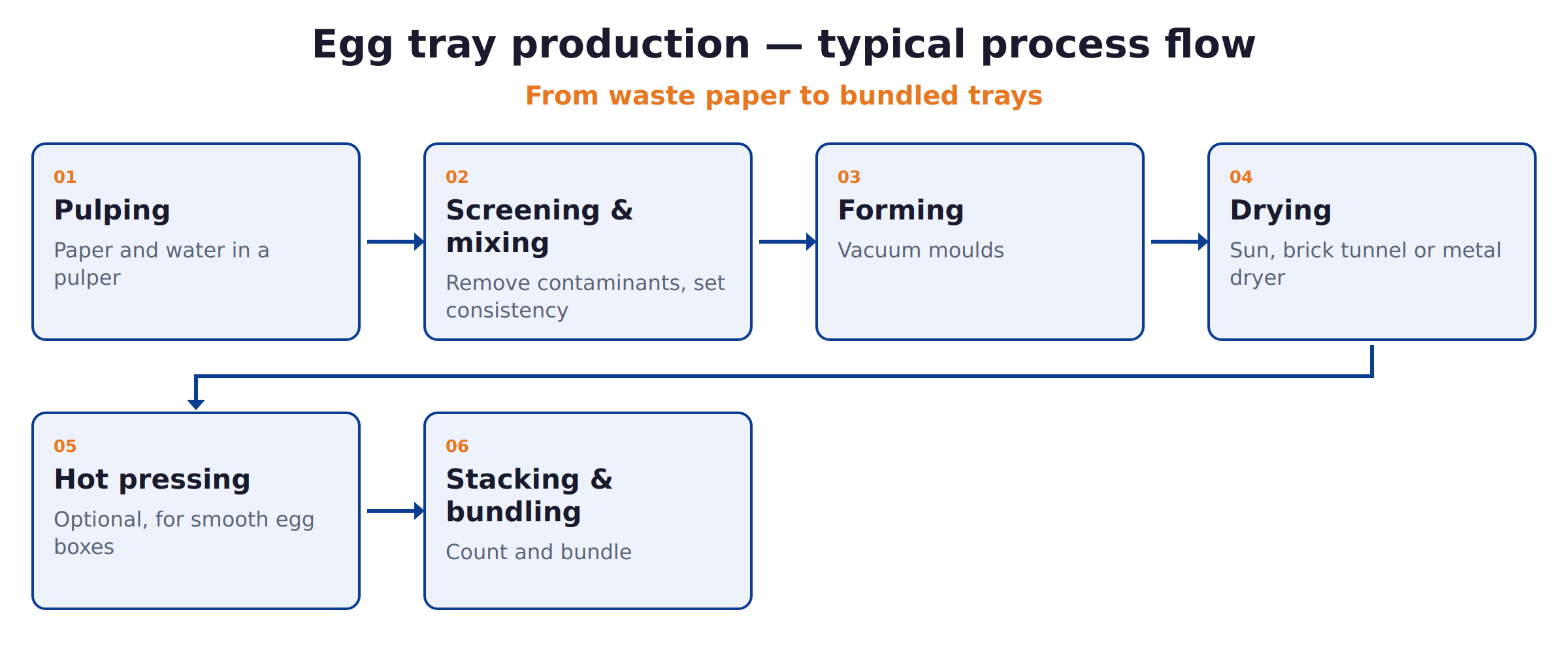
A pulp moulding plant pulps waste paper with water, forms wet trays on moulds, then dries them. Wet trays hold most of their weight as water, so drying takes far more energy than forming. Small plants often sun-dry, which depends on weather and space; larger plants use multi-layer metal dryers or brick tunnel dryers heated by gas, diesel, coal or biomass.
Ask any supplier three things:
- Dry trays per day, not forming cycles, at your local climate.
- Drying method and fuel use per thousand trays.
- Water use and recirculation, because a plant uses and recycles a lot of water.
What to check in the supplier
Moulds
Moulds decide tray shape, weight and stacking. Ask how many moulds are included, for which products (30-egg trays, 6- and 12-egg boxes, fruit trays), and the price of extra moulds.
Pulping and refining
Good pulping removes contamination and gives even trays. Ask about the pulper, screens and how plastic and sand are removed from waste paper.
Forming machine type
Reciprocating machines suit small plants; rotary machines give higher output. Ask for cycles per minute and trays per cycle.
Where to find egg tray machine suppliers
- Paper recycling bodies such as Fibre Circle know waste paper collectors and pulp users.
- Poultry and agricultural shows bring egg producers and packaging suppliers together; check dates with organisers.
- Working plants: visit a tray plant using a drying method like the one you plan.
- China: most pulp moulding machines sold in Africa are made in China. Our supplier audit checklist covers what to check.
We name no egg tray machine suppliers on this page.
How to choose: a 10-point checklist
- Products listed: egg trays, egg boxes, fruit trays.
- Dry trays per day, demonstrated at handover.
- Pulping system for your waste paper.
- Forming machine: reciprocating or rotary, moulds.
- Drying: sun, metal multi-layer or brick tunnel, fuel.
- Water system and recirculation.
- Hot pressing if you make smooth egg boxes.
- Bundling and baling of finished trays.
- Installation, commissioning and training.
- Support for moulds, vacuum pumps and burners.
Planning the business first? Read how to start an egg tray business in South Africa.
Ten questions to ask
- How many dry trays per day does the plant give in my climate?
- What drying method and fuel does it use, and how much fuel per 1,000 trays?
- How many moulds are included, and for which products?
- What waste paper grades does the pulper handle?
- How much water does the plant use and recycle?
- What vacuum pump and compressor does the forming machine need?
- What power does the whole plant draw?
- Is installation, commissioning and training included?
- How quickly can I get moulds and pump parts?
- Which tray plant runs this equipment, and could I see it?
Comparing egg tray plant quotes
| Section | What each quote should state |
|---|---|
| Pulping | Pulper, screens, refiner, tanks |
| Forming | Machine type, cycles per minute, moulds |
| Vacuum and air | Vacuum pumps, compressor |
| Drying | Method, layers or tunnel length, burner, fuel |
| Finishing | Hot press, stacker, baler |
| Water | Tanks, recirculation |
| Installation and training | Engineer days, trials |
| Owner's scope | Building, drying yard, power, water |
Only compare prices on identical scopes; the same-scope comparison shows how to get there.
Choose by situation
| Your situation | Usual route |
|---|---|
| Layer farm making trays for its own eggs | Small forming machine with pulping, sun drying plus a backup dryer |
| Supplying several egg packers | Complete plant with a metal multi-layer dryer for year-round output |
| Recycler with steady waste paper | Rotary forming machine and tunnel dryer, sized to the paper you collect |
| Fruit trays or egg boxes for retail | Extra moulds and hot pressing for a smooth finish |
| Uncertain demand | Start with one product and confirm monthly orders before adding moulds |
Common mistakes
- Quoting forming output as dry output.
- No dryer for winter or rain. Sun drying stops.
- Ignoring fuel cost per tray.
- Too few moulds for the product range.
- No waste paper contract. Raw material cost swings.
Egg tray machine prices in 2026
Indicative, in USD, from our toilet paper and egg tray machine price guide:
| Purchase | Capacity | Indicative price (2026) |
|---|---|---|
| Egg tray forming machine | About 1,000–3,000 trays/hour | From about US$8,000 ex-works |
| Small complete plant | Pulping, forming and drying, about 20,000 trays/day | About US$30,000 ex-works |
| Larger plant with drying line | Higher output, metal or brick dryer | Quoted per configuration |
Market, rules and duty in South Africa
- Egg packing rules. Eggs sold for consumption are graded, packed and marked under R.345 of 2020, and packers need trays and boxes that suit their graders.
- Waste paper. Paper packaging falls under the 2020 EPR scheme, and producer responsibility organisations fund collection that supplies recyclers.
- No duty protection for trays. Moulded paper pulp articles (4823.70) carry no general duty, so local trays compete with imports on price.
- Energy costs. Eskom's 2026/27 tariff increase raises the cost of electric drying and pumping; fuel choice for the dryer matters.
- Duty-free machinery. Machines for moulding paper pulp (8441.40) and pulp-making machinery (8439.10) carry no general duty. The 15% import VAT is reclaimable by VAT vendors; see the import duty guide.
Where CISH fits
CISH is a turnkey pulp moulding company. We specify pulping, forming and drying from audited factories in China against your products, waste paper and climate, ship and clear them, and install and commission the plant with dry trays per day demonstrated, and your operators trained. For a single small forming machine, a local dealer is often the better choice.
Frequently asked questions
Who sells egg tray machines in South Africa?
Dealers of imported pulp moulding machines, Chinese factories selling direct, used machine traders, and turnkey companies that supply complete egg tray plants.
How much is an egg tray machine?
As an indication for 2026, a forming machine for 1,000–3,000 trays an hour starts at about US$8,000, and a small complete plant for about 20,000 trays a day costs about US$30,000 ex-works.
What raw material do egg tray machines use?
Waste paper, such as old newspapers, cartons and office paper, pulped with water.
Do I need a dryer?
Small plants can sun-dry in good weather, but output stops in rain and winter. Most commercial plants use metal or brick dryers.
Is egg tray machinery duty-free?
Machines for moulding paper pulp (8441.40) carry no general duty in SARS's 2026 tariff. Import VAT of 15% applies.
Does CISH sell single forming machines?
No. We supply complete pulp moulding plants, installed and commissioned. For a single small machine, a local dealer is usually the better route.