The process is simple: waste paper is pulped with water, the pulp is formed on moulds under vacuum, and the wet trays are dried in the sun or in a dryer, then stacked and bundled. Buyers are egg farms, egg packers, wholesalers and retailers; South Africa's commercial layer farms use large numbers of trays every day, and many prefer a reliable local supplier to long-distance deliveries. Drying is the biggest running cost and the biggest decision: sun drying is cheap but depends on weather and space; brick tunnel or multi-layer metal dryers need fuel such as gas, diesel, coal or biomass.
Step 1: understand the market
Egg farms pack eggs in trays of 30, and egg packers and retailers use trays and boxes of 6, 12 and 18. Trays are bulky and cheap per piece, so transport is expensive relative to value; a plant close to its customers has an advantage. Talk to layer farms and packers in your area: how many trays they use a week, what they pay, who supplies them, and what they dislike about their supply. Some reuse trays; others need new ones for each delivery. Egg grading and packing rules (R.345 of 2020 under the APS Act) set how eggs are packed and marked, and buyers want clean, dry, strong trays.
Step 2: secure waste paper
Egg trays are made from waste paper and cardboard: newspapers, office paper, cardboard boxes and mixed paper. Collect from offices, shops, schools and recyclers, or buy bales from waste paper dealers. Paper packaging falls under the extended producer responsibility (EPR) scheme in GN R.1187 of 2020, and producer responsibility organisations such as Fibre Circle support collection and know the collectors. Keep paper dry and sorted, and remove plastic, tape and metal before pulping.
Step 3: how egg trays are made
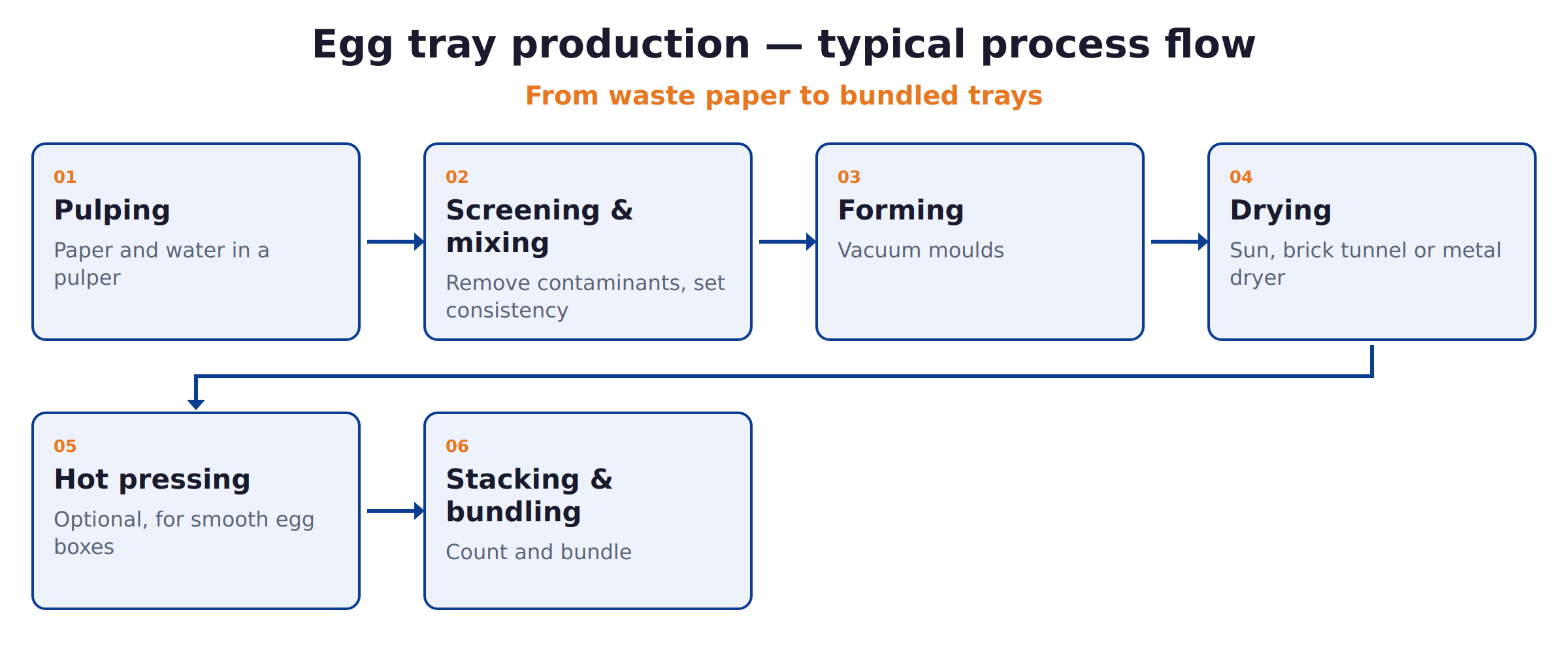
- Pulping: paper and water are mixed in a pulper into a smooth pulp.
- Screening and mixing: contaminants are removed and the pulp is diluted to the right consistency.
- Forming: moulds dip into the pulp, vacuum draws pulp onto them, and the trays are transferred off.
- Drying: wet trays are dried in the sun, in a brick tunnel dryer or a multi-layer metal dryer.
- Hot pressing (optional): for smooth egg boxes and better finish.
- Stacking and bundling: trays are counted, stacked and bundled for delivery.
Step 4: drying choices
| Drying method | Cost | Notes |
|---|---|---|
| Sun drying | Lowest | Needs large space and good weather; slow in winter and rainy seasons |
| Brick tunnel dryer | Medium | Built on site; fuel such as coal, wood, gas or biomass |
| Multi-layer metal dryer | Higher | Compact, faster, consistent; gas, diesel or biomass |
Drying uses most of the energy in the plant. Choose fuel by local price and availability, and recover heat where you can.
Step 5: equipment and costs
| What you buy | Capacity | Indicative price (2026) |
|---|---|---|
| Egg tray forming machine | About 1,000–3,000 pieces an hour | From about US$8,000 |
| Small complete plant with pulping and drying | About 20,000 trays a day | About US$30,000 |
| Automatic line with metal dryer | Higher outputs | Quoted per configuration |
Ask how many moulds are included, for which products, and the price of extra moulds. Our egg tray machine price guide shows the bands, and our guide to egg tray machine suppliers lists what to check in a quote.
Step 6: the site and utilities
You need a covered building for pulping and forming, a dryer or drying yard, dry storage for waste paper and finished trays, water supply and recycling of process water, three-phase power for pumps and vacuum, and truck access. Eskom's standard tariff rose 8.76% for 2026/27, so size motors and pumps sensibly. Recycle water from forming back to the pulper to save water.
Step 7: selling
Your main customers are layer farms and egg packers. Offer steady supply, delivery on a fixed schedule, consistent quality and fair prices. Some plants also sell egg boxes to packers and retailers, fruit trays to packhouses and seedling trays to nurseries. Agree prices and volumes in supply contracts where possible.
The numbers
Cost per tray is waste paper (a small share), drying fuel (often the largest), electricity, labour, moulds, water, transport and finance. Revenue is trays sold times price per tray. Because trays are cheap per piece, volume, low drying cost and short delivery distances matter most.
Worked example: an egg tray plant near layer farms
An entrepreneur in Gauteng's West Rand sees several layer farms within an hour's drive buying trays from far away. He sets up a plant with a 2,500 pieces an hour forming machine, a pulper and a brick tunnel dryer fired with biomass, collects cardboard from shops and offices, and agrees weekly deliveries with three farms. Later he adds a hot press and egg box moulds for a packer. The figures are illustrative.
Quality and consistency
Trays must be strong enough to stack loaded with eggs, dry so they do not go mouldy, and consistent in size so eggs sit securely. Check weight and moisture of trays daily, control pulp consistency, and maintain moulds and vacuum. Damp trays in storage grow mould and are rejected.
Common mistakes
- Sun drying only without enough space or a winter plan.
- No waste paper supply agreement.
- Plants far from egg farms.
- Damp storage that ruins trays.
- Too few moulds for the products buyers want.
Moulds and product range
Each product needs its own moulds: 30-egg trays, 6- and 12-egg boxes, fruit trays for packhouses, seedling trays and industrial packaging such as bottle trays. Moulds are usually aluminium with stainless mesh, and a set fits one forming machine. Adding products is often just a matter of new moulds, so ask your supplier for prices of extra moulds before you buy. Smooth egg boxes for retail packers need hot pressing after drying, which adds a machine and energy but earns a better price.
Labour and shifts
A small plant needs operators for pulping, forming, drying and stacking, plus someone collecting paper and delivering trays. Automatic lines with metal dryers need fewer people but more skilled maintenance. Running two shifts spreads the fixed costs of the dryer and building over more trays. Train at least two people on every key job, so that one absence does not stop the line, and keep a simple daily log of output, rejects and fuel used.
Where CISH fits
We supply complete egg tray and pulp moulding plants, pulping, forming, drying, hot pressing and stacking, from audited factories in China, sized to your trays a day and drying fuel. CISH ships, clears, installs and commissions the plant on your waste paper, and trains your team. For a single small forming machine, a local supplier is usually the better buy.
Frequently asked questions
How are egg trays made?
Waste paper is pulped with water, formed on moulds under vacuum, then dried and stacked.
How much does an egg tray machine cost?
As an indication for 2026, forming machines start at about US$8,000, and a small complete plant making about 20,000 trays a day costs about US$30,000.
What raw material is used for egg trays?
Waste paper and cardboard.
Who buys egg trays?
Layer farms, egg packers, wholesalers and retailers.
What is the biggest running cost?
Drying, unless you can sun-dry reliably.
Does CISH supply egg tray plants?
Yes, complete plants with commissioning and training.