In South Africa, growers distil rose geranium, tea tree, lippia, helichrysum and other crops, and the industry association SAEOPA has chambers for several of them. Essential oils themselves enter South Africa duty-free, so local producers compete on quality and traceability, not protection.
Distillation equipment prices in 2026
| Purchase | Size | What is included | Indicative price (2026) |
|---|---|---|---|
| Farm steam still | About 100–1,000 L | Still body, steam inlet or heating, condenser, oil separator (Florentine flask) | About US$3,000–25,000 ex-works |
| Multi-still plant | Several stills of 2–6 m³ | Stills, steam boiler, condensers, separators, cooling water, crane or bin handling | Quoted per configuration |
| Short-path molecular distillation (refining) | Lab to small production | Vacuum system, evaporator, condenser, controls | About US$20,000–80,000 ex-works |
Ex-works prices from factory listings, not quotes. Freight, installation, a boiler house, water, a building or shed, a laboratory and working capital come on top. In most projects we see, equipment is about 35–55% of the total.
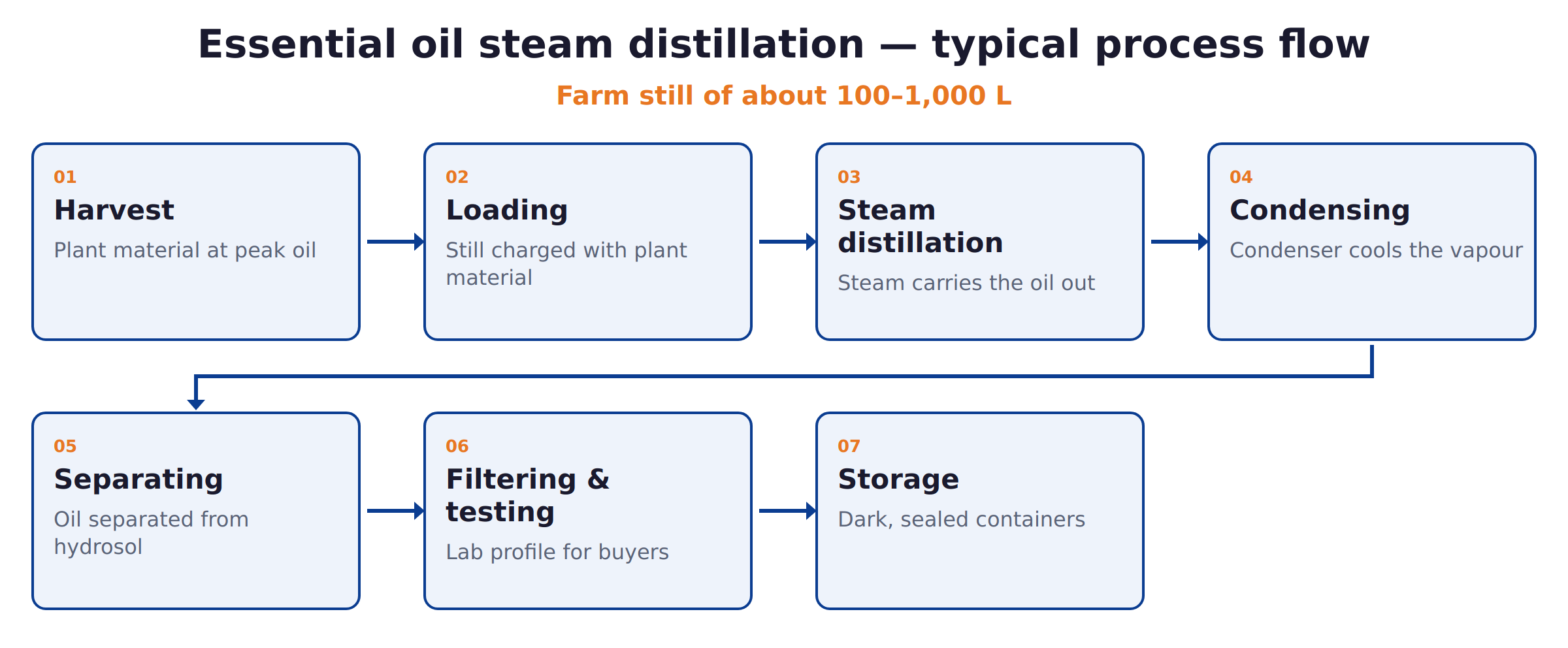
How steam distillation works
Plant material, fresh or partly dried, is loaded into the still. Steam passes up through it and carries the volatile oil out of the plant cells. The steam and oil vapour go to a condenser, where cold water turns them back into liquid. In the separator the oil, which does not mix with water, floats (or for some oils sinks) and is drawn off; the water, called hydrosol or floral water, can be sold too. Spent plant material is unloaded and composted or used as fuel.
What drives the price
| Factor | Effect |
|---|---|
| Still volume | Plant material per batch |
| Number of stills | Continuous work: one loads while another distils |
| Steam source | Built-in heating for small stills; a separate boiler for larger plants |
| Material | Stainless steel grades for food and cosmetic oils |
| Condenser size | Must match steam rate, or oil is lost |
| Loading and unloading | Baskets, hoists or tipping stills save labour |
| Controls | Temperature and pressure monitoring |
Yield: why the still is sized by the crop
Essential oil yields are small, often well under 1% of plant mass, and vary with the plant, the variety, harvest time, weather and how the material is handled before distillation. That means a still processes large volumes of plant material for a small volume of oil. Size the plant from your harvest:
- Tonnes of plant material per harvest day.
- Batch time for your crop, including loading and unloading.
- Batches per day per still.
- Number and size of stills to keep up with harvest.
Test distil your crop before you buy, ideally at a working distillery, so the yield and batch time in your plan are your own.
South African crops and the industry
South Africa's essential oil sector combines cultivated crops and indigenous plants. SAEOPA, the South African Essential Oil Producers' Association, has chambers for geranium, helichrysum, lippia, tea tree, marula, moringa and other products, and provides information on cultivation, quality control, HS codes and permits for indigenous plants. Growers in the Western Cape, Limpopo, Mpumalanga and KwaZulu-Natal distil different crops depending on climate. Indigenous plants bring extra rules: wild harvesting, export and commercial use of indigenous biological resources can need permits and benefit-sharing arrangements, which SAEOPA's resources cover.
Choosing by scenario
- New grower testing a crop: a small still to establish yield, quality and buyers before planting at scale.
- Established grower adding value: two or more stills with a boiler sized for harvest peaks, so oil is distilled within hours of cutting.
- Co-operative or service distillery: several stills that can process members' crops in turn, with good records of each batch.
Landed cost: what else to budget
| Item | Notes |
|---|---|
| Steam boiler | For multi-still plants; often the largest single item after stills |
| Boiler house and fuel | Wood, biomass, gas or diesel; spent plant material can be fuel |
| Cooling water | Condensers need a steady supply; a cooling tower or dam |
| Shed and concrete slab | Loading area, drainage |
| Handling | Trailers, bins, hoists |
| Laboratory testing | GC-MS profiles for buyers |
| Storage | Stainless or amber containers, cool and dark |
Distilling plant (8419.40) carries no general import duty; 15% import VAT applies.
How to compare quotes and choose a supplier
- Still volume and recommended plant load per batch.
- Steam source and boiler capacity in kg of steam per hour.
- Condenser and separator sizes, and whether they suit oils lighter or heavier than water.
- Material grade of all parts in contact with oil and steam.
- Loading method and labour per batch.
- Pressure equipment documents for boilers and vessels.
- Installation, commissioning on your crop, and training.
- Spares: gaskets, valves, gauges.
- References from distilleries running similar crops.
- Delivery time relative to your harvest.
Rules, duty and selling in South Africa
- Boilers and pressure vessels fall under pressure equipment rules made under the OHS Act; they need correct design documentation, installation and inspection.
- Duty on oils. Essential oils such as geranium oil (3301.29.10) carry no general duty, so imported oils compete freely.
- Duty on hydrosols. Aqueous distillates (3301.90.10) carry 20% general duty, with exemptions for the EU and UK, EFTA and SADC.
- Quality. Buyers in cosmetics, aromatherapy and flavours ask for test reports, batch traceability and, often, organic or other certification.
- Power. Pumps, cooling and controls need electricity; Eskom's standard tariffs rose 8.76% for 2026/27.
Worked example: from trial still to a harvest plant
A farm growing rose geranium on a few hectares might start with a single 500-litre steam still to test yield, oil quality and buyers. Each batch takes several hours, including loading, distilling and unloading, so one still can handle only a few batches a day. When the farm expands its planting, harvest days bring far more cut material than one still can process before it starts to lose oil and quality.
The next step is a small plant: two or three larger stills fed from one steam boiler, so that one still is loading while another distils, a condenser and separator for each, a cooling water dam or tower, and a hoist to lift baskets of plant material in and out. Spent material goes back to the fields as mulch or fuels the boiler. The farm also adds a laboratory test for every batch, because buyers of geranium oil compare the chemical profile before they agree a price. The equipment cost rises, but so does the share of the harvest turned into saleable oil.
Common mistakes
- Buying a still before testing the crop.
- Undersized condenser. Oil leaves with the steam.
- One still for a large harvest. Material waits and loses oil.
- No boiler documentation.
- Selling without a test report.
Where CISH fits
We supply complete distillation plants, stills, boiler, condensers, separators and handling, from audited factories in China, sized to your crop and harvest days. CISH ships and clears the plant, installs and commissions it on your plant material, and trains your team. For one small trial still, a local dealer or a direct purchase is usually enough.
Planning the whole business? See how to start an essential oil business in South Africa, from crop trials to buyers.
Frequently asked questions
How much does essential oil distillation equipment cost?
As an indication for 2026, a farm steam still of about 100–1,000 litres costs about US$3,000–25,000 ex-works. Multi-still plants with a boiler are quoted per configuration.
How much essential oil do you get from a tonne of plants?
Yields are small, often well under 1% of plant mass, and vary by plant and handling. Test distil your own crop.
Is steam distillation better than other methods?
It is the standard method for most herb and leaf oils. Citrus peel oils are often cold-pressed, and some delicate flowers use solvent extraction.
Is there import duty on essential oils in South Africa?
Most essential oils, including geranium oil, carry no general duty. Hydrosols carry 20% general duty, with exemptions for the EU and UK, EFTA and SADC.
Do I need permits to distil indigenous plants?
Wild harvesting and commercial use of indigenous plants can need permits and benefit-sharing arrangements. SAEOPA provides guidance.
Does CISH supply small trial stills?
We supply complete distillation plants. For a single trial still, a direct purchase or local dealer is usually enough.