Cosmetic manufacturing equipment in South Africa is sold by dealers of imported mixers and fillers, local stainless fabricators, Chinese factories that make vacuum emulsifying mixers, liquid mixing tanks and filling machines, and turnkey companies that set up a complete cream and lotion line. CISH supplies, installs and commissions complete cosmetics lines; for a single small mixer, a local dealer is the better buy.
Who sells cosmetic equipment
Skincare and haircare brands, contract manufacturers, pharmacies with own-label ranges and entrepreneurs moving from kitchen batches look for equipment. Four supplier types answer.
| Supplier type | What they sell | Price | Who answers for output | Best fit |
|---|---|---|---|---|
| Dealer of imported mixers and fillers | Small mixers, homogenisers, piston fillers | Moderate | The dealer, per machine | Small brands adding a machine |
| Local stainless fabricator | Mixing tanks, platforms, holding vessels | Low to moderate | The fabricator, for its items | Liquid products such as shampoo |
| Chinese factory, direct | Vacuum emulsifying mixers, liquid mixers, tube, jar and bottle fillers | Lowest on the quote | You, after delivery | Buyers with formulation and process skills |
| Turnkey cosmetics line company | Water treatment to labelled packs, commissioned | Between direct and dealer | The turnkey company, at agreed batches and packs per hour | Brands building a first factory |
Creams need a vacuum emulsifying mixer
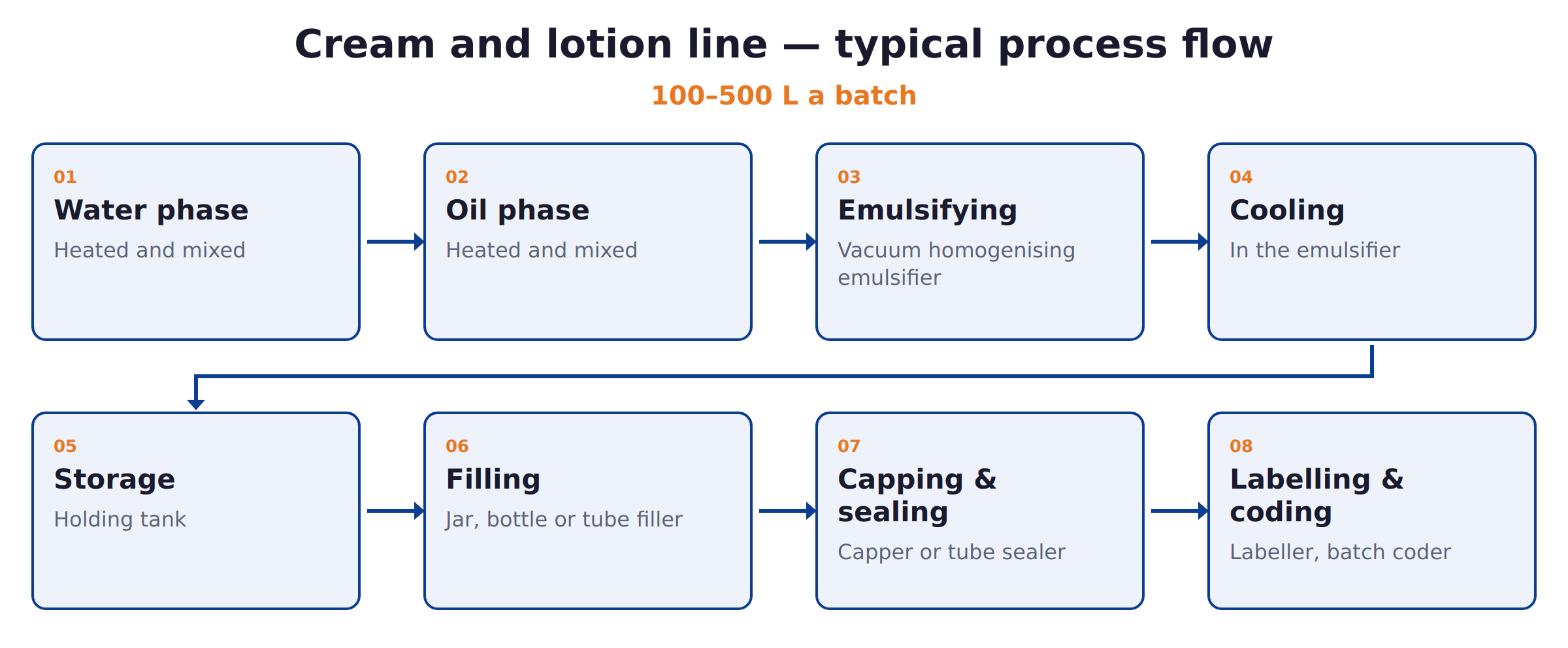
Creams and lotions are emulsions of oil and water. They need heating of both phases, high-shear homogenising, mixing under vacuum to remove air, and controlled cooling. Shampoos, shower gels and liquid soaps need simpler mixing tanks. Buying a liquid mixing tank for creams gives air bubbles and separation.
Ask any supplier three things:
- Which products: creams, lotions, gels, ointments, shampoos, with batch sizes and viscosities.
- What homogeniser speed and vacuum level the mixer reaches, and how phases are heated and cooled.
- Which packs you fill: jars, tubes, bottles or sachets, and at what accuracy.
What to check in the supplier
Hygienic design
Product-contact parts should be suitable stainless steel with a polished finish, easy to clean, with no dead spots. Ask about cleaning in place and how water is treated, because water is the main ingredient in most creams.
Batch control
Cosmetics brands need batch records: temperatures, times, weights and test results. Ask whether the mixer records these.
Filling
Thick creams need piston fillers; tubes need tube fillers and sealers. Ask for fill accuracy and changeover time between packs.
Where to find cosmetic equipment suppliers
- Cosmetic ingredient distributors know which equipment their customers use.
- Cosmetics and pharmaceutical trade shows feature mixers and fillers; confirm the dates with organisers.
- Contract manufacturers: visit one making products like yours before you invest.
- China: most vacuum emulsifying mixers sold in Africa are made in China. Our supplier audit checklist covers the checks before paying.
We do not name cosmetic equipment suppliers on this page.
How to choose: a 10-point checklist
- Products and batch sizes defined.
- Batch quality, demonstrated at handover on your formula.
- Mixer type: vacuum emulsifier for creams, tanks for liquids.
- Phase heating and cooling with control.
- Water treatment to cosmetic-grade quality.
- Filling for each pack type, with accuracy.
- Capping, sealing, labelling and coding.
- Batch records and a small lab.
- Installation, commissioning on your formula, and training.
- Support for seals, homogeniser heads and filler parts.
For what must be on the pack, see cosmetic and detergent labelling regulations.
New to cosmetics? Read how to start a cosmetic manufacturing business, from own brand to contract making.
Ten questions to ask
- What batch sizes and viscosities can the mixer handle?
- What homogeniser speed and vacuum level does it reach?
- How are oil and water phases heated and cooled?
- What water treatment is included?
- Which fillers suit my jars, tubes and bottles, and how accurate are they?
- Does the mixer record batch data?
- How is the line cleaned between products?
- Is installation, commissioning and training included?
- How quickly can I get seals and homogeniser parts?
- Which cosmetics maker runs this equipment, and could I visit?
Comparing cosmetics line quotes
| Section | What each quote should state |
|---|---|
| Water treatment | Filtration, RO or deionisation, UV |
| Phase preparation | Oil and water phase pots, heating |
| Emulsifying | Vacuum mixer, homogeniser, capacity |
| Liquid mixing | Tanks for shampoo and gels |
| Filling | Piston, tube or bottle fillers, accuracy |
| Closing and labelling | Cappers, sealers, labellers, coders |
| Cleaning | CIP or cleaning procedure |
| Installation and training | Engineer days, formula trials |
| Owner's scope | Building, clean rooms, lab, registration |
Put every quote on the same scope, then compare; our same-scope comparison has the method.
Choose by situation
| Your situation | Usual route |
|---|---|
| Testing formulas and small batches | Small emulsifier or lab homogeniser from a local dealer, or a contract manufacturer |
| Own-label creams for pharmacies | 100–200 litre vacuum emulsifier with piston and jar filling |
| Shampoo and shower gel brand | Liquid mixing tanks with bottle filling and capping |
| Contract manufacturer | Several mixers in different sizes, tube and bottle lines, and a lab |
Common mistakes
- Mixing creams in a liquid tank. Air and separation follow.
- Untreated water. Microbial contamination spoils products.
- No batch records. Problems cannot be traced.
- Labels without a full ingredient list.
- Claims that break the advertising code.
Cosmetic equipment prices in 2026
Indicative listed prices, in USD:
| Purchase | Capacity | Indicative price (2026) |
|---|---|---|
| Vacuum homogenising emulsifying mixer | 100–500 litres a batch | About US$5,000–52,000 ex-works, by size and specification |
| Liquid mixing and filling set | Batch tanks of a few hundred litres, small filler | About US$20,000–60,000 |
| Complete cream and lotion line | Water treatment, mixing, filling, labelling | Quoted per configuration |
The liquid set figure comes from our soap and detergent line cost guide. Mixer prices are listings collected in November 2026, not quotes.
Rules and duty for cosmetics in South Africa
- The governing Act. Cosmetics fall under the Foodstuffs, Cosmetics and Disinfectants Act 54 of 1972, administered by the Department of Health.
- Labelling and composition. Draft regulations on the labelling, advertising and composition of cosmetics were published for comment in 2016; check their current status before you print labels.
- Ingredient labelling. SANS 98 sets out ingredient labelling for cosmetic products.
- Advertising claims. The Advertising Regulatory Board's cosmetic code governs claims such as "anti-ageing" or "whitening".
- Worker safety. Mixers, homogenisers and heated vessels are covered by the OHS Act.
- Duty-free equipment. Mixing and emulsifying machines (8479.82) and filling machines (8422.30) carry no general duty. VAT vendors reclaim the 15% import VAT; read the import duty guide.
Where CISH fits
CISH is a turnkey cosmetics line company. We specify water treatment, emulsifying, mixing, filling and labelling equipment from audited factories in China against your products and packs, ship and clear them, and install and commission the line with batch quality and fill accuracy demonstrated on your formulas, and your team trained. For a single small mixer, a local dealer is often the better choice.
Frequently asked questions
Who sells cosmetic manufacturing equipment in South Africa?
Dealers of imported mixers and fillers, local stainless fabricators, Chinese factories selling direct, and turnkey companies that supply complete cream and lotion lines.
How much is a vacuum emulsifying mixer?
Listed prices in 2026 for 100–500 litre mixers run from about US$5,000 to US$52,000, depending on size, vacuum, homogeniser and heating.
Which law covers cosmetics in South Africa?
The Foodstuffs, Cosmetics and Disinfectants Act 54 of 1972. Ingredient labelling follows SANS 98, and claims follow the advertising code.
Can I make shampoo and cream on the same equipment?
Shampoo and gels need mixing tanks; creams need a vacuum emulsifier. Fillers can sometimes be shared with change parts.
Is cosmetic machinery duty-free?
Mixing and emulsifying machines and filling machines carry no general duty in SARS's 2026 tariff. Import VAT of 15% applies.
Does CISH sell single small mixers?
No. We supply complete cosmetics lines, installed and commissioned. For a single small mixer, a local dealer is usually the better route.