South African growers distil rose geranium, tea tree, lippia, helichrysum, eucalyptus, lavender, rosemary and other crops, and the South African Essential Oil Producers' Association (SAEOPA) supports producers with information on cultivation, quality and permits. Buyers pay for consistent quality and proof: laboratory test reports showing the oil's chemical profile, batch traceability and often organic or other certification. Indigenous plants bring extra rules: wild harvesting, export and commercial use can need permits and benefit-sharing arrangements.
Step 1: choose your crop
Pick a crop that grows well in your climate and soil, that buyers want, and that you can harvest and distil efficiently. Consider:
- Market demand: who buys this oil, in what volumes, and at what price?
- Yield: oil per tonne of plant material, which varies by crop, variety, season and handling.
- Harvests: how many cuts a year and how long each harvest lasts.
- Water and inputs: irrigation, fertilizer, labour for weeding and harvesting.
- Competition: world prices for oils grown at scale elsewhere may be low.
Many new growers start with one crop that has an established market and add others later.
Step 2: test before you plant at scale
Yields and oil quality vary so much by crop, variety and handling that the only reliable numbers are your own. Plant a trial plot, distil test batches, ideally at a working distillery or with a small still, and send samples to a laboratory for a chemical profile. Show the results to potential buyers before you commit to hectares and a large still. SAEOPA and experienced growers can help you plan trials.
Step 3: how steam distillation works
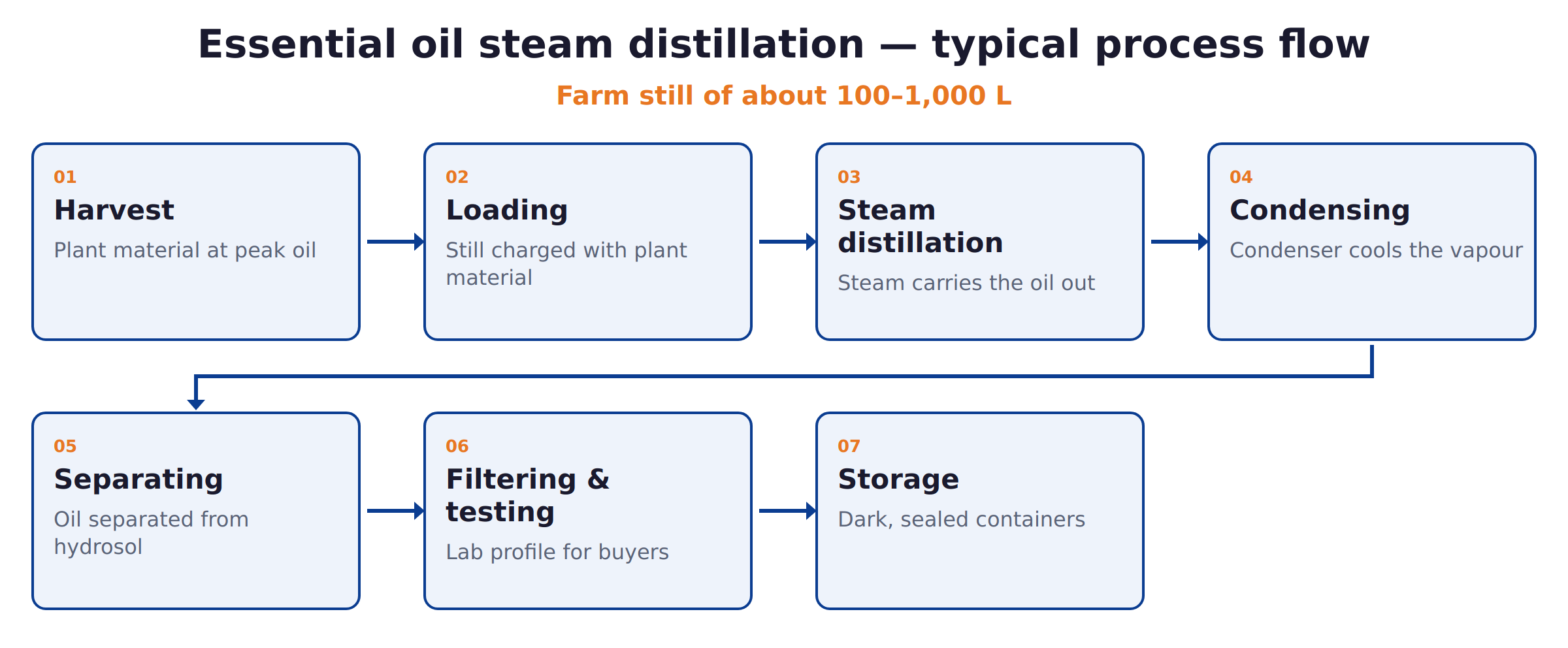
Plant material is packed into a still. Steam passes through it, carrying the volatile oil out of the plant. The steam and oil vapour are cooled in a condenser, and the oil separates from the water in a separator (often called a Florentine flask). The water, called hydrosol, can be sold for some crops. Distillation time and steam rate affect yield and quality, and different crops need different times.
Step 4: equipment and costs
| What you buy | Size | Indicative price (2026) |
|---|---|---|
| Farm steam still, single | About 100–1,000 L | About US$3,000–25,000 ex-works |
| Multi-still plant with boiler | 2–6 m³ stills | Quoted per configuration |
| Steam boiler | For multi-still plants | Often the largest item after stills |
| Separator, condenser, cooling | With each still | Usually in the still price; check |
Two or more stills let one be loaded while another distils, which keeps the boiler busy. Add a shed and concrete slab, a boiler house, cooling water from a dam or cooling tower, fuel storage and a small laboratory. Spent plant material can often fuel the boiler. Our distillation equipment price guide explains what drives the price.
Step 5: quality, testing and storage
Buyers compare the oil's chemical profile against standards for that oil before agreeing a price. Test every batch at a laboratory, record harvest dates, field, distillation time and yield, and keep retention samples. Store oil in clean stainless steel, aluminium or amber glass containers, full, cool and dark, to slow oxidation. Filter and dry oil to remove water. Label containers with the oil name, botanical name, batch and date.
Step 6: permits and rules
- Indigenous plants: wild harvesting, export and commercial use of indigenous biological resources can need permits and benefit-sharing arrangements. Check before you harvest or sell.
- Exports: buyers and destination countries may require certificates of analysis, safety data sheets and labelling to their rules.
- Cosmetics: if you make finished cosmetic products from your oil, cosmetic labelling and composition rules apply.
- Safety: boilers and pressure equipment fall under the OHS Act and its regulations, and need inspection and trained operators.
Step 7: buyers
- Local: cosmetic and soap makers, aromatherapists, spas, natural product brands.
- Export: fragrance and flavour houses, traders and brokers in Europe, North America and Asia.
- Value-add: your own branded oils, blends, soaps and creams.
Exports usually go through traders who consolidate oils from several growers. They want samples, test reports, steady supply and sometimes organic certification. Building relationships takes time, so start before your first large harvest.
The numbers
Revenue is oil yield per hectare times price per kilogram, plus any hydrosol sales. Costs include planting, irrigation, fertilizer, harvest labour, fuel for the boiler, electricity for pumps and fans, testing, packaging, transport, certification and finance. Electricity costs rose with Eskom's 2026/27 increase, so plan fuel and power carefully. Because yields are small, a few percentage points of yield or a small change in price make a big difference.
Worked example: rose geranium in the Eastern Cape
A farmer with irrigated land starts with a few hectares of rose geranium and a single 500 litre still to test yield, quality and buyers. After a season of laboratory results and a trader's offer, she plants more hectares and adds two larger stills and a wood-fired boiler that burns spent plant material. A laboratory tests every batch, because buyers of geranium oil compare the chemical profile before they agree a price. The figures are illustrative.
Harvest planning
The best oil comes from plants harvested at the right stage and distilled soon after cutting. Plan harvest and distillation together: cut only what the stills can process that day, avoid leaving material in heaps where it heats and loses oil, and train harvest teams. More stills or longer shifts in harvest season may be cheaper than one very large still.
Common mistakes
- Planting at scale before testing yield and finding buyers.
- One still too small for the harvest.
- No laboratory testing of each batch.
- Poor storage that lets oil oxidise.
- Ignoring permits for indigenous plants.
Boilers, fuel and water
A multi-still plant usually runs on a steam boiler fired by wood, biomass, gas or diesel. Spent plant material, dried, is a common fuel and cuts costs. Size the boiler for the number of stills running at once, plus some margin, and place it in its own boiler house. Pressure equipment must be registered, inspected and operated by trained people under the OHS Act and its pressure equipment rules. Condensers need a steady supply of cool water; a farm dam, borehole with a cooling tower, or recirculating system can supply it. Warm water from condensers can be reused to feed the boiler, saving fuel.
Certification for export buyers
Many export buyers ask for organic certification, good agricultural practice records, or both. Certification takes time and costs money, but it can raise prices and open markets. Start keeping records of fields, inputs, harvests and distillation from your first season so that certification is easier later. Some buyers also want sustainability information, such as water use and how indigenous plants are sourced.
Where CISH fits
We supply essential oil distillation plants, stills, condensers, separators, boilers and material handling, in suitable stainless steel grades, from audited factories in China, sized to your crop and harvest. CISH ships, clears, installs and commissions the plant on your plant material, and trains your team. For a single small trial still, a local fabricator is usually the better buy.
Frequently asked questions
How is essential oil made?
Usually by steam distillation: steam carries the oil out of the plant, a condenser cools the vapour, and the oil separates from the water.
How much does a distillation still cost?
As an indication for 2026, a single farm steam still of about 100–1,000 litres costs about US$3,000–25,000 ex-works.
How much oil do plants yield?
Often well under 1% of plant mass, varying by crop and handling; test your own crop.
Who buys essential oils?
Cosmetic and aromatherapy brands locally, and fragrance and flavour houses and traders abroad.
Do I need permits?
For indigenous plants, wild harvesting, export and commercial use can need permits and benefit-sharing arrangements.
Does CISH supply distillation plants?
Yes, complete plants with commissioning and training.