Choose the supplier who commits to tonnes per hour of pellets on your formulation, with steam conditioning, accurate batching and cooling included, and who designs for feed registration under Act 36.
Who builds feed mills
Poultry and pig farmers making their own feed, co-operatives, and commercial feed companies all search for feed mill manufacturers. They meet four kinds of supplier.
| Supplier type | What they sell | Price | Who answers for pellet output and quality | Best fit |
|---|---|---|---|---|
| Local feed-machinery and steelwork company | Hammer mills, mixers, bins, conveyors, small pellet mills; installation and service | Moderate | The company, machine by machine | Farm mills and mash feed |
| Agent of an imported pelleting brand | Pellet mills, conditioners, coolers, automation | Highest | The agent and the brand | Large commercial feed mills |
| Chinese factory, direct | Complete ring-die pellet mills by t/h, with grinding, mixing and cooling | Lowest on the quote | You, after delivery | Buyers with a feed technologist and engineer |
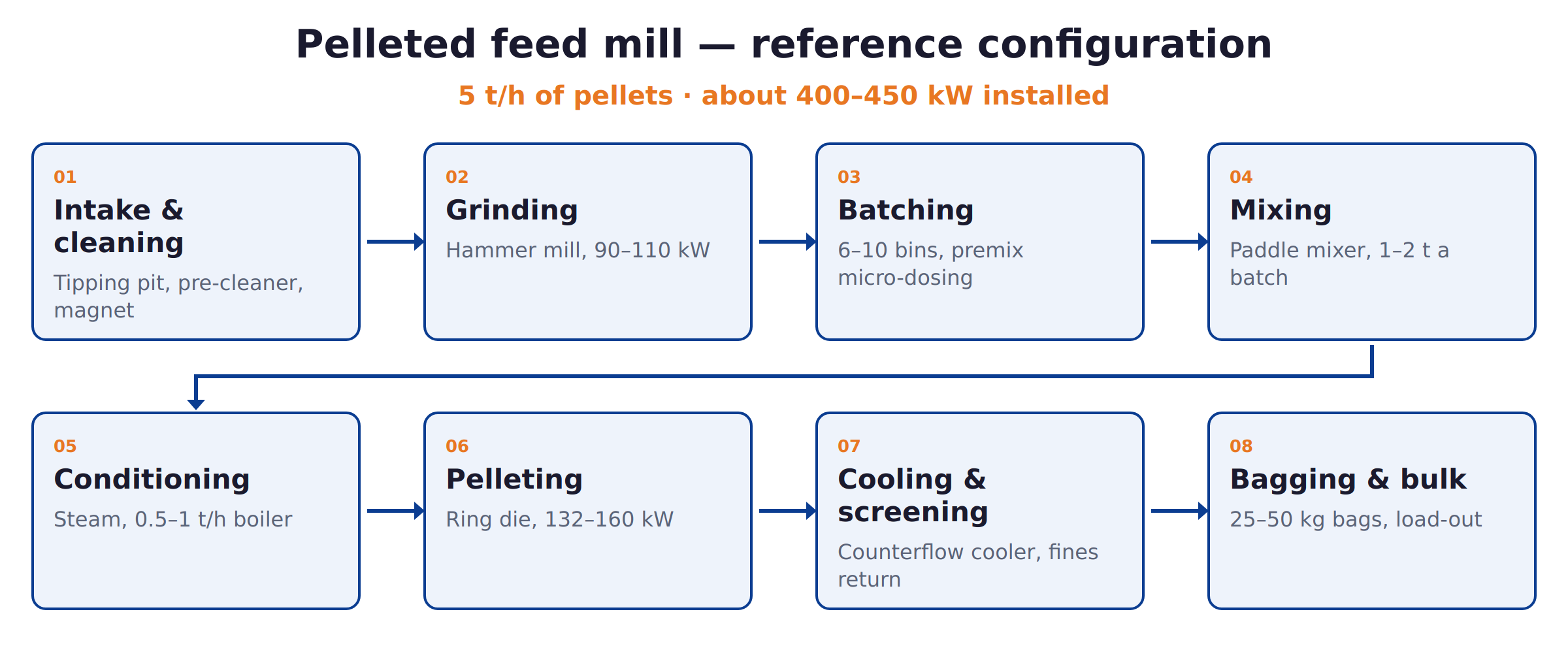
| Turnkey mill company | Intake, grinding, batching, mixing, conditioning, pelleting, cooling, crumbling, screening, bagging, installed and commissioned | Between direct and imported | The turnkey company, at agreed t/h on your formulation | First commercial mills and farms moving from mash to pellets |
Mash, pellets or both?
Many farm feed businesses start with mash: grind, batch and mix. Pellets need steam conditioning, a pellet mill, a cooler and usually a crumbler for young birds. Pelleting improves feed conversion and reduces waste, but it adds a boiler and much higher power. Decide which you need before comparing suppliers; our feed pellet machine price guide compares the scales.
Three tests for a feed mill supplier
Output on your formulation
Pellet mill output depends on the formulation: fibre, fat and the share of maize, soya and minerals. Ask for tonnes per hour of pellets of a stated diameter on your formulation, with pellet durability stated, demonstrated at handover.
Batching accuracy
Feed is a recipe. Ask how macro ingredients, minerals and premixes are weighed, with what accuracy, and how batches are recorded. Accurate micro-dosing protects animals and margins.
Steam and conditioning
Pellet quality depends on conditioning. A supplier who leaves out the boiler or sizes the conditioner too small has quoted a pellet mill, not a feed mill.
Where to find feed mill suppliers
- AFMA, the Animal Feed Manufacturers Association, is the representative body of South Africa's formal feed industry, with full, associate and affiliate members. Associate members include suppliers to the industry.
- The milling industry's events. The IAOM Middle East and Africa conference and expo runs at the CTICC in Cape Town on 23–26 November 2026, with the National Chamber of Milling as local host; feed and milling equipment suppliers exhibit.
- Other feed producers: visit a mill making similar feed, and ask about pellet durability, die life and power use.
- China: many small and mid-sized feed mills sold in Africa are built in China; use our supplier audit checklist first.
This page does not name or rate suppliers.
How to choose: a 10-point checklist
- Species and feed types: broiler, layer, pig, cattle, and mash, pellet or crumble.
- Output in tonnes per hour of pellets on your formulation.
- Grinding: hammer mill capacity and screen sizes matched to the pellet mill.
- Batching and mixing: scales, accuracy, mixer cycle time, premix dosing.
- Conditioning: boiler, conditioner size and retention time.
- Pelleting: ring or flat die, die sizes, motor power.
- Cooling, crumbling and screening included.
- Packing or bulk loading: bag sizes or bulk bins.
- Dust control and safety: aspiration and explosion protection.
- Installation, commissioning, training and support for dies, rollers and hammers.
Before you compare builders, fix the tonnes: our guide to choosing feed mill capacity shows the arithmetic.
Ten questions to ask
- What output in tonnes per hour of pellets will you guarantee on my formulation?
- What pellet durability will the mill achieve?
- How accurate is batching, and how are premixes dosed?
- Is the boiler included, and what fuel does it use?
- What is the connected electrical load?
- How long do dies and rollers last, and what do replacements cost?
- Is cooling, crumbling and screening included?
- Is installation, commissioning and training included?
- What does the warranty cover?
- Which feed mill in South Africa runs this equipment, and may I visit?
Comparing feed mill quotes
| Section | What each quote should state |
|---|---|
| Intake and storage | Intake pit, elevators, raw material silos or bins |
| Grinding | Hammer mill, screens, capacity |
| Batching and mixing | Scales, mixer, premix and liquid dosing |
| Conditioning | Boiler, conditioner, steam control |
| Pelleting | Pellet mill, die, motor |
| Cooling, crumbling, screening | Cooler, crumbler, screener |
| Packing and loading | Bagging scales or bulk loading |
| Controls | Recipe management, batch records |
| Freight, installation, commissioning | Incoterm, clearance, steel structure, test runs |
| Owner's scope | Building or foundations, power, water, roads |
Compare totals with what each quote leaves out; our same-scope comparison explains the method.
Common mistakes
- Buying a pellet mill without conditioning. Pellets break and fines rise.
- Underestimating power. Hammer mills and pellet mills are the largest loads on most farms.
- Ignoring raw material storage. Buying maize and soya at harvest saves money only if you can store it.
- No registration plan. Feed sold to others must be registered under Act 36.
- One die for every feed. Different species and ages need different pellet sizes.
Feed mill prices in 2026
Indicative, landed and commissioned, in USD, from our feed pellet machine price guide:
| Mill size | Indicative price (2026) |
|---|---|
| Small mill, 1–3 t/h | US$60,000–150,000 |
| Medium mill, 3–10 t/h | US$250,000–900,000 |
| Industrial mill, 10–30+ t/h | US$1.5–4 million and up |
South African facts that shape the decision
- Feed registration. Anyone who manufactures, imports or sells farm feed or pet food must be registered under the Fertilizers, Farm Feeds, Agricultural Remedies and Stock Remedies Act 36 of 1947; the Registrar publishes guidance on what an application needs.
- Raw materials. The CEC's seventh forecast (August 2026) put the yellow maize crop at about 7.91 million tonnes and soybeans at about 3.01 million tonnes, the two main feed ingredients; yellow maize traded around R3,902 a tonne.
- An organised industry. AFMA, registered in 1988, represents the formal feed industry and promotes good manufacturing practice for safe feed.
- Import duty. Machinery for preparing animal feeding stuffs (8436.10) is free of general duty in SARS's 2026 tariff. Import VAT of 15% applies and is claimable by VAT vendors; see our import duty guide.
Where CISH fits
CISH is a turnkey mill company. We specify feed mills from audited factories in China against your species, formulations and output, ship and clear them, and install and commission the mill from intake to bagged or bulk feed, with pellet output and durability demonstrated on your formulation and your team trained. We suit farms moving from mash to pellets and commercial feed producers adding capacity. For a single hammer mill or mixer, a local supplier is usually the better choice.
Frequently asked questions
Who builds feed mills in South Africa?
Local feed-machinery and steelwork companies, agents of imported pelleting brands, Chinese factories selling complete pellet mills direct, and turnkey mill companies. Farm mash mills are often local; pellet mills are frequently imported.
How much does a feed mill cost?
As an indication for 2026, a small 1–3 t/h feed mill landed and commissioned costs about US$60,000–150,000, and a 3–10 t/h mill about US$250,000–900,000.
Do I need to register my feed?
Yes, if you manufacture, import or sell farm feed or pet food. Registration is under Act 36 of 1947 with the Registrar at the Department of Agriculture.
Do I need a boiler for a feed pellet mill?
For good pellets, yes. Steam conditioning improves pellet durability and output; without it pellets break and fines rise.
Ring die or flat die pellet mill?
Ring die mills suit commercial output and continuous running; flat die mills suit small farm volumes. Most commercial feed mills use ring dies.
Is there import duty on feed mill machinery?
Machinery for preparing animal feeding stuffs (8436.10) is free of general duty in SARS's 2026 tariff. Import VAT of 15% applies.
Does CISH sell single pellet machines?
No. We supply, install and commission complete feed mills. For a single machine, a local supplier is usually the better route.