Larger plants also extract the oil left in the press cake with a solvent. In South Africa most cooking oil comes from sunflower seed, with soya rising.
The process at a glance
| Step | What happens | Machine |
|---|---|---|
| 1. Intake and cleaning | Seed weighed, sampled, cleaned of stones, dust and metal | Sieve cleaner, destoner, magnet |
| 2. Dehulling | Hulls cracked and separated (sunflower, cotton) | Dehuller, hull separator |
| 3. Conditioning | Seed flaked and heated so oil flows more easily | Flaking mill, cooker or conditioner |
| 4. Pressing | Oil squeezed out; press cake comes out the end | Screw press (expeller) |
| 5. Filtering | Solids removed from crude oil | Settling tank, plate or leaf filter |
| 6. Solvent extraction (larger plants) | Remaining oil washed out of the cake | Extractor, desolventiser, solvent recovery |
| 7. Degumming | Phospholipids (gums) removed | Degumming tank, centrifuge |
| 8. Neutralising | Free fatty acids removed | Neutraliser, separator |
| 9. Bleaching | Colour pigments removed with bleaching earth | Bleacher, filter |
| 10. Deodorising | Odour and taste removed under vacuum and steam | Deodoriser |
| 11. Dewaxing (sunflower) | Waxes removed so oil stays clear when cold | Crystalliser, filter |
| 12. Filling | Oil filled, capped and labelled | Filling line |
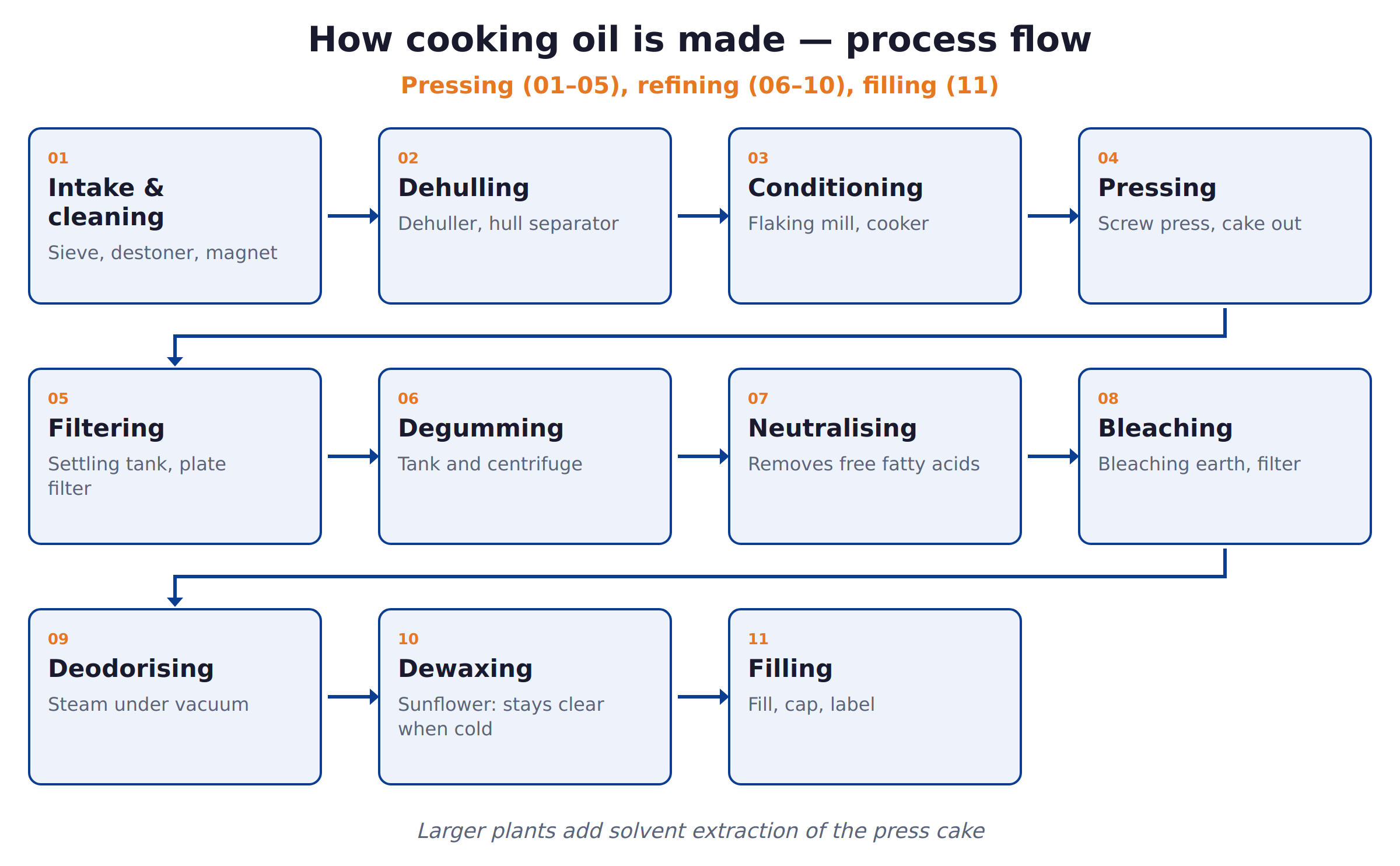
Stage one: getting the oil out of the seed
Cleaning and dehulling
Seed arrives with dust, stones, stalks and sometimes metal. Cleaning protects the press and the quality of the oil and cake. Sunflower seed is often partly dehulled: the hull holds little oil, takes up press capacity and lowers the protein in the cake, so removing part of it gives a better cake for feed.
Conditioning
The seed is flaked between rollers and heated in a cooker. Heat and moisture make the oil cells break more easily and the oil flow more freely, which raises the yield from the press. Cold-pressed oils skip most of this heat, which is why they yield less.
Pressing
A screw press, or expeller, forces conditioned seed along a tapering barrel. The pressure squeezes oil out through slots in the barrel, and the solid press cake leaves at the end. Pressing alone leaves several percent of oil in the cake; how much depends on the seed, the press and the conditioning. Sunflower seed contains roughly 40% or more oil, so even a few points of difference in recovery matter at scale.
Filtering
Crude oil carries fine solids. It is settled and filtered, often on plate-and-frame or leaf filters. Pressed, filtered oil can be sold as crude oil to refiners, used for feed, or sold locally as unrefined oil.
Solvent extraction
Large plants wash the remaining oil out of the cake with a food-grade solvent, usually hexane, then recover the solvent and toast the meal. Solvent extraction recovers almost all the oil but brings fire and explosion risk, strict safety design and a higher investment. It usually pays only at larger scale. Most small and medium plants in the region press only.
Stage two: refining crude oil into cooking oil
Supermarket cooking oil is refined: clear, light in colour, neutral in taste and stable on the shelf.
- Degumming. Water or acid is added to crude oil to make the gums, mainly phospholipids, separate; a centrifuge removes them.
- Neutralising. An alkali reacts with free fatty acids to form soapstock, which is separated. High free fatty acids make oil taste sharp and smoke at lower temperature.
- Bleaching. Bleaching earth absorbs colour pigments and traces of soap and metals, and is then filtered out.
- Deodorising. The oil is heated under deep vacuum with steam to strip out compounds that give smell and taste. This is the step that needs the most energy and the best vacuum system.
- Dewaxing (winterisation). Sunflower oil contains natural waxes that make it cloudy in a cold shop or fridge. The oil is cooled slowly so the waxes crystallise and are filtered off.
Refining can run in batches on smaller plants or continuously on larger ones. Batch refining suits a plant that refines a few tonnes a day; continuous refining is more efficient above that.
Stage three: filling
Refined oil goes to storage tanks and then to a filling line: bottle blowing or bought-in bottles, filling, capping, labelling and packing. The 750 ml bottle is a common retail size; 2 L, 5 L and 20 L containers serve households, caterers and food businesses. NAMC's monthly food basket report put the average urban price of 750 ml of sunflower oil at R37.97 in July 2026.
What comes out besides oil
| By-product | Where it goes |
|---|---|
| Press cake or meal | Animal feed, a major part of plant income |
| Hulls | Fuel for the boiler, or bedding |
| Gums | Often added back to meal |
| Soapstock | Soap makers, or split into acid oil |
| Spent bleaching earth | Disposal or reuse as fuel |
| Deodoriser distillate | Sold to specialist buyers |
What each scale of plant costs
Indicative, in USD, from our cooking oil machine price guide:
| Plant | Seed per day | Indicative price (2026) |
|---|---|---|
| Single screw press | Small | Under about US$10,000 |
| Pressing and refining plant | About 20 t | About US$150,000–400,000 ex-works |
| Larger plant | About 50 t | About US$400,000–900,000 ex-works |
| Industrial plant | About 100 t | About US$700,000–1.5 million and above ex-works |
Landed and installed, add roughly 25–45%. Seed for several months of production is often the largest working capital item.
Seed supply in South Africa
The Crop Estimates Committee's seventh estimate, reported by Grain SA in August 2026, put the 2026 sunflower crop at 874,805 tonnes, and the committee's September forecast put soya beans at about 3.01 million tonnes. Sunflower remains the main oilseed for cooking oil in South Africa; soya is crushed mainly for meal, with oil as the co-product. A plant has to buy seed at harvest, store it well and plan for price swings.
Food rules and tax
- Food premises. An oil plant is a food premises under R638 of 2018 and needs a Certificate of Acceptability from the municipality.
- Labelling. Bottled oil must be labelled under R146 of 2010.
- VAT. Cooking oil made from vegetables, other than olive oil, is zero-rated for VAT under Schedule 2 Part B of the VAT Act.
- Solvent extraction. Hexane storage and use bring hazardous substance, fire and pressure equipment duties.
Common mistakes
- Buying a press with no filter. Crude oil full of solids will not sell.
- No dehulling on sunflower. The cake is worth less and the press works harder.
- Refining without enough steam and vacuum. The deodoriser cannot do its job.
- No dewaxing for sunflower oil. Bottles go cloudy on the shelf.
- Not budgeting for seed stock. The plant stands half the year.
- Ignoring the cake market. Feed buyers often decide whether the plant pays.
Where CISH fits
CISH specifies complete oil plants, from seed cleaning and pressing to refining and filling, from audited factories in China against your seed and the oil you want to sell. We ship and clear the plant, install it, commission it on your seed with throughput and oil quality measured, and train your team. For a single small press, a local machine dealer is usually the better buy.
Frequently asked questions
How is cooking oil made?
Seed is cleaned, dehulled where needed, conditioned and pressed. The crude oil is filtered, and for supermarket oil it is refined by degumming, neutralising, bleaching, deodorising and, for sunflower, dewaxing, before filling.
What machines do I need to make cooking oil?
Cleaners, a dehuller for sunflower, a flaking mill and cooker, a screw press and filters for pressing. Refining adds degumming, neutralising, bleaching, deodorising and dewaxing equipment, then a filling line.
What is the difference between pressed and refined oil?
Pressed, filtered oil keeps more colour and flavour and has a shorter shelf life. Refined oil is clear, neutral and stable, which is what most supermarket cooking oil is.
Do small oil plants use solvent extraction?
Usually not. Solvent extraction recovers almost all the oil but adds safety requirements and cost, so it tends to pay only at larger scale.
Is cooking oil zero-rated for VAT in South Africa?
Yes. Cooking oil made from vegetables, other than olive oil, is zero-rated under the VAT Act.
How much does a cooking oil plant cost?
As an indication for 2026, a 20 tonne a day pressing and refining plant costs about US$150,000–400,000 ex-works.