Work out tonnes of feed a day, from animal numbers and intake for your own farm, or from customer orders for a feed business; divide by the hours your mill will run; then add headroom of 20–30% for growth, peaks and stoppages. As rough examples, 20,000 layers eat about 2.2–2.4 tonnes of feed a day, and 100 dairy cows fed 6–10 kg of concentrate each about 0.6–1 tonne a day; check intakes with your nutritionist. Remember that the pellet mill is not the only limit: grinding, batching, conditioning with steam and cooling must all match. Mash lines are cheaper and faster than pellet lines of the same tonnage. CISH supplies, installs and commissions complete feed mills sized to the tonnes you sell.
Step 1: tonnes a day
For your own animals (rough examples)
| Animal | Rough feed intake | 1,000 animals eat about |
|---|---|---|
| Layers | About 110–120 g a day | 110–120 kg a day |
| Broilers | About 3.5–4.5 kg per bird over a cycle | 3.5–4.5 t per cycle |
| Finishing pigs | About 2–3 kg a day | 2–3 t a day |
| Dairy cows (concentrate) | About 6–10 kg a day | 6–10 t a day |
These are rough figures; your nutritionist and breed guides give the right numbers for your animals.
For a feed business
Add up confirmed and likely orders by feed type, by month, including seasonal peaks. Feed businesses usually start at one shift and grow into two.
Step 2: hours a day
Tonnes a day ÷ productive hours = tonnes an hour. A shift of eight hours typically gives about seven productive hours after start-up, cleaning and formula changes. Two shifts double the hours without doubling the mill.
Step 3: add headroom
Add 20–30% for growth, peaks such as festive seasons for broilers, and stoppages for die changes and maintenance. A mill running at 100% every day has no time for maintenance and no room to grow.
Mash or pellets changes the capacity
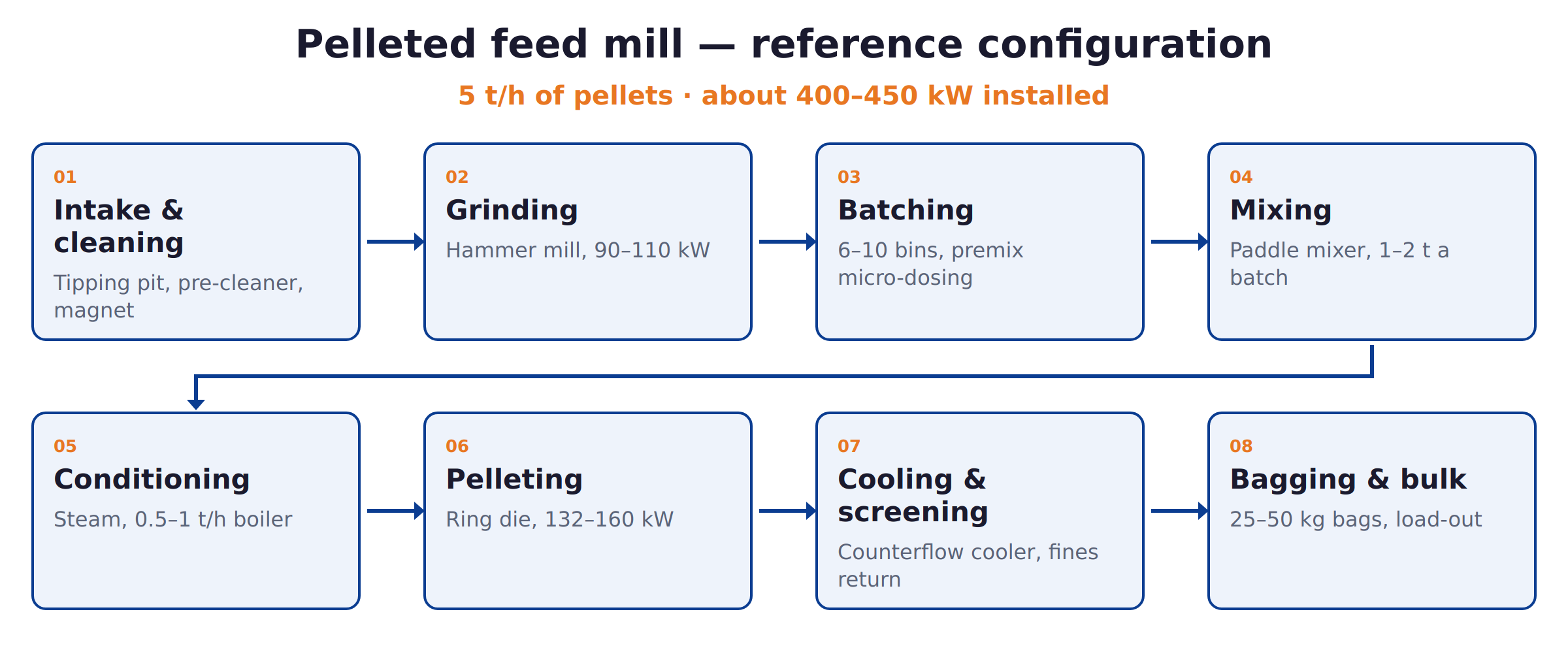
A mash line (grinding, batching, mixing, bagging) runs faster and cheaper than a pellet line of the same tonnage. Pelleting adds a steam conditioner, pellet mill, cooler and crumbler, and the pellet mill's throughput depends on the formula and die. Fibrous dairy feeds pellet more slowly than broiler feeds. If you make both, size the mixer for total tonnage and the pellet mill for the pelleted share. Our guide to ring die and flat die pellet mills explains why commercial mills use ring dies with steam.
Balance the whole mill
| Section | Must match |
|---|---|
| Intake and storage | Daily raw material deliveries and several days of stock |
| Hammer mill | Ground tonnes per hour for all feeds |
| Batching and mixing | Batches per hour × batch size |
| Conditioner and pellet mill | Pelleted tonnes per hour for your formulas |
| Boiler | Steam for the conditioner at full pellet output |
| Cooler and sifter | Pellet output |
| Bagging | Bags per hour at peak |
The smallest section sets the mill's real output.
Worked example: a layer farm with neighbours
A farm in North West runs 40,000 layers, eating about 4.5–5 tonnes of mash a day, and two neighbours want another 5 tonnes a day of layer and broiler feed. Total demand is about 10 tonnes a day, rising to 15 in two years. On one shift of seven productive hours, that needs about 2 tonnes an hour, growing past 2 tonnes an hour; with headroom, the farm chooses a 3 t/h mash line with batching and premix dosing, plus a 2 t/h pellet line with a small boiler for broiler feed. The figures are illustrative.
Power and steam
A 3 t/h pellet line has hammer mill and pellet mill motors that are among the largest loads on a farm. Eskom's standard tariff rose 8.76% for 2026/27; check your supply before choosing capacity, and plan backup for critical motors. The boiler must deliver steam for the conditioner at full output.
Registration and the market
Feeds sold to other farmers must be registered under Act 36 of 1947. Feeds made only for your own animals are a different case; check with the Registrar if you plan to sell. The Animal Feed Manufacturers Association represents commercial feed makers. Feed machinery under heading 8436.10 enters duty-free.
Five questions before you choose
- What tonnes a day of each feed, now and in three years?
- Mash, pellets or both?
- How many shifts will you run?
- Do you have steam and enough power?
- How much raw material storage do you need?
Common mistakes
- Sizing from the pellet mill rating alone.
- No headroom for growth and maintenance.
- A mixer too small for the pellet mill.
- No boiler capacity for conditioning.
- Ignoring raw material storage.
Shifts, products and changeovers
A mill's rated capacity is per hour of running. Your real output depends on how many hours you run, how many different feeds you make, and how often you change over. Each change from one formula to another needs cleaning to avoid carry-over, especially between feeds for different animals or with medicated additives. A mill making ten formulas in small batches loses more time than one making two formulas in long runs.
Work out your monthly tonnes by product, divide by the working days and hours you can realistically run, and add time for changeovers and cleaning. Then add a margin for growth and for breakdowns. If your sales are seasonal, size the mill for your busy months, or plan bagged stock ahead of them.
Raw materials and storage
Feed mills need storage for maize, soya and other ingredients, plus premixes and bagged stock. Buying raw materials after harvest when prices are lower can help, but only if you have dry, clean storage and the cash to hold stock. Test incoming grain for moisture and mycotoxins, and rotate stock so older material is used first.
Power and building
Hammer mills and pellet mills draw high power. Check your supply capacity, your tariff and the cost of upgrades before choosing capacity, and plan the building height for bins, elevators and the pellet line.
A simple sizing example
Suppose you plan to sell 600 tonnes a month of mash and pellets, working 22 days a month on one eight-hour shift. That is about 27 tonnes a day, or about 3.4 tonnes an hour of running time. Allow for changeovers and stops, and a 3–5 tonne an hour mill is a sensible range. The figures are illustrative.
Where CISH fits
We supply complete feed mills, intake, grinding, batching, mixing, conditioning, pelleting, cooling and bagging, from audited factories in China, sized to your tonnes and feeds with every section balanced. CISH ships, clears, installs and commissions the mill on your formulas, and trains your team. For a farm hammer mill and mixer, a local supplier is usually the better buy.
Frequently asked questions
What capacity feed mill do I need?
Work out tonnes a day of feed, divide by productive hours, and add 20–30% headroom.
How much feed do 1,000 layers eat?
Roughly 110–120 kg a day; confirm with your nutritionist.
Is a pellet line slower than a mash line?
Yes, for the same tonnage, and it needs steam, a conditioner and a cooler.
How much does a feed mill cost?
As an indication for 2026, a complete 1–3 t/h mill costs about US$60,000–150,000 landed and commissioned; 3–10 t/h about US$250,000–900,000.
Do I need to register feed made for my own animals?
Feeds sold to others must be registered under Act 36; check with the Registrar if you plan to sell.
Does CISH supply feed mills?
Yes, complete mills with commissioning and training.