In a flat die mill, rollers press feed down through holes in a flat, horizontal disc; the machine is simple, cheap and easy to change, and often runs without steam, but output is limited, dies wear unevenly and pellets are less consistent. In a ring die mill, rollers press feed outward through a rotating ring-shaped die; with a steam conditioner in front, ring dies make dense, durable pellets at one to many tonnes an hour with lower energy and wear per tonne. Ring die mills are the standard in commercial feed plants for poultry, pigs, cattle and fish sinking feed. CISH supplies, installs and commissions complete feed mills with ring die pelleting.
The short answer
| Flat die pellet mill | Ring die pellet mill | |
|---|---|---|
| How it works | Rollers press feed down through a flat disc die | Rollers press feed outward through a rotating ring die |
| Typical output | Small, up to a few hundred kg/h | About 1 t/h to tens of t/h |
| Conditioning | Often none, or water added | Steam conditioner standard |
| Pellet durability | Lower, varies | Higher, consistent |
| Energy per tonne | Higher | Lower at scale |
| Die wear | Uneven, faster per tonne | More even, longer life per tonne |
| Price | Low | Higher, part of a complete mill |
| Best fit | Farms, hobby and small mixers | Feed businesses, commercial mills |
How each mill makes pellets
Flat die
Feed falls onto a flat steel disc with holes. Rollers turning above it press the mash through the holes, and a knife underneath cuts pellets to length. Because the outer edge of the roller travels faster than the inner edge, wear and pressure are uneven across the die. Flat dies are often reversible, which extends their life, and they are easy to clean and change.
Ring die
A ring-shaped die rotates around fixed rollers. Mash from the conditioner is fed inside the ring and pressed outward through the holes; knives outside cut the pellets. Pressure is even across the die, which gives consistent pellets and longer die life per tonne. Ring die mills are built for long hours and work with steam conditioning, molasses and fat addition.
Why conditioning matters
Steam conditioning heats and moistens the mash before pelleting. It gelatinises starch, improves binding, reduces fines and lowers energy and die wear. Most commercial feeds for broilers, layers, pigs and dairy cubes are conditioned. Flat die mills rarely have proper conditioners, which is a large part of why their pellets are softer. If you need durable pellets for broilers or trucking feed long distances, you need steam, a ring die and a cooler.
Match the mill to your situation
- Farm pelleting for own animals: a flat die mill with a small hammer mill and mixer.
- Small feed business selling bags locally: a complete 1–3 t/h mill with a ring die pellet mill and a small boiler.
- Regional feed brand: a 3–10 t/h mill with batching, conditioning, ring die pelleting and cooling.
- Fish feed: sinking pellets from a ring die mill; floating feed needs an extruder.
The rest of the pellet line
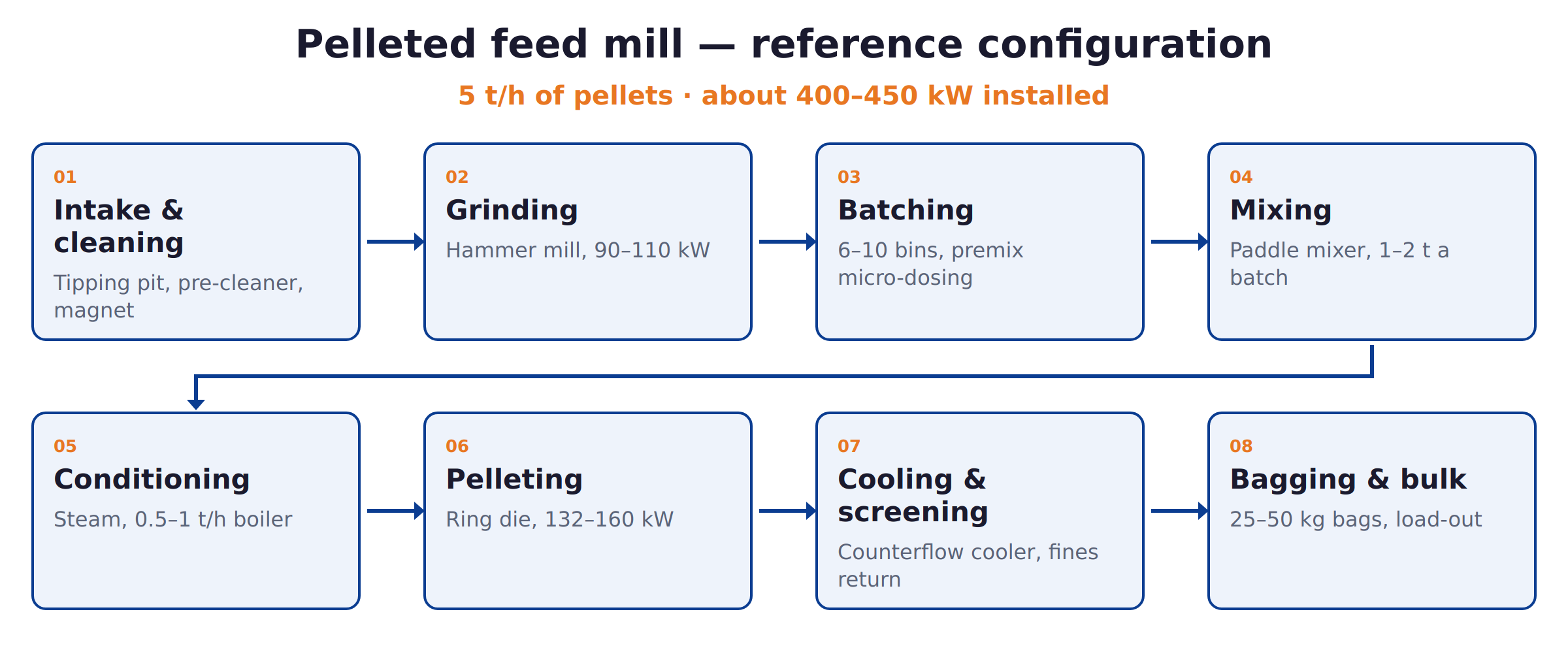
A pellet mill is one machine in a line. Pellets leave the die hot and soft; a counterflow cooler hardens and dries them, a crumbler makes chick crumbles, and a sifter removes fines for return to the mill. Before the mill you need grinding, accurate batching and mixing, and premix dosing. Budget for these when comparing a pellet mill price with a complete feed mill. Our feed pellet machine price guide shows the bands.
Power and wear parts
Pellet mills are among the largest electrical loads in a feed plant. Eskom's standard tariff rose 8.76% for 2026/27, so energy per tonne matters. Dies and rollers are wear parts: their life depends on the feed formula, conditioning and maintenance. Keep a spare die and roller set for your main pellet size, and record tonnes per die so you can plan replacements. Ring dies can usually be refurbished; flat dies are often flipped and then replaced.
Registration and quality
Whatever mill you use, farm feeds sold in South Africa must be registered under Act 36 of 1947, with labels showing the registration number and guaranteed analysis. Pellet durability, fines and moisture are quality points buyers check. The Animal Feed Manufacturers Association represents the commercial feed industry.
Worked example: from flat die to ring die
A pig farmer in KwaZulu-Natal pellets feed for his own herd on a flat die mill of about 300 kg an hour. Neighbouring farmers want to buy his feed, and the soft pellets break into dust in bags. He registers two feeds under Act 36 and installs a 2 t/h line with a hammer mill, batching scales, a mixer, a steam conditioner and small boiler, a ring die pellet mill, a cooler and a bagging scale. Pellet fines drop sharply and he sells bagged feed to farmers within 100 km. The flat die mill is kept for trials. The figures are illustrative.
Five questions before you buy
- What tonnes per hour of finished pellets do you need, for which feeds?
- Do you have, or will you install, steam for conditioning?
- What die hole sizes and pellet lengths do your feeds need?
- What is the die and roller life on a formula like yours?
- Who commissions the mill on your formulas and trains your operator?
Common mistakes
- A flat die mill for a commercial feed business.
- A ring die mill without a conditioner or cooler.
- No spare die and rollers.
- Comparing a bare pellet mill price with a complete feed mill.
- Selling unregistered feed.
Die care decides pellet quality
Whichever mill you buy, the die is a wear part. A new die needs running in with an oily, slightly abrasive mix before production, or pellets come out rough and the holes glaze. Keep a spare die and rollers, set roller gap as the maker specifies, and never leave feed in the die when you stop: it hardens and blocks holes. Track tonnes per die so you know when to replace it, and keep the conditioner's steam dry, because wet steam causes blockages and soft pellets. A well-kept ring die lasts far longer than one that is run hard without care.
Where CISH fits
We supply complete feed mills, grinding, batching, mixing, steam conditioning, ring die pelleting, cooling, crumbling and bagging, from audited factories in China, sized to your feeds and tonnes. CISH ships, clears, installs and commissions the mill on your formulas, and trains your operators. For a single flat die mill for a farm, a local supplier is usually the better buy. Feed machinery under heading 8436.10 enters duty-free; VAT applies.
Frequently asked questions
What is the difference between a ring die and flat die pellet mill?
A flat die presses feed down through a flat disc; a ring die presses it outward through a rotating ring. Ring dies give more consistent pellets at higher output.
Which pellet mill is best for a small farm?
A flat die mill is usually enough for pelleting your own feed in small quantities.
Which pellet mill is best for a feed business?
A ring die mill with steam conditioning and a cooler.
Do I need steam to make pellets?
For durable commercial pellets, yes; steam conditioning improves binding and lowers energy and wear.
How much does a pellet mill cost?
As an indication for 2026, basic ex-China pellet machine sets of 1–2 t/h cost about US$10,000–50,000; a complete small feed mill about US$60,000–150,000 landed and commissioned.
Does CISH supply pellet mills?
We supply complete feed mills with ring die pelleting. For a farm flat die mill, a local supplier is usually better.