First, run more hours: overtime, a second or third shift, or weekend work, which costs labour but no capital, within the limits of the Basic Conditions of Employment Act and the line's maintenance needs. Second, remove the bottleneck: measure where the line loses output and fix that step, often with a faster machine, an automated transfer or packing step, better changeovers or a control upgrade; a machine-level control retrofit costs about US$2,000–8,000 as an indication for 2026. Third, upgrade the line: replace several machines or the controls to raise its rated speed, a mid-size line control retrofit having cost about US$26,500 in a published example. Fourth, add a line, which multiplies capacity but needs building space, utilities, people and the full project cost. Outsourcing to a co-packer can bridge the gap while you decide. The right answer depends on how much extra volume you need, for how long, and where the line actually loses output.
The four options compared
| Option | Typical extra output | Capital needed | Time to extra output | Best when |
|---|---|---|---|---|
| More hours (overtime, shifts) | Up to double or triple, if the line is reliable | None | Days to weeks | Short peaks, or the line runs one shift today |
| Remove the bottleneck | Often 10–30% | Low to moderate | Weeks to months | One machine or step limits the line |
| Upgrade the line | Often 30–60% or more | Moderate | Months | The line is sound but slow or the controls are obsolete |
| Add a line | Doubles capacity or more | High | Many months | Demand is high and lasting, space and power are available |
| Outsource (co-packing) | As agreed | None | Weeks | Bridging a gap, or for low-volume products |
These ranges are typical; your line's figures depend on where it loses output today.
Step 1: measure before you spend
Count, for at least two weeks, by machine and by shift: units produced, stops and their causes, changeover times, rejects and rework. Most lines lose output in a few places: one slow machine, long changeovers, waiting for materials, breakdowns, or a manual step. Our guide to measuring and improving production efficiency explains how. The numbers tell you which option is realistic.
Option 1: more hours
A line that runs one 8-hour shift five days a week uses less than a quarter of the hours in a week. Adding a second shift can nearly double output with no new equipment. Plan:
- Labour: recruitment, training, supervision and shift allowances; overtime is limited under the Basic Conditions of Employment Act, so long-term growth usually needs extra shifts rather than permanent overtime.
- Maintenance: more hours mean more wear; schedule maintenance windows and stock spares.
- Utilities: many industrial electricity tariffs include charges for peak periods and maximum demand; running at night or spreading loads can cost less per unit than squeezing more into peak hours. Eskom's standard tariff rose 8.76% for 2026/27.
- Materials and storage: more raw material deliveries and finished stock space.
Option 2: remove the bottleneck
A line can only run as fast as its slowest step. Common bottleneck fixes:
- A faster or second machine at the slow step, such as a second filler head or labeller.
- Automated transfer between machines that are linked by hand.
- Shorter changeovers: quick-change parts, standard settings, better planning of runs.
- Control upgrade of an unreliable machine; a machine-level control retrofit costs about US$2,000–8,000 and takes a few days.
- Buffers between machines so a short stop at one does not stop the others.
Option 3: upgrade the line
If the line is mechanically sound but slow, or its controls are obsolete, an upgrade can lift the whole line: new drives and PLC, faster filling and packing sections, automatic feeding. A mid-size line control retrofit, with hardware, engineering, wiring and commissioning, cost about US$26,500 in a published example and paid back in about six months. Plan the shutdown: upgrades usually need days or weeks with the line stopped, so build stock first. Our comparison of semi-automatic and fully automatic lines helps decide how far to automate.
Option 4: add a line
A new line is the right answer when demand is high and lasting, the existing line is near its practical limit even after bottleneck fixes, and you have the space, power, water and people. It costs the full project: equipment, freight, duties, building work, utilities, installation, commissioning, training and working capital. A second line also gives resilience: if one stops, you still produce. Work out the payback with realistic utilisation; our payback guide has a worked example.
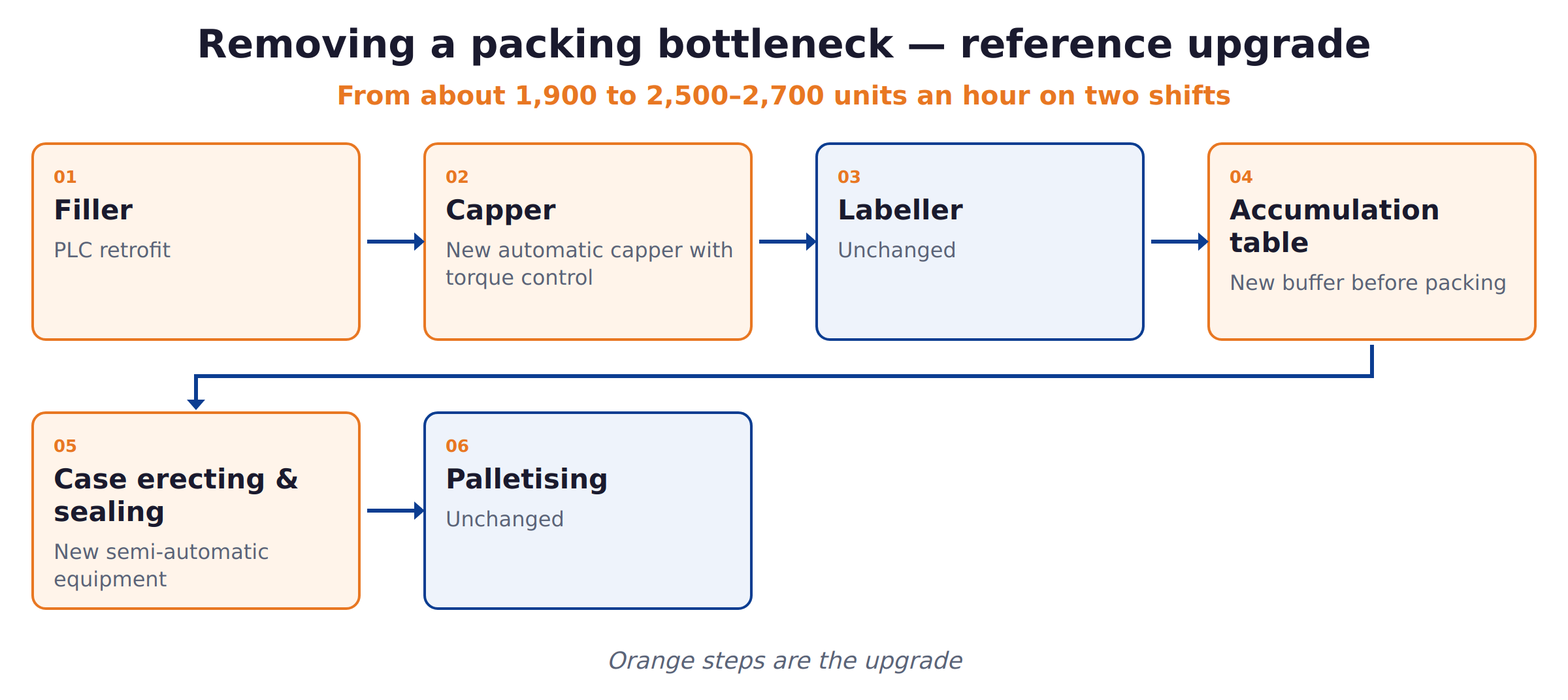
A reference upgrade: removing a packing bottleneck
For a South African factory with steady demand, the cheapest extra output usually comes from fixing the slowest step rather than adding a shift or a line. A typical bottleneck project on a filling and packing line:
| Item | Reference specification |
|---|---|
| Starting point | Two shifts, line rated 3,000 units an hour, averaging about 1,900; capping and manual case packing set the pace |
| Measurement | Two weeks of stop and speed logging on each machine to confirm where the time goes |
| Changes | Automatic inline capper with torque control, accumulation table before packing, semi-automatic case erector and sealer, machine-level PLC retrofit on the filler |
| Downtime | Installed over two weekends, without stopping weekday production |
| Budget | About US$40,000–70,000 installed |
| Expected result | About 2,500–2,700 units an hour on the same two shifts |
Who supplies what
- CISH: the capper, accumulation table, case equipment and controls, installation, commissioning and operator training.
- You: production data access, a shutdown window, spare-part stocking and operators for the trials.
Acceptance targets to write into the contract
- Factory acceptance test (FAT), in China: capper torque and changeover times checked on your bottles and caps; accumulation table run at line speed.
- Site acceptance test (SAT), on your product: average output of at least 2,500 units an hour over five consecutive shifts, measured the same way as the baseline; cap torque within specification; no increase in rejects.
For a delivered project of this kind, see our Johannesburg OEE retrofit case study.
For reference only.
Choosing between them
| Your situation | Usually best |
|---|---|
| Extra demand for a few months only | More hours or outsourcing |
| Line runs one shift and is reliable | A second shift |
| One machine stops or limits the line | Remove the bottleneck |
| Line is sound but old or slow | Upgrade |
| Demand will double or more for years | Add a line |
| New product with uncertain demand | Outsource first, then invest |
Worked example: a sauce factory
A sauce maker runs one line on one shift and sells 20% more than it can make. Measurement shows the filler is fine, but the labeller stops often and the cartons are packed by hand. Option 1, a second shift, would cover the gap but needs eight new staff. Option 2 replaces the labeller and adds a case packer, lifting one-shift output by about 25% with two fewer people per shift. The owner chooses option 2, and plans a second shift for next year's growth and a new line when the business wins a national retail listing. The figures are illustrative.
Safety when you push a line harder
More speed and more hours raise the risk of accidents and breakdowns. Keep guards and emergency stops in place, train new shift staff, and follow the Driven Machinery Regulations. Do not bypass safety devices to gain speed.
Common mistakes
- Buying a new line before measuring the old one.
- Fixing a step that is not the bottleneck.
- Permanent overtime instead of a proper shift.
- Upgrades without a shutdown plan.
- A new line sized for optimism, not orders.
Outsourcing to a co-packer
A co-packer or contract manufacturer can make part of your volume while you decide on the long-term solution, or permanently for low-volume products that take up too much line time. Agree the specification, quality checks, who supplies raw materials and packaging, the price per unit and minimum runs. Visit the co-packer, check their food safety or quality certification, and run trial batches before committing. Outsourcing protects customer service, but watch your margin and your recipes.
Where CISH fits
We supply complete new lines and upgrades of lines we have supplied, from audited factories in China, sized to the extra volume you can sell. CISH ships, clears, installs and commissions them with output demonstrated, and trains your operators. When a second shift or a simple bottleneck fix would do the job, we will say so before we propose a new line.
Frequently asked questions
How can I increase production capacity without buying a new line?
Run more hours with an extra shift, remove the bottleneck machine or step, shorten changeovers, or upgrade the controls.
How do I find the bottleneck?
Measure output, stops and their causes at each machine for at least two weeks.
When should I add a new production line?
When demand is high and lasting, the existing line is near its limit after bottleneck fixes, and you have space, power and people.
How much does it cost to upgrade a line's controls?
As an indication for 2026, a machine-level retrofit costs about US$2,000–8,000; a mid-size line retrofit cost about US$26,500 in a published example.
Is a second shift cheaper than a new line?
Usually, if the line is reliable and you can recruit and supervise the extra staff.
Does CISH supply line upgrades?
Yes, for lines we supply, and complete new lines when extra capacity needs one.