Processed meat plants work under HACCP regulations, the VC 9100 compulsory specification and product regulations, so choose the supplier who designs for hygiene and cold chain and commits to kilograms per hour on your recipe.
Who sells meat processing equipment
Butcheries, processed meat makers, game and biltong processors and abattoir owners all look for meat processing equipment. The offers come from four kinds of company.
| Supplier type | What they sell | Price | Who answers for output | Best fit |
|---|---|---|---|---|
| Butchery equipment dealer | Mincers, bowl cutters, saws, slicers, fillers, vacuum packers from stock | Moderate | The dealer, machine by machine | Butcheries and small processors |
| Local stainless fabricator | Tables, trolleys, tumblers, brine tanks, smoke trolleys, hanging rails | Lower for simple items | The fabricator, for its own items | Fit-out around imported machines |
| Chinese factory, direct | Grinders, choppers, vacuum fillers, linkers, injectors, smokehouses, packers | Lowest on the quote | You, after delivery | Buyers with their own technicians |
| Turnkey processing company | A complete line from frozen block or carcass to packed product, laid out and commissioned | Between direct and dealer | The turnkey company, at agreed output | New plants and expansions |
The machines matter less than the rooms
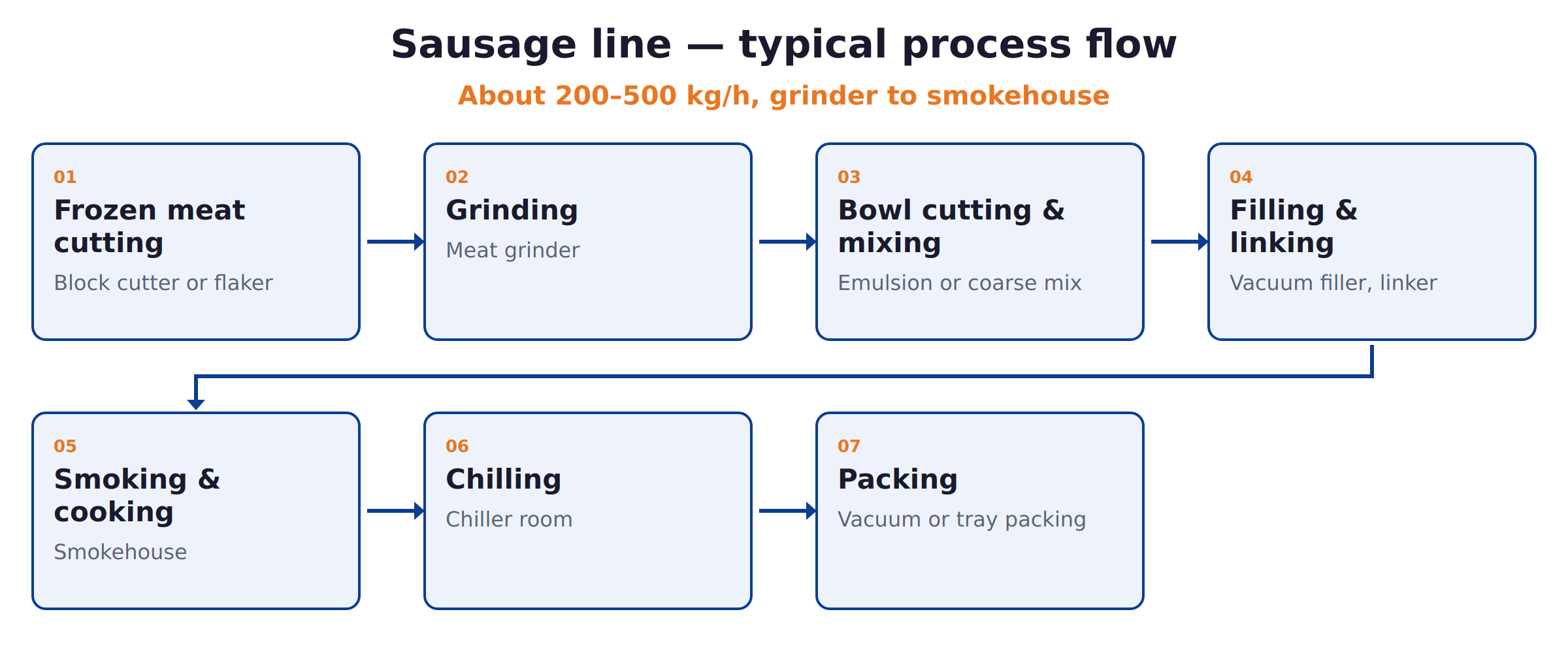
A meat plant is a sequence of temperature-controlled rooms: raw material chilling, preparation, mixing, filling, cooking or smoking, chilling, slicing and packing, and dispatch. The machines sit inside those rooms. Most problems in new plants come from the layout, not the machines: raw and cooked product crossing, rooms too warm, or no space to chill product before packing.
Ask any supplier three things:
- Which products the line makes, such as boerewors, viennas, polony, bacon or cured meats, and at what kilograms per hour.
- How raw and cooked product are separated, because cross-contamination is the main food safety risk.
- What cooling the plant needs, from raw material chillers to blast chilling after cooking.
What to check in the supplier
Hygienic design
Food-contact parts should be stainless steel of a suitable grade, easy to strip and clean, without crevices where meat lodges. Ask to see how each machine is cleaned at the end of a shift.
Cooking, smoking and chilling
Cooked products such as polony and viennas need controlled cooking to a core temperature, then fast chilling. A smokehouse or cooking cabinet should log temperatures, because you will need records for HACCP.
Vacuum filling and linking
For volume, a vacuum filler with a portioning or linking unit gives consistent weight and less air in the product. Hand stuffers suit small butcheries only.
Where to find meat processing equipment suppliers
- The South African Meat Processors Association (SAMPA) publishes the legislation that applies to processed meat manufacturers and is a starting point for the industry.
- Food processing trade shows in Johannesburg and Cape Town include meat equipment; check current dates with organisers.
- Working plants: ask to visit a processor running the machine classes you are considering.
- China: many grinders, fillers and smokehouses sold in Africa are made in China. Use our supplier audit checklist before paying a deposit.
Meat equipment suppliers are not named or ranked here.
How to choose: a 10-point checklist
- Products and kilograms per hour for each product, demonstrated at handover.
- Room layout with raw and cooked product separated.
- Hygienic stainless design, easy to strip and clean.
- Cooking and smoking with temperature control and logging.
- Chilling capacity from raw intake to finished product.
- Filling accuracy by weight per portion.
- Packing: vacuum or modified atmosphere, labelling and coding.
- Utilities: steam or heating, refrigeration, compressed air, water and effluent.
- Installation, commissioning on your recipe and training in the price.
- Support: who services filler pumps, knives and refrigeration after year one.
For biltong in particular, see how to start a biltong business.
Ten questions to ask
- Which products will this line make, and at what kilograms per hour each?
- How will raw and cooked product be kept apart in the layout?
- What cooling and freezing capacity does the plant need?
- Does the smokehouse or cooker log core temperature?
- What weight accuracy does the filler give per portion?
- What cleaning does each machine need, and how long does it take?
- What steam, power, air and water does the plant use?
- Is installation, commissioning and training included?
- How quickly can I get knives, plates, seals and filler parts?
- Which plant in South Africa runs this line, and may I visit?
Comparing meat line quotes
| Section | What each quote should state |
|---|---|
| Raw material handling | Frozen block flaker or tempering, mincers, plates and knives |
| Mixing and emulsifying | Bowl cutter or emulsifier size, vacuum or not |
| Filling | Vacuum filler, portioning, linker, clipper |
| Cooking and smoking | Chambers, trolleys, temperature control and logging |
| Chilling | Blast chiller or shower, chill rooms |
| Slicing and packing | Slicer, vacuum or tray packer, labelling |
| Refrigeration | Chill and freezer rooms, capacities |
| Utilities | Steam, power, air, water, effluent |
| Installation and training | Engineer days, operator training |
| Owner's scope | Building, finishes, drainage, permits |
List what each quote omits before you compare totals. Our same-scope comparison shows a worked example.
Common mistakes
- Buying machines before the layout. Raw and cooked product then cross.
- Too little chilling. Cooked product waits warm before slicing.
- Hand stuffing at volume. Weights vary and labour costs rise.
- No temperature records. HACCP needs them.
- Underestimating effluent. Fat and blood in waste water need pre-treatment.
Meat processing equipment prices in 2026
Indicative, in USD, from our sausage machine price guide and poultry abattoir cost guide:
| Purchase | Capacity | Indicative price (2026) |
|---|---|---|
| Sausage line, mincer to smokehouse | About 200–500 kg/h | About US$9,000–50,000 ex-works |
| Industrial processed meat line | 1,000 kg/h and above, vacuum filling, linking, cooking | Quoted per configuration |
| Chicken slaughter line, core machines | 500–1,000 birds/hour | About US$20,000–75,000 ex-works |
| Complete poultry processing plant | 1,000–2,000 birds/hour | About US$250,000–800,000 landed and commissioned |
| Chill rooms | Sized to throughput | From about US$15,000 installed |
South African facts that shape the decision
- HACCP is compulsory for processed meat. The HACCP regulations (R908 of 2003), amended in 2018, apply to processed meat manufacturers.
- A compulsory specification. Processed meat products must meet VC 9100, administered by the NRCS.
- Product regulations. Processed meat products are classified, packed and marked under R1283 of 2019, raw processed meat under R2410 of 2022, and boerewors and sausage under their own regulation.
- Food premises. The plant must meet R638 of 2018 and hold a Certificate of Acceptability, and labels follow R146 of 2010.
- Listeriosis changed the industry. The 2017–2018 outbreak, which WHO reported as the largest recorded, was traced to a processed meat plant and tightened controls on ready-to-eat meats.
- Abattoirs are separate. Slaughter falls under the Meat Safety Act 40 of 2000, with design approval by provincial veterinary services before building.
- Tariff protection. Imported sausages (1601.00.90) carry general duty of 40% or 240 cents a kilogram, while machinery for preparing meat (8438.50) is free of general duty. Import VAT of 15% applies and is claimable; see our import duty guide.
Where CISH fits
CISH is a turnkey processing company. We specify meat processing lines from audited factories in China against your products and recipes, plan the rooms with raw and cooked product separated, ship and clear the equipment, and install and commission the line with kilograms per hour demonstrated on your product, and your operators trained. We suit processors building or expanding a plant. For a single mincer, saw or slicer, a butchery equipment dealer is often the better choice.
Frequently asked questions
Who sells meat processing equipment in South Africa?
Butchery equipment dealers, local stainless fabricators, Chinese factories selling direct, and turnkey companies that set up complete processing plants. Butcheries usually buy from dealers; processed meat plants usually buy a planned line.
How much does a sausage making line cost?
As an indication for 2026, a line from mincer to smokehouse for 200–500 kg an hour costs about US$9,000–50,000 ex-works. Industrial lines with vacuum filling and cooking are quoted per configuration.
Do I need HACCP to make sausages and polony?
Yes. The HACCP regulations (R908 of 2003) apply to processed meat manufacturers, and products must meet the VC 9100 compulsory specification.
What is VC 9100?
The compulsory specification for processed meat products, administered by the NRCS. Products must comply before they are sold.
Is meat processing machinery duty-free?
Machinery for preparing meat (8438.50) is free of general duty in SARS's 2026 tariff. Import VAT of 15% applies and VAT vendors reclaim it.
Does CISH sell single mincers or slicers?
No. We supply complete meat processing lines, installed and commissioned. For a single machine, a butchery equipment dealer is usually the better route.