Either way you need a food premises that meets R638 and a Certificate of Acceptability from the municipality, bread packed and marked under R.405 of 2017, and a safe gas or electrical installation. Bread sells on price and freshness: a 700 g white loaf averaged R19.61 and brown R17.72 in July 2026, so cost per loaf and delivery decide the business.
Township bakery or bread factory?
| Neighbourhood or township bakery | Bread factory | |
|---|---|---|
| Typical output | Hundreds to a few thousand loaves a day | Thousands of loaves an hour |
| Products | Bread, rolls, vetkoek, scones, cakes | Standard sliced loaves, rolls, sometimes buns |
| Customers | Walk-in, spaza shops, small stores, schools | Supermarkets, wholesalers, route distribution |
| Equipment | Machine set; deck or rack oven | Semi-automatic or automatic line; tunnel or travelling oven |
| Equipment cost (2026) | About US$15,000–45,000 | From about US$80,000; automatic lines about US$250,000–800,000+ |
| Building | Shop with bakery behind | Factory with flour store, dispatch and vehicle yard |
| Staff | A few bakers and sales staff | Shifts of bakers, technicians, drivers, sales |
Most successful bread factories in the region started as smaller bakeries that already had customers. Start at the scale your market can absorb now, with a building and power supply that allow you to grow.
Step 1: Know your market and your price
Bread is a price-sensitive staple. Before buying anything, find out:
- Who buys bread in your area, where they buy it, and at what price.
- Which shops and spazas would stock your bread, and how often they want deliveries.
- What sells besides bread: rolls, vetkoek, cakes and pies often carry better margins.
- Brown or white: brown bread is zero-rated for VAT and white bread is not, which affects the shelf price if you are VAT-registered.
Step 2: Work out the cost per loaf
The figures below are an example only; replace them with your own quotes.
| Cost item | Example per 700 g loaf |
|---|---|
| Flour and other ingredients | About R6.00–8.00 |
| Bag and closure | About R0.60 |
| Energy (oven, prover, mixer) | About R0.80–1.50 |
| Labour | About R1.50–2.50 |
| Delivery | About R0.80–1.50 |
| Rent, maintenance, loan repayments | About R1.00–2.00 |
| Total | About R10.70–16.10 |
Compare that with what a shop will pay you, not the shelf price, since the shop adds its own margin. The gap is small, which is why bakeries watch yield, waste and returns closely. Returned stale bread is often the biggest hidden cost.
Step 3: Find premises and get approval
A bakery is a food premises. Under R638 of 2018 it needs washable walls, floors and ceilings, hand-wash basins, staff toilets and change areas, pest control, separation of raw and baked product, and safe water. The municipality's environmental health practitioner inspects the premises and issues a Certificate of Acceptability before you trade. Our Certificate of Acceptability guide explains the steps.
Also check:
- Zoning. The site must be zoned for the use; a factory usually needs industrial or business zoning.
- Power. Ovens and provers draw heavy loads; ask the municipality or Eskom about capacity before you sign a lease.
- Gas. If your oven runs on LPG, the installation must follow SANS 10087 and be installed and certified by a registered gas practitioner, who issues a certificate of conformity.
- Fire. Ovens, gas and flour dust mean the fire department will want to see escape routes and extinguishers.
Step 4: Choose the equipment
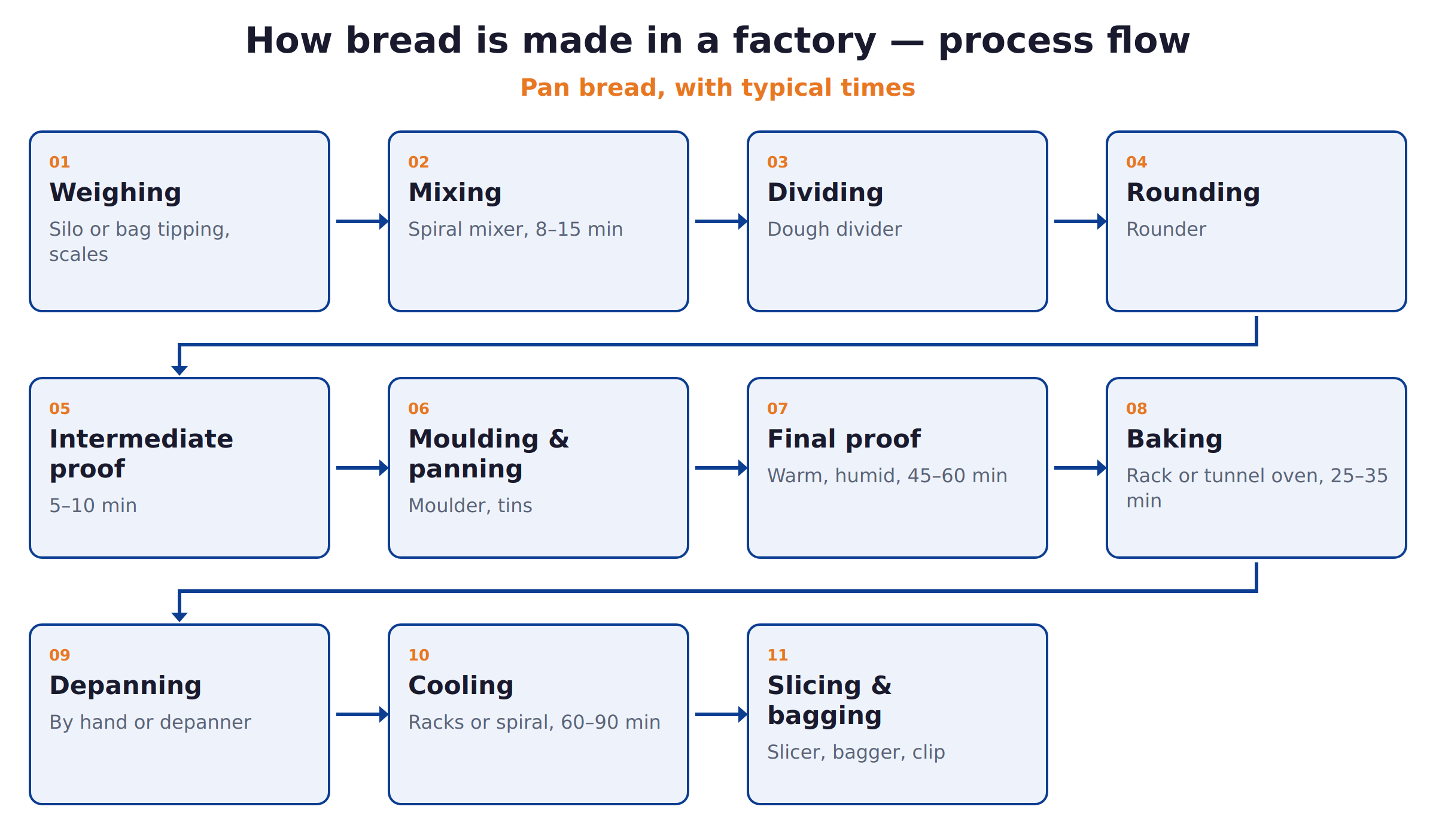
Equipment follows output. Size every step for the same number of loaves an hour: mixer, divider, prover, oven, cooling and slicing. A large oven with a small prover makes no more bread. Our guide to the bread making process in a factory shows each step and its machine.
| Purchase | What you get | Indicative price (2026) |
|---|---|---|
| Bakery machine set | Mixer, divider, moulder, prover, deck or rack oven, slicer | About US$15,000–45,000 |
| Semi-automatic bread line | Linked make-up, larger ovens, cooling, slicing and bagging | From about US$80,000 |
| Fully automatic bread line | Dosing, continuous make-up, tunnel oven, spiral cooler, bagging | About US$250,000–800,000 or more |
Bakery ovens carry no general import duty. Freight, installation, building work and working capital are on top of equipment; in most lines we see, equipment is about 35–55% of the project.
Step 5: Packaging and labels
Wheat products, including bread, are graded, packed and marked under R.405 of 2017. Your bags and closures must show the required information, including the date. Pre-packed products must also declare their quantity correctly, so weigh your loaves regularly; under-weight bread is a compliance problem, over-weight bread gives away profit.
Step 6: Staff, hygiene and routines
Bakeries work early hours. Plan shifts so bread is baked, cooled and delivered fresh each morning. Train staff on hygiene, allergens (wheat, eggs, milk, soya), safe use of mixers and slicers, and gas safety. Keep cleaning schedules and temperature records; the health inspector will ask.
Step 7: Sales and delivery
Bread is sold where people already shop. A delivery vehicle on a fixed morning route, with reliable times and a clear returns policy, wins spaza and store accounts. Larger retailers and wholesalers expect consistent quality, barcodes, supplier registration and food safety audits; school feeding and institutional contracts usually go through tenders. Start with the customers you can serve every day without fail.
A realistic path
| Stage | What it looks like |
|---|---|
| Year 1 | Machine set, one or two products, local shops and walk-in trade |
| Year 2–3 | Second oven or larger prover, delivery route, cakes and rolls |
| Factory stage | Semi-automatic or automatic line, retail and wholesale accounts, route distribution |
Common mistakes
- Buying a big oven before having customers.
- No plan for stale returns.
- Ignoring power capacity at the site.
- Gas installed without a certificate of conformity.
- Under-sized prover and cooling.
- Selling only one product with a thin margin.
Where CISH fits
We work with bakeries that are ready to move from a machine set to a production line. CISH specifies complete bread lines from audited factories in China against your loaf sizes and hourly output, ships and clears them, installs and commissions the line with output demonstrated on your recipe, and trains your bakers. For a first neighbourhood bakery, a local catering equipment dealer is usually the better place to buy.
Before you choose machines, read how European, Chinese and local bakery equipment compare on price, life and service.
Frequently asked questions
How much does it cost to start a bakery in South Africa?
As an indication for 2026, a set of bakery machines costs about US$15,000–45,000. A semi-automatic bread line starts from about US$80,000. Building, power, licences and working capital come on top.
What licence do I need to open a bakery?
A Certificate of Acceptability from the municipality for the food premises under R638, correct zoning, and, if you use gas, a certificate of conformity for the installation.
Is bread zero-rated for VAT in South Africa?
Brown bread is zero-rated. White bread carries standard VAT at 15%.
What equipment do I need to start a bakery?
A mixer, divider, moulder, prover, oven, cooling racks and a slicer. A bread factory adds dosing, automatic make-up, larger ovens, a spiral cooler and bagging.
How much profit is there in a loaf of bread?
Margins are thin. Work out your own cost per loaf, including ingredients, packaging, energy, labour, delivery and returns, and compare it with what shops will pay.
Does CISH supply bakery equipment for small bakeries?
We supply complete bread lines for factory-scale production. For a small bakery, a local catering equipment dealer is usually better.