Processed meat products in South Africa fall under the NRCS compulsory specification VC 9100 and the processed meat regulations listed by the meat processors' association, so check with the NRCS how your products are classified before you sell to retailers. Biltong loses roughly half or more of its weight in drying, so meat cost and drying yield decide the margin. Retailers, butchers, garages, pubs and online sales are the main channels. Export is limited: since the foot-and-mouth outbreak, several markets have closed to South African products of cloven-hoofed animals unless they have been treated to inactivate the virus.
Step 1: decide what you will make and for whom
| Product | Notes |
|---|---|
| Biltong (beef, game) | Sticks, slabs or sliced; wet, medium or dry |
| Droëwors | Dried sausage; needs a filler and casings |
| Chilli bites and snap sticks | Thin strips, short drying |
| Sliced biltong packs | Retail packs, vacuum or modified atmosphere |
Channels decide the format: butchers and markets sell whole sticks by weight; retailers, garages and pubs want sealed, labelled packs with a shelf life; food service buys bulk.
Step 2: meat supply
Under section 7 of the Meat Safety Act, meat sold to the public must come from animals slaughtered at a registered abattoir. Buy from abattoirs or wholesalers who can show where the meat came from, and keep invoices and batch records. Silverside, topside and other lean cuts are the usual choice; game biltong needs game meat from approved slaughter. Meat is most of your cost, and prices change with the season and the livestock market.
Step 3: premises and licences
- Certificate of Acceptability: your premises must meet R638 of 2018: washable surfaces, separate raw and dried areas, hand-wash stations, pest control, temperature control and trained staff. Apply to your municipality before you start.
- Processed meat rules: the South African Meat Processors Association lists the rules that apply to processed meat manufacturers, including the NRCS compulsory specification VC 9100 for processed meat products and R1283 for classification, packing and marking. Ask the NRCS how your products are classified and what registration or inspection applies.
- HACCP: retailers usually expect a HACCP-based food safety system and an audit.
- Labels: R146 of 2010 requires the product name, ingredients including spices and preservatives, allergens if any, net weight, batch, dates, storage instructions and your details.
Step 4: equipment
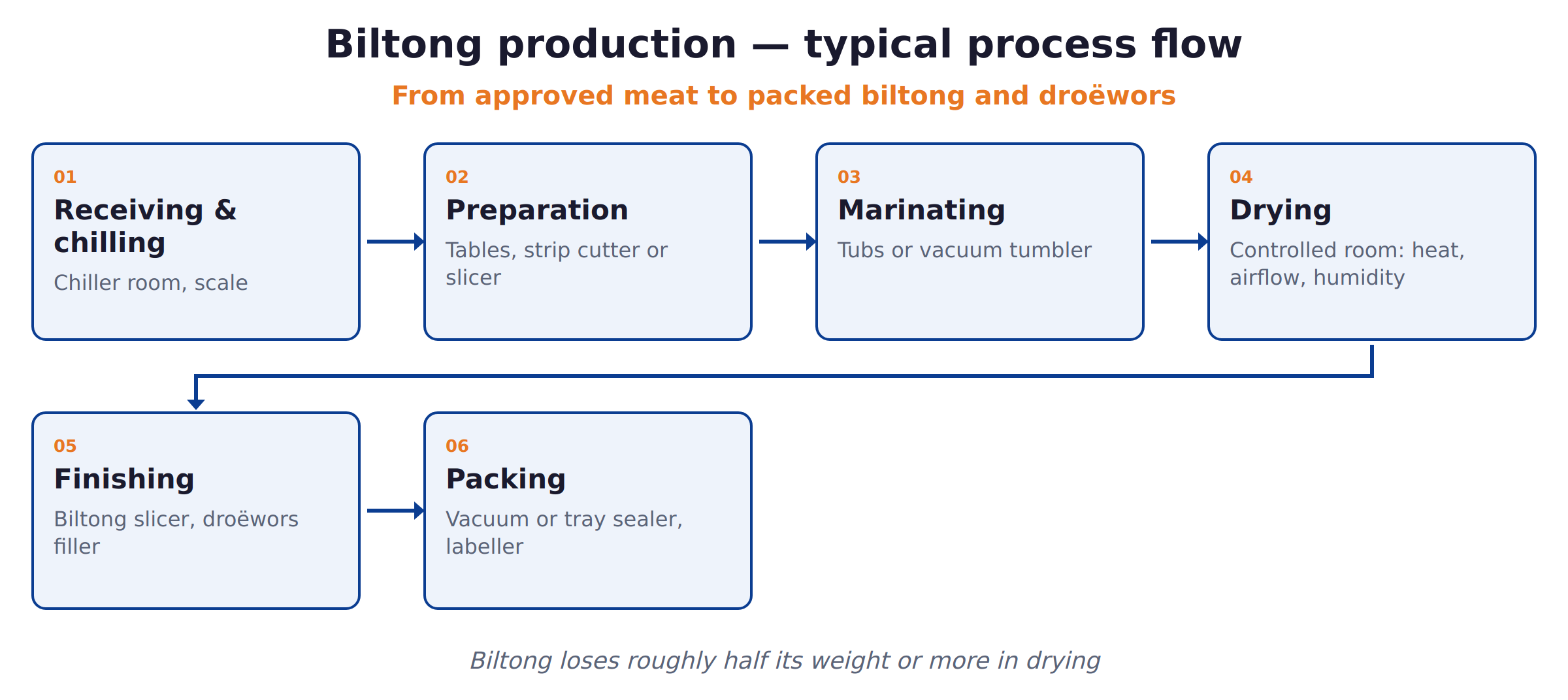
| Area | Equipment | Price |
|---|---|---|
| Receiving and raw storage | Chiller room, scale | Small chiller rooms about US$15,000–38,000 installed |
| Preparation | Stainless tables, knives, strip cutter or slicer | Priced per configuration |
| Marinating | Tubs or a vacuum tumbler | Priced per configuration |
| Drying | Drying room or cabinets with fans, heating, dehumidification and controls | Priced per configuration |
| Finishing | Biltong slicer, droëwors filler if needed | Priced per configuration |
| Packing | Vacuum or tray sealer, labeller, coder | Priced per configuration |
Drying is the heart of the business. A drying room with controlled temperature, humidity and airflow dries evenly, every season, in a fraction of the floor space of hanging lines in an open room, and reduces the risk of mould and case hardening.
Step 5: size the drying room
Work back from what you will sell. If you sell 500 kg of biltong a week and your drying yield is around 45–50%, you need roughly 1,000–1,100 kg of wet meat a week. Divide by the batches you can dry each week, given your drying time for your product, to get the load per batch, and size the hanging rails or racks for that load with space for airflow. Add capacity for droëwors and chilli bites if you make them. These figures are an example; test your own yields.
Step 6: cost per kilogram
Add meat, spices and vinegar, casings for droëwors, packaging, labour, electricity for drying and cold rooms, rent, testing, transport and retailer margins. Because about half the wet weight is lost, a small change in yield or meat price changes the cost per kilogram sharply. Measure yield on every batch.
Step 7: sell, and the limits on export
Biltong sells at butcheries, markets, garages and forecourt shops, pubs, sports events, retailers and online. Many South Africans abroad want biltong, but exports of meat products depend on animal health status. In reply to parliamentary questions in late 2025, the Minister of Agriculture said several markets had closed to South African exports since the foot-and-mouth outbreak, and that products of cloven-hoofed animals may be exported only if the virus has been sufficiently inactivated or treated. Check the current export conditions with the Department of Agriculture before you plan export.
Worked example: from a garage to a registered factory
A biltong maker in Pretoria dries about 200 kg of wet meat a week in a converted garage and sells to friends and a pub. A chain of forecourt shops wants sealed packs. The business leases a small food unit, separates raw and dried areas, installs a chiller room, a vacuum tumbler, a controlled drying room for about 300 kg per batch, a slicer and a vacuum packer, writes a HACCP plan and gets its Certificate of Acceptability. It checks the classification of its products with the NRCS, prints R146-compliant labels and starts supplying the forecourt shops with 80 g sliced packs. The figures are illustrative.
Common mistakes
- Meat without proof of abattoir origin.
- Drying in an uncontrolled room: mould in wet weather, case hardening in dry weather.
- No yield records.
- Labels without net weight, batch or storage instructions.
- Planning export without checking animal health rules.
Food safety controls
Biltong is a raw meat product made safe by salt, vinegar and drying, so each step must be controlled. Keep raw meat cold until it is cut and marinated, use measured amounts of salt and vinegar for every batch, and dry until the product reaches your target moisture or weight loss. Clean cutting surfaces and tumblers between batches, keep raw and dried products apart, and train staff in hand hygiene. A HACCP plan identifies these critical points and how you monitor them; retailers will ask to see it. Test finished product periodically for microbiology at an accredited laboratory, and keep the results with your batch records.
Where CISH fits
We supply meat processing and drying lines, chilling, cutting, tumbling, controlled drying rooms, slicing and packing, from audited factories in China, sized to your weekly output. CISH ships, clears, installs and commissions the equipment, and trains your team. For a small drying cabinet or a single slicer, a local supplier is usually the better buy.
Frequently asked questions
Do I need a licence to sell biltong?
Yes. You need a Certificate of Acceptability for your food premises under R638, meat from registered abattoirs, and labels that meet R146. Check with the NRCS how VC 9100 applies to your products.
Can I make biltong at home and sell it?
Only from premises that hold a Certificate of Acceptability and meet R638.
How much meat do I need for 1 kg of biltong?
Typically about 2 kg of wet meat or a little more, because biltong loses roughly half or more of its weight in drying.
Can I export biltong?
Exports of products of cloven-hoofed animals are restricted after the foot-and-mouth outbreak; check current conditions with the Department of Agriculture.
What equipment do I need?
A chiller room, cutting tables or a slicer, marinating tubs or a tumbler, a controlled drying room, a biltong slicer and a vacuum packer.
Does CISH supply biltong drying rooms?
Yes, as part of complete meat processing and drying lines.