As an indication for 2026, a semi-automatic potato crisp line of about 100–300 kg an hour costs about US$15,000–80,000 ex-works; puffed snack extrusion lines are priced per configuration. Raw material, oil and packaging are most of the cost: crisps yield roughly a quarter to a third of the raw potato weight, so potato price and quality matter. Your premises need a Certificate of Acceptability under R638, labels must meet R146, and savoury snacks must meet the sodium limits in R214 of 2013, for example 550 mg of sodium per 100 g for flavoured potato crisps as originally set. Big brands dominate supermarket shelves, so new makers usually win in spaza shops, schools, garages and regional wholesalers with value packs.
Step 1: choose your product
| Potato crisps | Puffed maize snacks | |
|---|---|---|
| Raw material | Fresh potatoes | Maize grits |
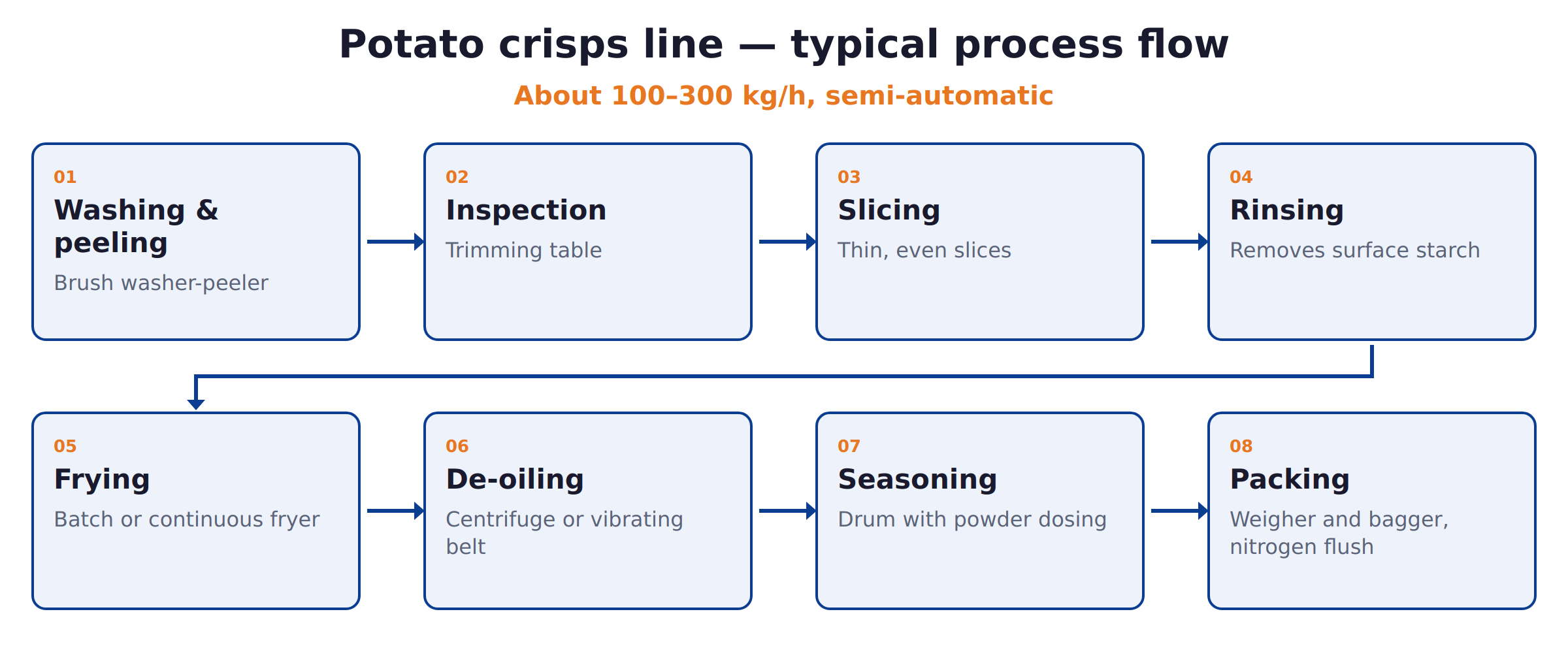
| Key machines | Washer-peeler, slicer, fryer, de-oiler, seasoning drum, packer | Extruder, dryer or oven, oil and seasoning drum, packer |
| Frying | Yes | Often no; baked or dried, then coated |
| Raw material risk | Potato quality and price swings | Grits supply is steadier |
| Typical packs | 30–125 g bags | Small value packs, multipacks |
| Main channels | Retail, garages, schools | Spaza shops, schools, wholesalers |
Step 2: understand the market
Large brands dominate supermarket crisps. Local makers usually grow through:
- Spaza shops and informal traders: small value packs at low prices, delivered often.
- Schools and tuck shops.
- Garages and convenience stores with regional brands.
- Private label for wholesalers and regional retailers.
- Speciality crisps: kettle-cooked, sweet potato, or local flavours at premium prices.
Price per pack, flavour and steady supply win these channels.
Step 3: licences, labels and sodium
- Premises: a food premises meeting R638 with a Certificate of Acceptability from your municipality.
- Labels: R146 of 2010 requires the product name, ingredients, allergens, net quantity, batch, dates and your details.
- Sodium: R214 of 2013 set maximum sodium levels for savoury snacks; as originally set, flavoured potato crisps were limited to 550 mg per 100 g, salt-and-vinegar flavours to 850 mg, and other ready-to-eat savoury snacks to 700 mg from June 2019. The regulations have since been amended, so check the current limits for your product.
- Retail: supermarkets ask for a food safety audit and barcodes.
Step 4: equipment and costs
| What you buy | Capacity | Indicative price (2026) |
|---|---|---|
| Semi-automatic potato crisp line | About 100–300 kg an hour of crisps | About US$15,000–80,000 ex-works |
| Automatic frozen fries line | Higher output | About US$120,000–500,000+ |
| Puffed maize snack extrusion line | By output | Quoted per configuration |
| Nitrogen-flush packing machine | By speed and bag size | Priced per configuration |
Our potato chips machine price guide shows the bands. Processing machines under 8438.80 and packing machines under 8422.40 enter duty-free.
Step 5: raw materials
Potatoes for crisps need low sugar and the right dry matter, or crisps fry dark. Agree supply with farmers or packers and store potatoes cool and dark. Potatoes South Africa represents growers and publishes industry information. Puffed snacks need consistent maize grits, oil and seasoning blends. Oil is a large cost: keep frying temperature steady and filter oil daily.
Step 6: packaging
Crisps go stale quickly in air and light. Metallised film bags flushed with nitrogen keep them crisp and protect them from crushing. A vertical form-fill-seal machine with a multihead weigher and nitrogen flushing is the usual choice once volumes grow. Our guide to types of packaging machines explains the options.
Step 7: the numbers
Cost per pack is potatoes or grits, oil, seasoning, film, nitrogen, gas or power for frying, labour, distribution and finance. Measure yield: if crisps are about a quarter to a third of raw potato weight, a tonne of potatoes makes roughly 250–330 kg of crisps, depending on peel losses and slice thickness. Price packs for your channel, leaving margin for wholesalers and shops.
Worked example: a township snack brand grows
A business in Soweto makes puffed maize snacks in small batches and sells to spaza shops in the area. Demand grows, and a wholesaler offers to distribute across Gauteng. The owner moves into a food unit with a Certificate of Acceptability and installs an extrusion line with a dryer, a seasoning drum and a vertical packer for small value packs. Flavours are tested for sodium against R214, and labels are updated. The figures are illustrative.
Common mistakes
- Wrong potatoes: dark, oily crisps.
- No nitrogen flushing: stale crisps and returns.
- Sodium above the limits.
- Competing on supermarket shelves first.
- Oil not filtered or changed.
Potatoes, oil and quality
Chips are mostly potato, oil and packaging, so those three set your cost and quality. Potatoes for frying need low sugar and suitable dry matter; the wrong variety or potatoes stored too cold turn dark when fried. Buy from growers who supply processing varieties, and store potatoes cool, dark and ventilated, not refrigerated. Test a sample from each delivery by frying a few slices before accepting the load.
Oil quality decides taste and shelf life. Filter frying oil regularly, top it up, and replace it when it darkens or smokes. Track oil use per kilogram of chips; it is one of the main costs to control. For packaging, use a barrier film that keeps out light and moisture, and consider nitrogen flushing for longer shelf life. Pack weights must meet the net quantity rules.
Testing the market first
Many chip makers start with a small batch fryer and sell locally to learn which flavours and pack sizes sell. Keep notes on cost per pack, returns and which shops reorder. When repeat orders are steady, move to a continuous line with slicing, washing, frying, de-oiling, seasoning and packing, sized for your proven volumes rather than your hopes.
Food safety and records
Keep records of potato lots, oil changes, cleaning and seasoning batches. Acrylamide forms when starchy foods are fried at high temperatures, so control frying temperature and time and avoid very dark chips. Retailers will ask how you manage it.
Equipment in a small chips plant
A small plant usually has a peeler, a slicer, washing and blanching tanks, a fryer, a de-oiling centrifuge, a seasoning drum and a packing machine. Each must match the others in output, so the slowest machine sets the line's capacity. Ask suppliers for the full line in one quote, sized to your kilograms an hour.
Where CISH fits
We supply complete snack lines, potato crisp lines from washing to packing, and puffed snack extrusion lines, from audited factories in China, sized to your output and packs. CISH ships, clears, installs and commissions the line on your raw materials, and trains your team. For a small fryer or slicer, a local supplier is usually the better buy.
Frequently asked questions
How much does it cost to start a chips business in South Africa?
As an indication for 2026, a semi-automatic potato crisp line of about 100–300 kg an hour costs about US$15,000–80,000 ex-works; puffed snack lines are quoted per configuration.
What licence do I need to make chips?
A Certificate of Acceptability for your food premises under R638, and labels that meet R146.
Are there sodium limits for chips?
Yes. R214 of 2013 set maximum sodium levels for savoury snacks, including potato crisps; check the current amended limits.
How many crisps come from a tonne of potatoes?
Roughly 250–330 kg, depending on potato quality, peeling losses and slice thickness.
Why use nitrogen in chip packets?
It keeps oxygen out, so crisps stay fresh and crunchy, and cushions them in the bag.
Does CISH supply snack lines?
Yes, complete crisp and puffed snack lines with commissioning and training.