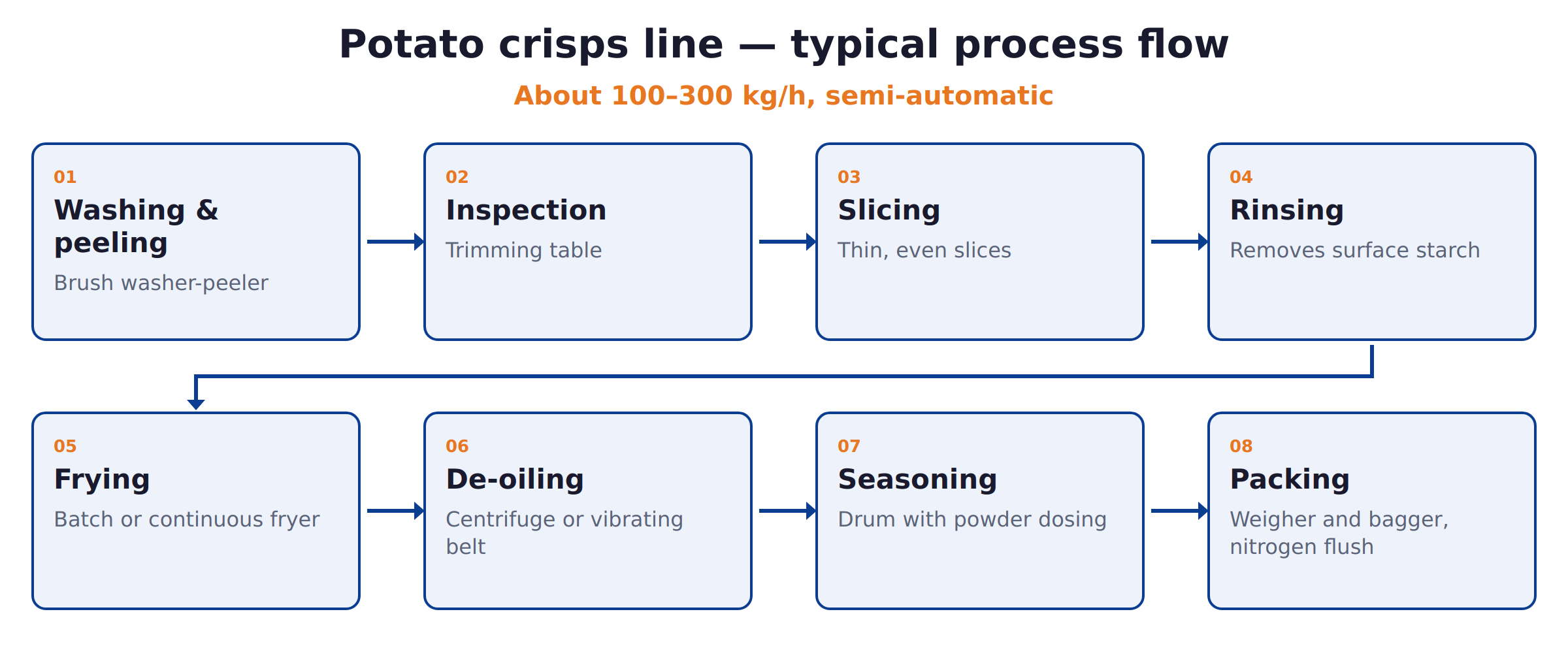
A crisps line washes, peels and slices potatoes thinly, washes off surface starch, fries the slices, de-oils and seasons them, and packs them in nitrogen-flushed bags. A frozen French fries line cuts potatoes into strips, blanches them, par-fries them, freezes them in a tunnel freezer and packs them for frozen storage. As an indication for 2026, a semi-automatic crisps or fries line for about 100–300 kg an hour costs about US$15,000–80,000 ex-works from Chinese factories; a fully automatic frozen fries line with blanching, frying and freezing costs about US$120,000–500,000 or more; industrial plants are quoted per configuration. Imported frozen fries and other potato products carry 20% general duty, with exemptions for the EU and SADC. CISH supplies, installs and commissions complete crisps and fries lines.
Potato chips and fries line prices in 2026
| Line | Output | What is included | Indicative price (2026) |
|---|---|---|---|
| Semi-automatic crisps or fries line | About 100–300 kg/h | Washer-peeler, slicer or cutter, rinsing, batch fryer, de-oiler, seasoning drum | About US$15,000–80,000 ex-works |
| Fully automatic frozen fries line | Several hundred kg/h and up | Washing, steam or abrasive peeling, cutting, blanching, drying, continuous fryer, tunnel freezer, packing | About US$120,000–500,000 or more |
| Automatic crisps line with nitrogen packing | Per output | Continuous fryer, de-oiling, seasoning, multihead weigher, nitrogen form-fill-seal | Quoted per configuration |
| Industrial plant | Tonnes per hour | Multiple lines, optical sorting, freezing and storage | Quoted per configuration |
Ex-works prices; freight, installation, building, utilities and working capital are extra. On snack projects like this, the machinery is typically only 35–55% of the total spend.
Crisps and frozen fries: the two processes
| Step | Crisps (potato chips) | Frozen French fries |
|---|---|---|
| Washing and peeling | Yes | Yes |
| Cutting | Thin slices, about 1–2 mm | Strips of a set cross-section |
| Starch removal | Slices rinsed | Strips washed |
| Blanching | Sometimes, to control colour | Yes, to set texture and colour |
| Drying | Air knives remove surface water | Yes |
| Frying | Full fry to crisp | Par-fry only |
| De-oiling | Centrifugal or vibrating | Shaking |
| Seasoning | Drum or tumbler | Usually none |
| Freezing | No | Tunnel or spiral freezer |
| Packing | Nitrogen-flushed bags | Frozen bags, cold store |
What drives the price
- Output in kg of finished product per hour.
- Batch or continuous frying. Continuous fryers give consistent colour at volume.
- Oil heating. Direct gas or thermal oil heat exchangers; oil filtration extends oil life.
- Peeling method. Abrasive peelers for small lines; steam peelers for less waste at scale.
- Freezing, which is a large share of a fries line.
- Packing. Nitrogen flushing for crisps; frozen packing and cold storage for fries.
- Optical sorting to remove defects.
Raw material: potatoes decide the product
Crisps need potato cultivars with high dry matter and low sugars, so the chips fry light and crisp; fries need long, floury potatoes for long strips. Storage conditions matter: cold-stored potatoes build up sugars and fry dark. Potatoes South Africa represents growers and provides industry information; agree supply of suitable cultivars with growers before you size a line. As a rough guide, finished crisps are around a quarter to a third of the raw potato weight, and fries retain more, but your own yield depends on cultivar, peeling, cutting and frying.
Utilities and running cost
Frying needs steady heat and good extraction for oil vapour; freezing needs large refrigeration capacity. Both put pressure on power and fuel costs, with Eskom's standard tariffs up 8.76% for 2026/27. Plan for:
- Gas, thermal oil or electric heating for the fryer.
- Refrigeration for the freezer and cold store on fries lines.
- Water for washing, peeling and cutting, and effluent with starch and peel.
- Fire protection around fryers.
Choosing by scenario
- New snack business: a semi-automatic crisps line with a batch fryer and semi-automatic bagging, sold to local retailers and spaza shops.
- Food service supplier: a fries line with blanching, par-frying and freezing, supplying restaurants and caterers, with a cold store.
- Upgrading an existing snack plant: a continuous fryer, oil filtration and a nitrogen packing line for longer shelf life.
How to compare quotes and choose a supplier
- Finished product per hour, not raw potato input.
- Fryer type, heat source and oil volume.
- Oil filtration and oil turnover.
- Peeling losses at your potato size.
- Freezer capacity and temperature for fries.
- Seasoning and packing included, with nitrogen for crisps.
- Utilities: heat, power, water and refrigeration.
- Installation, commissioning on your potatoes, and training.
- Spares for blades, belts and fryer parts.
- References of plants running similar products.
Rules and duty in South Africa
- Food premises. The plant needs a Certificate of Acceptability under R638 of 2018.
- Labelling. Crisps and frozen fries must be labelled under R146, with ingredients, allergens where relevant, net quantity and dates.
- Import duty on products. Frozen French fries (2004.10) and other prepared potatoes including crisps (2005.20) carry 20% general duty, with exemptions for the EU and SADC.
- Duty-free machinery. Vegetable preparation machinery (8438.60), industrial freezing equipment (8418.69.90) and packing machinery (8422.40) carry no general duty.
Worked example: a regional crisps business
Consider a snack maker that wants to sell salted and flavoured crisps in 30 g and 125 g packs to spaza shops, schools and local retailers. A semi-automatic line of about 100–150 kg of finished crisps an hour fits a first market: a washer-peeler, a slicer, a rinsing tank, a batch fryer with oil filtration, a centrifugal de-oiler, a seasoning drum and a semi-automatic bagger with nitrogen flushing.
The owner's first task is not the machine but the potatoes. Chips made from the wrong cultivar, or from potatoes stored too cold, fry dark and taste bitter, so the business agrees a supply of suitable potatoes with growers and stores them at the right temperature. The second task is oil: filtering the oil every shift and topping it up keeps the flavour stable and the oil life long. As sales grow, the business replaces the batch fryer with a continuous fryer and adds a multihead weigher and automatic bagger, which lift output and pack accuracy without many more staff.
Shelf life and packaging
Crisps go stale when they absorb moisture and the oil oxidises, so packaging is part of the product. Metallised or barrier film keeps out light and moisture, and flushing the bag with nitrogen before sealing pushes out oxygen and cushions the chips against breakage. Bag size, fill weight and seal strength should be checked every shift. Frozen fries have the opposite problem: they must stay frozen from the freezer to the customer's fryer, so the cold store, the delivery vehicles and the customer's freezer all matter. In both cases, a line that makes good product but packs it badly loses the margin in returns.
Common mistakes
- Wrong potato cultivar. Chips fry dark or soft.
- No oil filtration. Oil degrades quickly and flavour suffers.
- No nitrogen flushing. Crisps go stale and break.
- Undersized freezer on a fries line.
- Ignoring starch effluent.
Where CISH fits
We supply complete crisps and frozen fries lines, from washing and peeling to frying, freezing and packing, from audited factories in China, matched to your product and output. CISH ships and clears the line, installs and commissions it with output demonstrated on your potatoes, and trains your team. For a single fryer for a takeaway, a local catering dealer is the better choice.
Before you buy the line, see how to start a chips manufacturing business: raw material, packaging and where new brands sell.
Frequently asked questions
How much does a potato chips making machine cost in South Africa?
As an indication for 2026, a semi-automatic line for about 100–300 kg an hour costs about US$15,000–80,000 ex-works. A fully automatic frozen fries line costs about US$120,000–500,000 or more.
What is the difference between a crisps line and a fries line?
A crisps line fries thin slices fully and packs them in nitrogen-flushed bags. A fries line par-fries strips and freezes them.
Which potatoes are best for chips?
Cultivars with high dry matter and low sugars for crisps, and long, floury potatoes for fries. Agree supply with growers before sizing a line.
Is there import duty on frozen fries in South Africa?
Frozen French fries carry 20% general duty, with exemptions for the EU and SADC.
What licence do I need to make potato chips?
A Certificate of Acceptability for the food premises under R638, and labels that meet R146.
Does CISH supply takeaway fryers?
No. We supply complete crisps and fries production lines.