Customers include meat and poultry producers, fish and frozen food importers and distributors, fruit and vegetable growers and packhouses, dairies, and food manufacturers who lack their own space. The store's value is in reliable temperature, clean handling, records and location close to customers and transport routes. Electricity is the largest running cost: Eskom's standard tariff rose 8.76% for 2026/27, and many business tariffs include demand and time-of-use charges, so insulation, efficient refrigeration and smart scheduling decide profit as much as occupancy. You also need a food premises with a Certificate of Acceptability if you store food, refrigeration work by SAQCC Gas authorised persons, and backup power.
Step 1: choose your model
| Model | How you earn | Customers |
|---|---|---|
| Third-party storage | Fee per pallet position per day, week or month, plus handling | Producers, importers, distributors |
| Own frozen food trading | Margin on stock you buy and sell | Retailers, butchers, caterers |
| Produce cooling | Fee per bin or pallet in season | Farmers and packhouses |
| Mixed | Storage fees and trading | Several |
Third-party storage is steadier but needs enough customers to fill the rooms; trading earns more per pallet but carries stock risk.
Step 2: temperatures and rooms
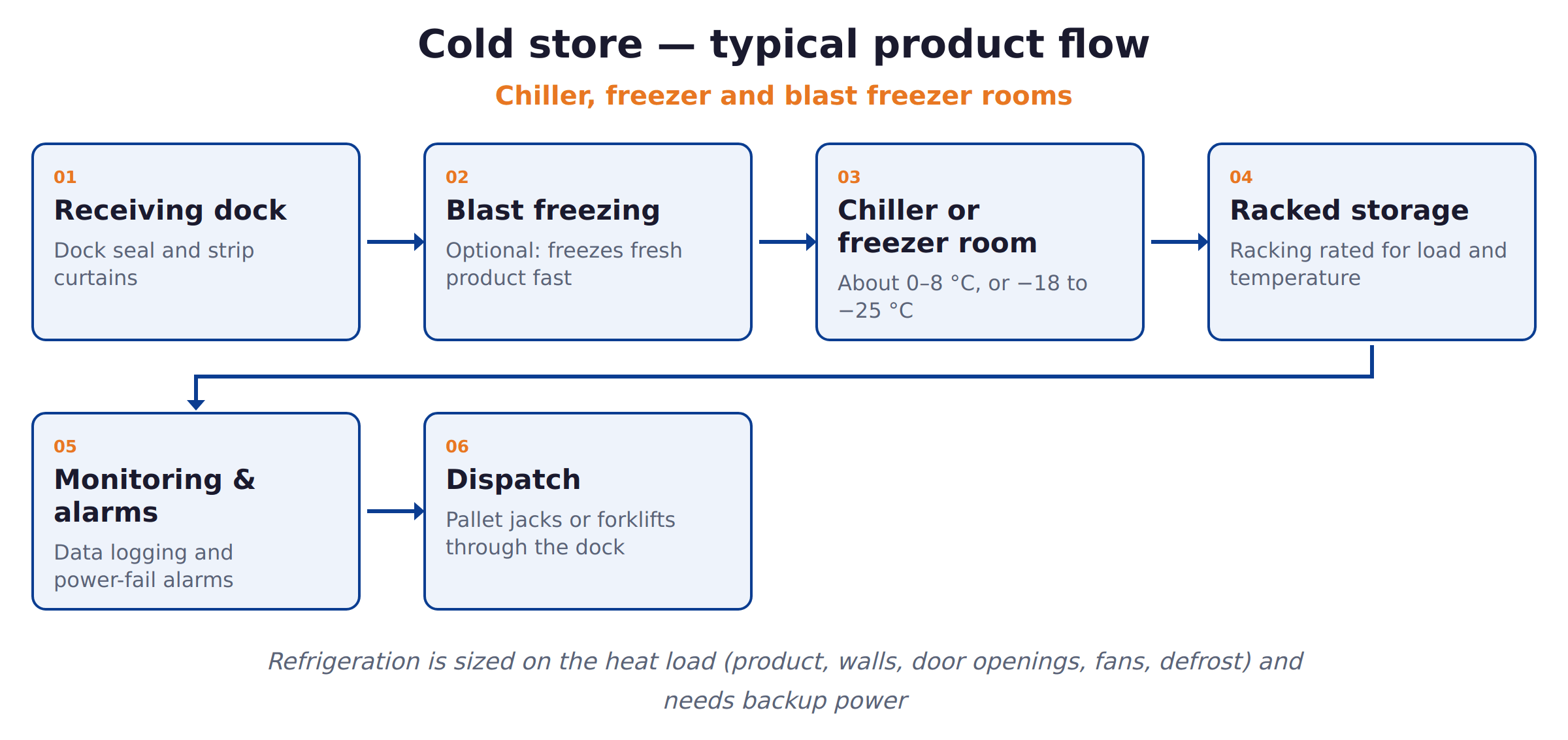
- Chillers at about 0–8 °C for fresh produce, dairy and meat holding.
- Freezer rooms at about −18 to −25 °C for frozen meat, fish, vegetables and ready meals.
- Blast freezers to freeze fresh product quickly for customers who need it.
Different products often need separate rooms; raw and ready-to-eat foods must be kept apart. Our guide what size cold room do I need shows how to size rooms by pallets.
Step 3: location
- Near customers and on good transport routes, or near ports and markets.
- Strong power supply with room to grow, and space for a generator or solar.
- Truck access for refrigerated trucks, with a loading dock or covered bay.
- Zoning that allows warehousing and refrigeration plant.
Step 4: equipment and costs
| What you buy | Indicative price (2026) |
|---|---|
| Small to medium chiller room, installed | About US$15,000–38,000 |
| Cold room kit plus installation | About US$5,000–40,000 plus about US$2,500–7,500 |
| Blast freezer | From about US$60,000 |
| Multi-room store with racking and docks | Quoted per configuration |
Add racking, forklifts or pallet jacks, a loading dock with seals, temperature monitoring and alarms, and backup power. Our cold room price guide breaks down the bands, and our guide to choosing a cold room company lists what every quote must include.
Step 5: electricity: the running cost that decides profit
Eskom's standard tariff rose 8.76% for 2026/27, and many business tariffs include charges for maximum demand and different prices by time of day. Ways to cut the bill:
- Thick insulation and good doors to cut heat gain.
- Efficient refrigeration sized correctly, with good condensing conditions.
- Defrost and door management.
- Pre-cool at off-peak times where your tariff rewards it.
- Solar to reduce daytime grid purchases.
Ask installers for the expected kWh per pallet position per month, and test your pricing against it.
Step 6: licences, records and safety
If you store food, your premises are a food premises under R638 and need a Certificate of Acceptability. Keep temperature logs, cleaning records and stock records for each customer. Refrigeration work must be done by authorised persons registered with SAQCC Gas, and new plants should not use HCFC refrigerants being phased out under the ozone-depleting substances regulations. Cold store work involves forklifts, low temperatures and heavy loads; follow the OHS Act, provide protective clothing and safe access.
Step 7: the numbers (example)
Revenue = occupied pallet positions × fee per pallet per month + handling fees. Costs = electricity, labour, maintenance, insurance, rent or finance, and backup fuel. As an example, a 200-pallet freezer store at 80% occupancy earns on 160 pallets a month; if electricity takes a third of revenue, a 10% rise in the tariff takes a noticeable share of profit. Insurance and service contracts are essential: a breakdown can spoil a customer's whole stock. The figures are illustrative.
Worked example: a produce cold store
A farmer in the Hex River Valley has spare land near the main road and neighbours who lose fruit waiting for trucks. He builds three chiller rooms with racking for about 300 pallets, a loading dock and a generator, charges per pallet per week in season, and stores frozen vegetables for a distributor out of season. Temperature records are sent to customers weekly. The figures are illustrative.
Common mistakes
- Thin panels and cheap doors.
- No backup power or alarms.
- One large room for products that need different temperatures.
- No service contract.
- Ignoring demand charges on the electricity bill.
Contracts, insurance and liability
Customers trust you with stock worth far more than the storage fee. Put that trust in writing: a storage contract should set the temperature range, how you record it, what happens during a power failure or breakdown, how stock is released, the fees and notice periods, and who is liable for loss. Insure the building and equipment, and talk to your broker about cover for customers' stock, often called stock deterioration or goods in trust cover. Many customers will also insure their own stock.
Good records protect you. Log temperatures automatically, keep alarm histories, record every pallet in and out with its date and condition, and photograph damaged stock on arrival. When a customer disputes a loss, records are your evidence.
Building occupancy
New stores often fill slowly. Talk to target customers before you build, ideally with letters of intent, and consider starting with fewer rooms and adding more when the first ones are full. Offer flexible terms to fill quiet seasons, and look for customers whose peak seasons differ from each other, such as fruit in summer and frozen vegetables or meat in winter.
Staff and skills
You need staff who can run forklifts safely in cold rooms, check temperatures, manage stock and respond to alarms at night.
Maintenance and breakdowns
Refrigeration plant must run day and night for years. Agree a service contract with planned visits, keep spare parts for common failures, and know who will answer a call at night or on a public holiday. Clean condensers, check refrigerant charge and door seals, and test alarms and generators regularly. A good maintenance plan costs less than one spoiled room.
Where CISH fits
We supply cold rooms, freezer rooms and blast freezers with refrigeration, racking and backup sized together, from audited factories in China, as part of storage and processing projects. CISH ships, clears, installs and commissions the rooms with registered technicians, and trains your team. For a single small room, a local installer is usually the better buy.
Frequently asked questions
How does a cold storage business make money?
By charging per pallet position for storage plus handling fees, or by trading its own frozen stock.
How much does it cost to build a cold store?
As an indication for 2026, small and medium chiller rooms cost about US$15,000–38,000 installed; larger stores with racking and docks are quoted per configuration.
What is the biggest running cost?
Electricity, including demand and time-of-use charges on many business tariffs.
Do I need a licence to store food?
Yes. A food storage premises needs a Certificate of Acceptability under R638.
What temperature do frozen foods need?
Freezer rooms usually run at about −18 to −25 °C.
Does CISH supply cold stores?
Yes, as part of storage and processing projects, with commissioning and training.