Many brands start by having products made by a contract manufacturer and move to their own factory when volumes are steady. In South Africa, cosmetics fall under the Foodstuffs, Cosmetics and Disinfectants Act 54 of 1972, ingredient labelling follows SANS 98 with INCI names, packs must show net quantity, and claims must follow the advertising code. Draft regulations on cosmetic labelling, advertising and composition would require a safety assessment for each product, manufacture under good manufacturing practice and a product information file; check their current status, but many retailers already expect this. Complete lines with water treatment, mixing, filling, capping and labelling are priced per configuration.
Step 1: own brand, contract maker, or both
| Own brand, contract-made | Own factory | Contract manufacturer for others | |
|---|---|---|---|
| What you do | Formulate or brief, brand, sell | Make and sell your brand | Make for many brands |
| Investment | Low | Medium to high | Medium to high |
| Control | Less | Full | Full, but on others' schedules |
| Margin | Lower per unit | Higher at volume | Steady fees, volume driven |
| Risk | Supplier quality, minimums | Capacity, compliance | Customer concentration |
A common path is to launch with a contract maker, prove the brand sells, then invest in a factory that may also make for other brands.
Step 2: products and formulas
Start with a few products that suit one customer group, such as hair food and leave-in conditioner for natural hair, or body butters and lotions. Work with a cosmetic chemist to develop stable, safe formulas, test them for stability, preservation and compatibility with your packaging, and document each formula. Buy raw materials from reliable suppliers who provide specifications and safety data sheets.
Step 3: rules, labels and claims
- The Act: cosmetics fall under the Foodstuffs, Cosmetics and Disinfectants Act 54 of 1972, administered by the Department of Health.
- Ingredient labels: SANS 98 sets ingredient labelling using INCI names in descending order of concentration.
- Net quantity: under the Legal Metrology rules (SANS 289), with contents within tolerance.
- Claims: the Advertising Regulatory Board's cosmetic code covers what you may claim.
- Draft regulations: published for comment, they include a safety assessment, GMP and a product information file kept for at least 10 years after the last batch is sold. Check their status with the Department of Health.
Products claiming to kill germs or treat conditions may fall under other rules. Our guide to cosmetic labelling regulations sets out what must be on the pack.
Step 4: equipment
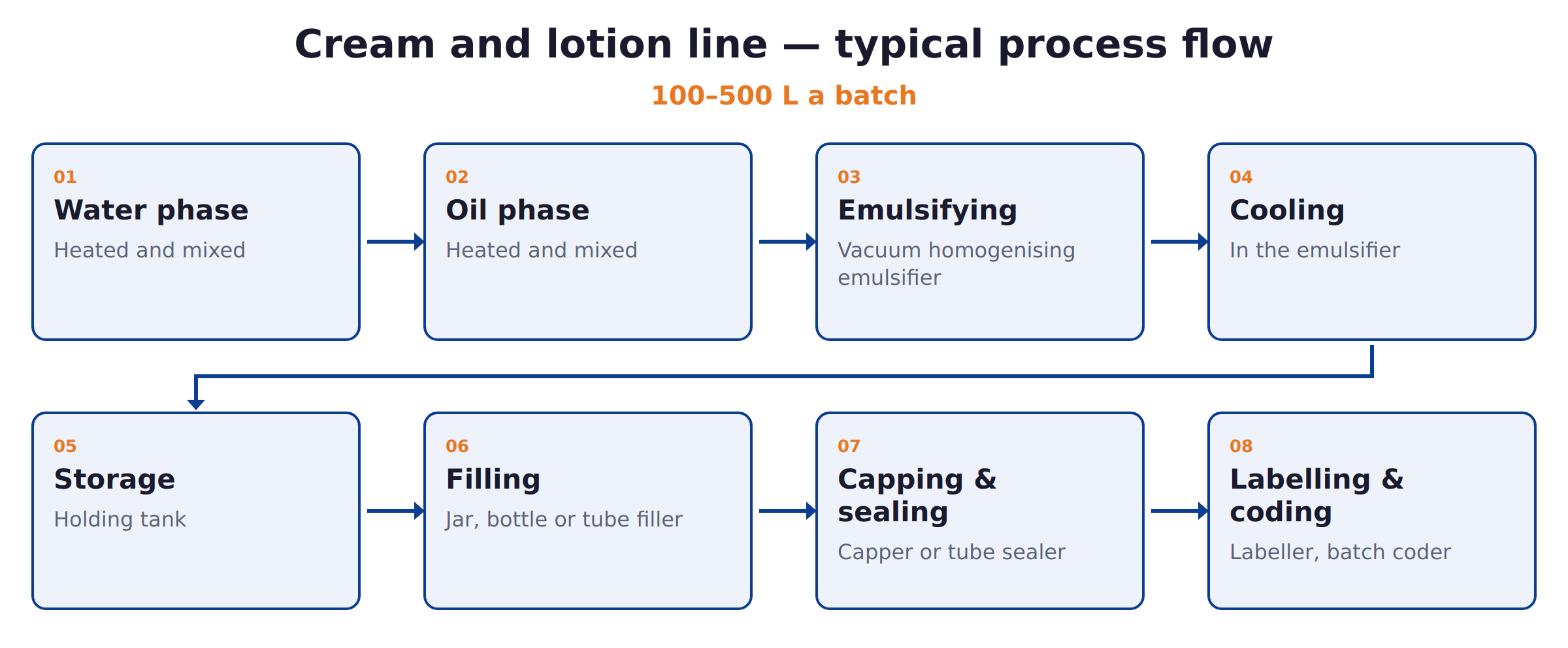
- Water treatment: purified water, usually by reverse osmosis, because water is the main ingredient in most products.
- Vacuum homogenising emulsifier: for creams and lotions; mixes oil and water phases under vacuum with a homogeniser and heating and cooling.
- Mixing tanks: for shampoos, gels and liquids.
- Filling machines: piston fillers for creams, liquid fillers for shampoo, tube fillers for tubes.
- Capping, sealing, labelling and coding.
- Laboratory: pH, viscosity and stability testing.
Step 5: costs
| What you buy | Indicative price (2026) |
|---|---|
| Vacuum homogenising emulsifier, 100–500 L | About US$5,000–52,000 ex-works |
| Semi-automatic filler | About US$1,000–10,000 each |
| Complete line with water treatment, mixing, filling, capping, labelling | Quoted per configuration |
Mixing and emulsifying machines (8479.82) and filling machines (8422.30) carry no general import duty, though import VAT applies. Our cosmetic filling machine price guide shows the bands.
Step 6: the premises and GMP
Cosmetics should be made in a clean, organised area with washable surfaces, separate areas for raw materials, mixing, filling and finished goods, controlled access, and hygiene rules for staff. Good manufacturing practice means documented procedures, batch records, cleaning records, trained staff and quality checks. Retailers often audit suppliers against GMP, so build it in from the start.
Step 7: selling
Channels include salons and spas, pharmacies, independent stores, online shops and social media, markets, and large retailers once your systems are in place. Large retailers expect GMP, product information files, barcodes, insurance and steady supply.
The numbers
Cost per unit is raw materials, packaging (often a large share for cosmetics), labour, energy, testing, certification, marketing, distribution and finance. Packaging minimum orders can tie up cash, so start with stock packs and add custom packs as you grow.
Worked example: a natural haircare brand in Johannesburg
A haircare brand made by a contract manufacturer sells well online and in salons, but the maker's minimums and lead times hold it back. The founders lease a small unit, install reverse osmosis water treatment, a 200 litre vacuum emulsifier, a mixing tank, a piston filler and a capper, and hire a cosmetic chemist. They keep batch records and product information files from the first batch, and later begin making products for two smaller brands. The figures are illustrative.
Quality and stability
Test each new formula for stability at different temperatures over time, check preservation, and test compatibility with your packs. For each batch, check pH, viscosity, appearance and smell, and keep retention samples. Record raw material lots so you can trace any problem.
Safety
Emulsifiers, heated vessels and mixers are covered by the OHS Act. Guard moving parts, train staff, and handle raw materials according to their safety data sheets.
Common mistakes
- No cosmetic chemist or stability testing.
- Labels without INCI lists or net quantity.
- Claims beyond what the code allows.
- No batch records or product information files.
- Buying a large line before the brand sells.
Packaging choices
Packaging sells cosmetics as much as the formula. Jars suit creams and butters, tubes suit lotions and gels, bottles with pumps or flip caps suit shampoos and lotions, and sachets suit trial sizes and low price points. Check that your filler handles each pack, that lids seal, and that packs do not react with the product. Stock packs from packaging distributors let you start without large minimum orders; custom moulded packs come later.
Contract manufacturing for others
Once your line runs well, making products for other brands can use spare capacity. Agree in writing who owns each formula, who is responsible for the product information file and safety assessment, how batches are approved and released, minimum orders and lead times, and who pays for testing and recalls. Keep each customer's materials, labels and records separate to avoid mix-ups. Contract work can fill quiet months, but do not let it crowd out your own brand in your busiest season; plan capacity for both.
Where CISH fits
We supply complete cosmetic manufacturing lines, water treatment, vacuum emulsifiers, mixing tanks, filling, capping and labelling, from audited factories in China, sized to your products and batches. CISH ships, clears, installs and commissions the line on your formulas, and trains your team. For a single small emulsifier for trials, a local supplier is usually the better buy.
Frequently asked questions
Which law covers cosmetics in South Africa?
The Foodstuffs, Cosmetics and Disinfectants Act 54 of 1972, administered by the Department of Health.
What must be on a cosmetic label?
The product name, ingredients by INCI name in descending order, net quantity, batch, your details and any warnings.
What machine do I need to make creams?
A vacuum homogenising emulsifier, plus filling and capping machines.
How much does a cosmetic emulsifier cost?
As an indication for 2026, 100–500 litre vacuum emulsifiers cost about US$5,000–52,000 ex-works.
Can I start a cosmetic brand without a factory?
Yes, with a contract manufacturer, then build your own line when volumes are steady.
Does CISH supply cosmetic lines?
Yes, complete lines with commissioning and training.