A complete cream and lotion line with water treatment, emulsifying, storage, filling and labelling is quoted per configuration. Cosmetics fall under the Foodstuffs, Cosmetics and Disinfectants Act, ingredients are labelled following SANS 98, and imported beauty preparations carry 20% general duty. CISH supplies, installs and commissions complete cosmetic lines.
Cosmetic line prices in 2026
| Purchase | Capacity | What is included | Indicative price (2026) |
|---|---|---|---|
| Vacuum homogenising emulsifier | 100–500 L a batch | Main tank with homogeniser and scraper agitator, oil and water phase tanks, vacuum, heating, lifting lid | About US$5,000–52,000 ex-works |
| Semi-automatic filler, capper or labeller | Per machine | Operator places each container | About US$1,000–10,000 each |
| Automatic fill-cap-label or tube fill-seal monoblock | By product and speed | Filling, capping or tube sealing, coding, labelling | About US$13,000–60,000 |
| Complete cream and lotion line | Per configuration | Water treatment, emulsifiers, storage, transfer, filling, sealing, labelling, packing | Quoted per configuration |
Ex-works listing prices; freight, installation, a clean building, purified water, a laboratory and working capital come on top. Expect the machines to be roughly a third to a half of what the whole cosmetics project costs.
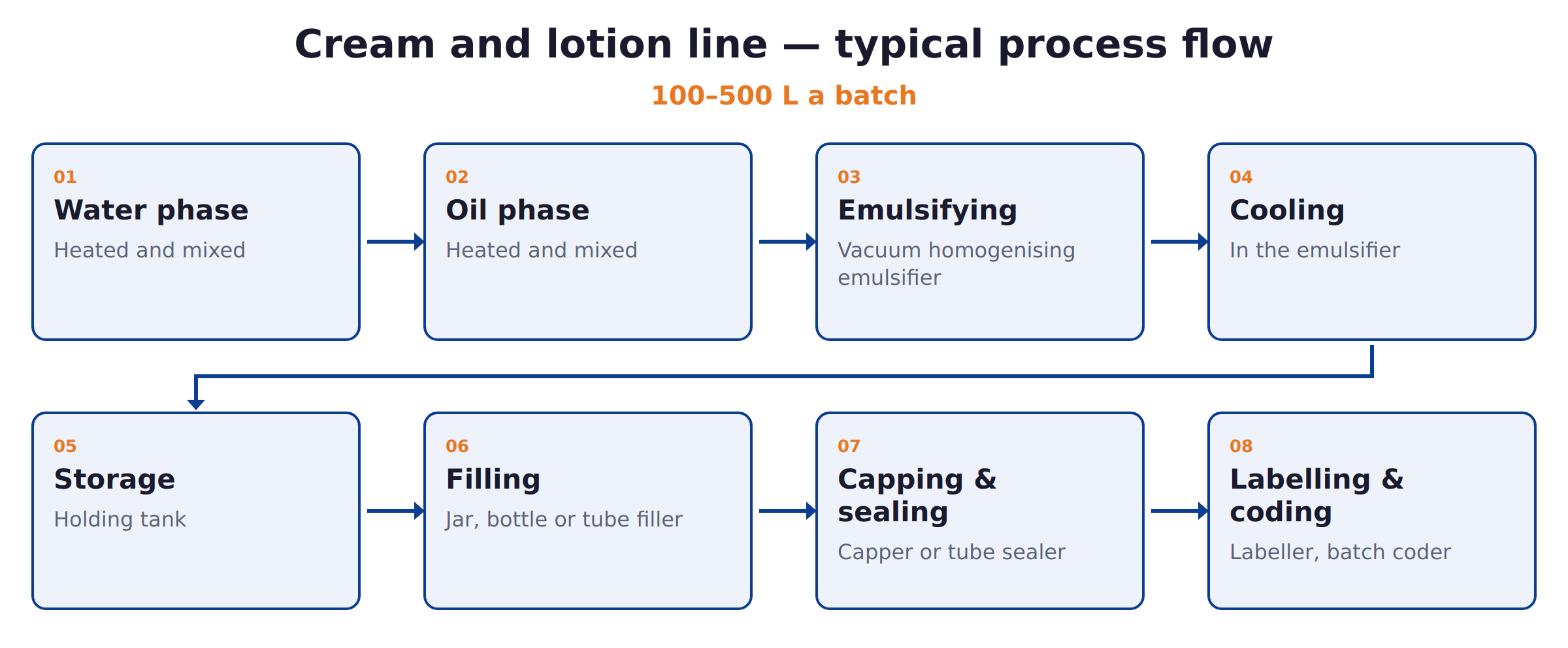
How a cream or lotion line works
- Water treatment. Cosmetics need purified water, usually by reverse osmosis with UV, since water is often most of the product.
- Phase preparation. Oil-phase ingredients are melted in one tank and water-phase ingredients heated in another.
- Emulsifying. Both phases go into the vacuum emulsifier, where a high-shear homogeniser makes fine droplets while vacuum removes air bubbles. The batch is cooled, and heat-sensitive actives, preservatives and fragrance are added at lower temperatures.
- Storage. The batch is held in a storage tank and tested.
- Filling. Piston or pump fillers dose cream into jars, bottles or tubes; servo fillers give the best accuracy on thick products.
- Closing. Capping for bottles and jars; heat or ultrasonic sealing for tubes.
- Coding and labelling. Batch number and expiry date; front and back labels.
- Packing. Cartons, shrink wrap, cases.
Choosing the filler for your product
| Product | Filler | Container |
|---|---|---|
| Lotions, liquid soap, shampoo | Piston or pump filler; bottom-up for foaming products | Bottles with pump or flip caps |
| Creams and body butters | Piston filler with heated hopper for thick products | Jars, tubs |
| Gels and toothpaste-type products | Tube filling and sealing machine | Plastic or laminate tubes |
| Oils and serums | Peristaltic or pump filler | Glass dropper bottles |
| Balms and lip products | Hot-fill depositor | Tins, sticks |
Our guide to types of filling machines explains each principle.
What drives the price
- Emulsifier size and features: homogeniser speed, vacuum, scraper agitator, tilting or bottom discharge.
- Stainless grade and finish of product-contact parts; cosmetics need hygienic, polished surfaces.
- Filling accuracy and servo control.
- Tube sealing: hot air or ultrasonic sealing for different tube materials.
- Changeover time between products and pack sizes.
- Clean-in-place and sanitary fittings.
- Water treatment capacity and quality.
Choosing by scenario
- New skincare brand: one 100–200 L emulsifier, a semi-automatic piston filler, a capper and a labeller, with RO water. Add automation as volumes grow.
- Contract manufacturer: several emulsifiers in different sizes and fillers that change over quickly between clients' products.
- Existing soap or detergent maker adding creams: an emulsifier and piston filler beside the existing liquid line, in a separate clean room.
Landed cost: what else to budget
| Item | Notes |
|---|---|
| Clean production room | Washable surfaces, controlled access, pest control |
| Purified water system | RO and UV, with storage and distribution loop |
| Laboratory | pH, viscosity, stability, microbiological testing |
| Packaging stock | Jars, bottles, tubes, caps, labels, cartons |
| Raw materials | Emulsifiers, oils, actives, preservatives, fragrances |
| Steam or hot water | For phase heating, unless electric |
Filling, closing and labelling machines (8422.30) and mixing machines (8479.82) carry no general import duty.
How to compare quotes
- Emulsifier volume, homogeniser speed and vacuum level.
- Product-contact material and surface finish.
- Filling range and accuracy for each product and pack.
- Tube sealing method for your tube type.
- Changeover time between products.
- Cleaning: CIP or easy dismantling.
- Water treatment included or not.
- Installation, commissioning on your formulations, and training.
- Spares: seals, nozzles, heating elements.
- References from cosmetic plants running similar products.
Rules and duty in South Africa
- The law. Cosmetics are regulated under the Foodstuffs, Cosmetics and Disinfectants Act 54 of 1972.
- Ingredient labelling. SANS 98 sets out how ingredients are labelled on cosmetic products, using standard ingredient names.
- Labelling and composition regulations. Draft regulations on the labelling, advertising and composition of cosmetics have been published; check their current status before printing labels.
- Advertising claims. The Advertising Regulatory Board's code for cosmetics applies to claims such as "anti-ageing" or "whitening".
- Hygiene. Good manufacturing practice for cosmetics, batch records and stability testing are expected by retailers.
- Import duty on products. Beauty and skin care preparations (3304) carry 20% general duty, with exemptions for the EU and UK, EFTA and SADC.
Worked example: a skincare brand bringing production in-house
Consider a skincare brand that has used a contract manufacturer for its body lotion, hand cream and lip balm. Minimum order sizes and long lead times make it hard to launch new products, so the owner sets up a small plant. The core is a 200-litre vacuum emulsifier with oil and water phase tanks, a reverse osmosis water system with UV, a storage tank, a piston filler with a heated hopper for creams, a semi-automatic tube filling and sealing machine for hand cream, a capper and a labeller.
The first batches show why the emulsifier needs vacuum and controlled cooling: without them, creams trap air and separate after a few weeks on the shelf. The brand runs stability tests at room temperature and in a warm cabinet before launch, keeps a batch record for every run, and prints ingredient lists using standard ingredient names. Lip balm is filled by hand from a small heated tank until volumes justify a hot-fill depositor. Bringing production in-house lets the brand launch smaller runs quickly, at the cost of taking on quality control itself.
Common mistakes
- Tap water in the product. Microbial problems and short shelf life.
- No vacuum in the emulsifier. Air bubbles and unstable creams.
- Wrong filler for thick creams. Inaccurate fills and dripping.
- No batch coding. Recalls become impossible.
- Claims that break the advertising code.
Where CISH fits
We supply complete cosmetic lines, water treatment, emulsifiers, storage, filling, sealing, coding and labelling, from audited factories in China, matched to your products and packs. CISH ships and clears the line, installs and commissions it with output demonstrated on your formulations, and trains your team. For one small filler for a start-up, a local dealer is often the better choice.
Frequently asked questions
How much does a cosmetic filling machine cost in South Africa?
As an indication for 2026, semi-automatic fillers cost about US$1,000–10,000 each, and automatic fill-cap-label or tube fill-seal monoblocks about US$13,000–60,000.
How much is a vacuum emulsifier for creams?
As an indication for 2026, a 100–500 litre vacuum homogenising emulsifier costs about US$5,000–52,000 ex-works.
Which filler is best for creams and lotions?
Piston or servo pump fillers. Thick creams may need a heated hopper; gels in tubes need a tube filling and sealing machine.
What rules apply to making cosmetics in South Africa?
The Foodstuffs, Cosmetics and Disinfectants Act, ingredient labelling following SANS 98, the advertising code for cosmetics, and good manufacturing practice.
Is there import duty on cosmetics?
Beauty and skin care preparations carry 20% general duty, with exemptions for the EU and UK, EFTA and SADC.
Does CISH supply single cosmetic fillers?
We supply complete cosmetic lines. For one small filler, a local dealer is often better.