South Africa's milk regulations (R1555 of 1997) allow both: the batch or holder method heats every particle of milk to at least 63 °C, not above 65.5 °C, for at least 30 minutes and cools it below 5 °C within 30 minutes; the HTST method heats to at least 72 °C for at least 15 seconds and cools immediately below 5 °C, with automatic control and monthly calibration. Both need temperature charts kept for at least four weeks and a passing phosphatase test. A batch pasteurizer costs a fraction of that.
The short answer
| Batch (vat) pasteurizer | HTST plate pasteurizer | |
|---|---|---|
| R1555 method | Holder method: at least 63 °C (max 65.5 °C) for 30 minutes, cool below 5 °C within 30 minutes | High-temperature short-time: at least 72 °C for 15 seconds, cool immediately below 5 °C |
| Typical volume | A few hundred to about 1,000 litres a day | From about 1,000 litres an hour upward |
| Products | Yoghurt, maas, cheese, small fresh milk runs, flavoured milk | Fresh milk in volume, plus milk for yoghurt and cheese |
| Process | One batch at a time: fill, heat, hold, cool, empty | Continuous flow through heat exchanger plates and a holding tube |
| Energy | Higher per litre: heats and cools the whole batch | Lower per litre: regeneration recovers heat |
| Labour | Operator attends each batch | Automatic once running |
| Records | Thermograph for each batch | Continuous chart, automatic flow diversion |
| Cleaning | Manual or simple CIP of the vat | CIP of plates and pipes |
| Investment | Low | Higher: plates, holding tube, controls, CIP |
When batch makes sense
- Low volume: less than about a thousand litres a day.
- Many products: a vat can pasteurize and then ferment yoghurt or warm milk for cheese in the same tank.
- Flexible days: small farms that process on some days only.
- Limited utilities: batch vats can be electrically heated or use hot water; HTST usually needs a hot-water set or steam.
The disadvantages are time and energy: a 500 litre batch with heating, a 30-minute hold and cooling takes a couple of hours, and none of the heat is recovered.
When HTST makes sense
- Fresh milk volumes: several thousand litres a day sold as pasteurized milk.
- Long shifts: continuous processing every day.
- Supermarket supply: consistent product, automatic records and flow diversion.
- Energy cost: regeneration sections recover most of the heat, so energy per litre falls sharply.
HTST plants include a balance tank, plate heat exchanger with regeneration, heating and cooling sections, a holding tube, a flow diversion valve, controls and recorder, often with a separator and homogenizer. R1555 requires the HTST process to be mechanically controlled for temperature and holding time, and the apparatus to be calibrated monthly.
Cream and sweetened products
R1555 sets higher conditions for cream and milk or dairy products with added sweeteners: at least 66 °C for 30 minutes, or at least 74 °C for 15 seconds. If you plan flavoured milk, custard or cream, make sure your pasteurizer can reach and hold these temperatures.
Records and tests
For both methods, R1555 requires thermographic recording of pasteurization temperatures, kept for at least four weeks, and milk is not considered pasteurized if it fails the phosphatase test. A batch vat needs a chart recorder or data logger on each batch; an HTST plant records continuously and diverts under-temperature milk automatically. Inspectors and retailers will ask for these records.
The rest of a small dairy
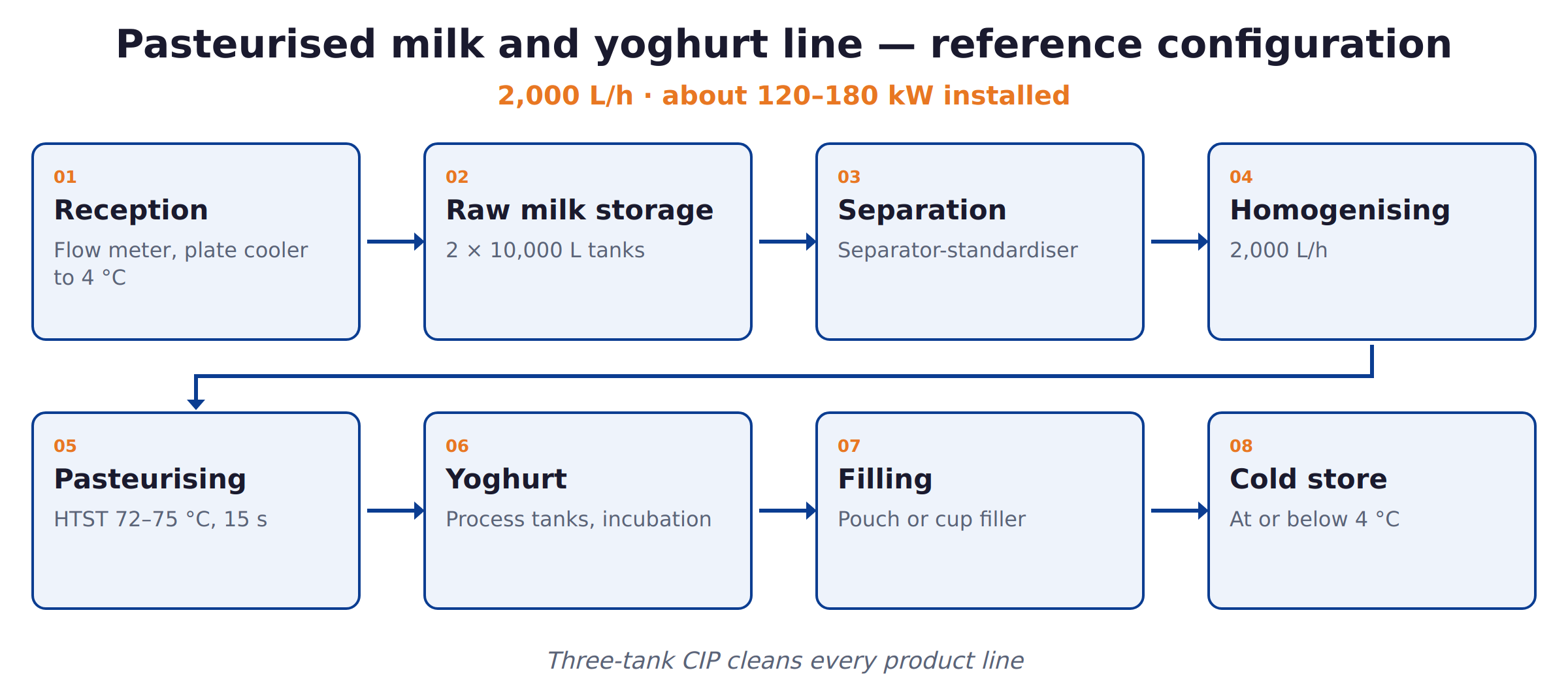
The pasteurizer is one part of the plant. A small dairy also needs:
- Milk reception: a cooling tank, filter and a way to test milk for antibiotics and quality.
- Separation and standardisation if you sell low-fat milk or cream.
- Homogenizer for fresh milk that does not cream off.
- Filling: a bottle, pouch or cup filler, with a coder.
- Cold room for finished product at below 5 °C.
- Cleaning: hot water, detergents and a CIP routine.
- Premises: a food premises meeting R638, with a Certificate of Acceptability.
Our dairy processing line guide has the full picture and 2026 bands for HTST, ESL and UHT.
Registration and industry bodies
Processors in the secondary dairy industry are required to register with Milk SA under statutory measure No. 1397 of 2017. The Dairy Standard Agency monitors compliance with dairy legislation. Check registration and testing obligations before you start selling.
Electricity and steam
Eskom's standard tariff rose 8.76% for 2026/27. A batch vat heated electrically uses a lot of power per litre; a small boiler or heat pump for hot water can cut costs. HTST regeneration typically recovers most of the heat, so the heating and cooling loads per litre are much lower. Plan backup power for refrigeration and the pasteurizer, because an interrupted pasteurization batch must be restarted.
What a wrong choice costs
- Batch for high volumes: long days, high energy, and a bottleneck in front of the filler.
- HTST for a few hundred litres: a costly plant standing idle and expensive cleaning for each short run.
- No recorder: milk cannot be shown to be pasteurized.
- No cooling capacity: milk does not reach below 5 °C in time.
- No plan for cream and sweetened products: temperatures too low.
Five things to confirm before you decide
- Litres a day now and in three years.
- Products: fresh milk, yoghurt, maas, cheese, flavoured milk, cream.
- Utilities: power capacity, hot water or steam, chilled water.
- Filling: bottles, pouches or cups, and speed.
- Records: recorder type and who keeps the charts.
Worked example: a farm dairy growing
A dairy farm in the Eastern Cape processes about 600 litres a day into yoghurt and maas in a 300 litre batch vat, two batches a day, and sells to shops in two towns. A supermarket offers to list its fresh milk at about 3,000 litres a day. At that volume, batch pasteurization would mean ten batches a day, long hours and high energy. The farm keeps the vat for yoghurt and maas and adds a small HTST plate pasteurizer with regeneration, a separator for standardising fat, a homogenizer, a bottle filler and a larger cold room. The HTST plant records temperatures continuously and diverts milk automatically if it falls below 72 °C. The farm registers its new products and keeps its charts for at least four weeks, as R1555 requires. The figures are illustrative.
How to test what your pasteurizer does
Whatever type you choose, check the process. Calibrate thermometers and recorders, test pasteurized milk with the phosphatase test, check that milk is below 5 °C after cooling, and test finished products for bacteria. Keep the results with your temperature charts.
How CISH helps you choose
We start from your litres and products. We specify reception, pasteurizer (batch or HTST), separator, homogenizer, filling, cold storage and CIP as one plant, supply it from audited factories in China, ship and clear it, install and commission it on your milk to R1555 temperatures and times, and train your team. For a single small vat, a local supplier is often the better buy.
For the whole business, not just the pasteuriser, see how to start a dairy processing business in South Africa.
Frequently asked questions
What is the difference between batch and HTST pasteurization?
Batch heats milk to at least 63 °C for 30 minutes in a vat; HTST heats flowing milk to at least 72 °C for 15 seconds in a plate heat exchanger.
Which pasteurizer is best for a small dairy?
Batch for up to roughly 500–1,000 litres a day and many products; HTST for several thousand litres a day of fresh milk.
What does South African law require for pasteurization?
R1555 of 1997 allows the batch method (63 °C, 30 minutes) or HTST (72 °C, 15 seconds), with cooling below 5 °C, temperature records kept for four weeks and a passing phosphatase test.
How much does an HTST pasteurizer cost?
As an indication for 2026, a small HTST line costs about US$50,000–125,000 ex-works, about US$95,000–250,000 landed.
Can I make yoghurt in a batch pasteurizer?
Yes. Many small dairies pasteurize and ferment yoghurt in the same vat.
Does CISH supply small dairy lines?
Yes, with batch or HTST pasteurizers, filling, cold storage and commissioning.