The business is the formulation more than the machine: a paint that covers well, meets a grade and sells at the right price. You can develop your own with a paint chemist, buy formulations, or start with a local kit or franchise package that sells equipment, formulas and training together. SANS 1586 sets the grades for emulsion paints.
Start with the product, not the machine
| Product | Uses | Difficulty to make |
|---|---|---|
| PVA (vinyl emulsion) | Interior walls and ceilings | Lowest; the usual first product |
| Acrylic emulsion | Exterior walls | Moderate; binder quality matters |
| Primers and sealers | Under topcoats | Moderate |
| Textured coatings | Exterior walls | Moderate; heavy fillers, special filling |
| Roof paint | Roofs | Moderate to high |
| Enamels and solvent-based paints | Metal, wood, trim | High; solvents, fire risk, explosion-protected equipment |
Water-based paints let you start without solvent storage, explosion-protected motors and the extra permits that come with flammable liquids.
Step 1: Get a formulation
Paint is binder, pigment (mainly titanium dioxide for white), extenders such as calcium carbonate and talc, water and additives: dispersants, thickeners, defoamers, biocides and coalescents. Your formula decides opacity, washability, cost per litre and grade. Three routes:
- Your own chemist, who develops and adjusts formulas for your raw materials. Highest control.
- Purchased formulations from a consultant or raw material supplier. Faster, but test them on your raw materials.
- A local kit or franchise package, which sells equipment, formulations, training and supplier lists together. A real option for a first business; check what support continues after you buy.
SAPMA, which says it regulates more than 90% of paint made in South Africa, runs technical training for people entering the industry.
Step 2: Meet the lead rules from day one
The Regulations Relating to Lead in Paint or Coating Materials, 2024, made under the Hazardous Substances Act, set a 90 ppm lead limit from 17 May 2025 and labelling requirements from 17 May 2026. A declaration of compliance is needed for the first production batch and whenever raw materials change. Lead usually comes from pigments and driers, so choose lead-free raw materials and keep certificates. A study released in November 2025 found that half of 24 brands tested in Durban sold at least one paint above 90 ppm, so buyers and inspectors are watching.
Step 3: Know the grades
SANS 1586 covers emulsion paints and sits behind many specifications and tenders for PVA and acrylic paints. Contractors and government buyers often ask which type and grade a paint meets. Even if you sell only to retail at first, test your products against the standard so you can answer.
Step 4: Premises and safety
- Building: a clean, dry unit with a concrete floor, ideally bunded so spills are contained, raw material storage and a filling area.
- Water: for production and cleaning.
- Wash water: pigment and binder must not go down the drain untreated; plan settling and ask the municipality about trade effluent.
- Dust: pigments and extenders are fine powders; control dust and give workers protection under the OHS Act.
- Power: dispersers draw high loads; a three-phase supply is usual.
- Zoning for light industrial use.
Step 5: Choose the equipment
| Stage | Equipment |
|---|---|
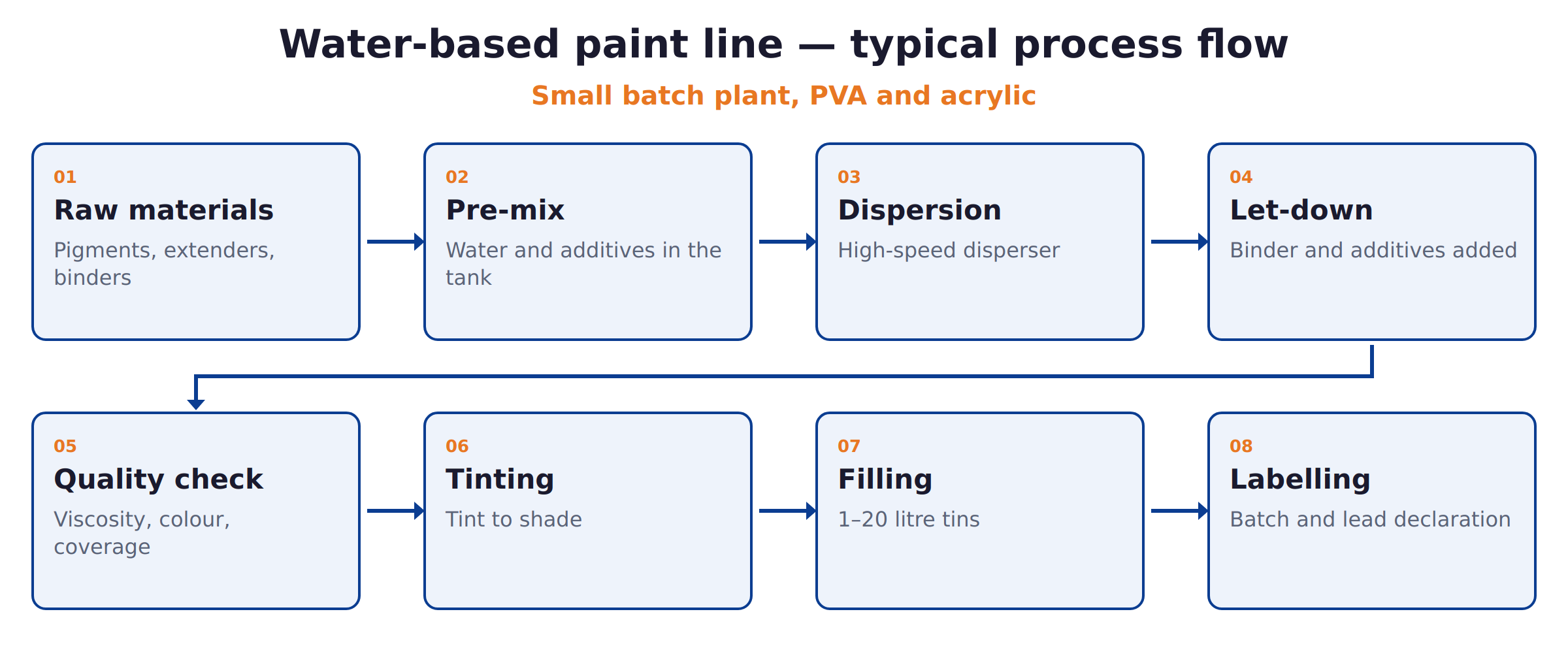
| Dispersion | High-speed disperser with a stainless tank |
| Milling (fine and gloss products) | Bead or basket mill |
| Let-down | Mixing tanks with slow agitators |
| Filtering and filling | Filter bags, semi-automatic or automatic filler for 1, 5 and 20 L |
| Laboratory | Viscosity cup or viscometer, density cup, fineness gauge, drawdown bars, oven |
| Tinting (optional) | Tinting machine and colourants |
Indicative, in USD, from our paint factory cost guide:
| Purchase | Capacity | Indicative price (2026) |
|---|---|---|
| Single disperser or mixing unit | 500–1,000 litres a batch | About US$2,000–8,000 per machine ex-works |
| Small water-based paint line | A few batches a shift | About US$10,000–80,000 ex-works |
| Complete PVA and acrylic plant | Several products, tinting, automatic filling, lab | Quoted per configuration |
Mixing and dispersing machines, fillers and steel tanks carry no general import duty.
Step 6: Work out cost per litre
Raw materials are most of the cost of paint, often far more than labour and energy. Price every raw material per kilogram, calculate the cost of each formula per litre, then add the tin or bucket, label, lid, labour, power, wash water handling and delivery. Titanium dioxide is usually the most expensive ingredient in white paint; cutting it lowers cost and opacity together. Compare your cost per litre at each grade with what hardware stores and contractors pay.
Step 7: Sell
| Channel | What they want |
|---|---|
| Hardware stores | Branded tins, a range of colours, steady supply, credit terms |
| Contractors and painters | Price per square metre covered, consistent batches, 20 L buckets |
| Property developers and managers | Grade, coverage, warranty |
| Government and tenders | Stated type and grade, often against SANS 1586 |
A realistic first year
Many paint businesses follow a similar path in their first year:
- Months 1–2: choose two products, usually an interior PVA and an exterior acrylic, settle formulations, and test them for coverage, washability and lead content.
- Months 2–3: lease and fit out a small unit with a bunded floor, a disperser, two let-down tanks, a semi-automatic filler and a basic laboratory.
- Months 3–4: make the first batches, file the declaration of compliance for the first batch, and print labels that meet the lead labelling rules.
- Months 4–8: sell 20 L buckets to painters and contractors, where price per square metre matters more than brand, and 5 L tins to a few hardware stores.
- Months 8–12: add a third product, tinting or a second disperser once orders are steady.
The point is to sell before you scale: a second disperser costs little, but a stock of unsold tins ties up cash.
Common mistakes
- Buying equipment before testing a formulation.
- Ignoring lead in raw materials. Pigments and driers must be lead-free.
- No laboratory. You cannot prove grade or consistency.
- Over-thinning to cut cost. Coverage falls and customers leave.
- Wash water down the drain.
- Starting with solvent paints before the plant and permits are ready.
Where CISH fits
We supply complete paint plants for makers ready to scale: dispersers, mills, tanks, filling and laboratory equipment from audited factories in China, matched to your products and litres a shift. CISH ships and clears the plant, installs and commissions it with output demonstrated on your formulations, and trains your team. For a first disperser and tank, a local kit or fabricator is usually the better route.
Frequently asked questions
How much does it cost to start a paint manufacturing business?
As an indication for 2026, a disperser costs about US$2,000–8,000, and a small water-based paint line about US$10,000–80,000 ex-works. Raw materials and working capital come on top.
What is the lead limit for paint in South Africa?
90 ppm since 17 May 2025, with labelling requirements from 17 May 2026 and a declaration of compliance for the first batch and after any change of raw materials.
Which standard applies to PVA paint?
SANS 1586 covers emulsion paints and is the usual reference for PVA and acrylic grades.
Do I need a chemist to make paint?
You need a tested formulation. You can employ a chemist, buy formulations, or start with a kit or franchise package that includes them.
Can I make paint at home?
Paint production needs a suitable building with dust control, wash water handling and correct zoning. A home kitchen or garage is not suitable for selling paint.
Does CISH sell paint franchise kits?
No. We supply complete paint plants for makers ready to scale. For a first kit, local kit suppliers are the usual route.