Paint manufacturing equipment in South Africa is sold by local businesses offering paint-making kits and franchise packages, local fabricators who build dispersers and tanks, Chinese factories selling direct, and turnkey companies that set up a multi-product plant. CISH supplies, installs and commissions complete paint plants; for a first disperser and tank, a local kit or fabricator is the better buy.
Who sells paint manufacturing equipment
Hardware suppliers, contractors, chemical traders and entrepreneurs starting a paint brand all search for paint equipment. The offers come from four places.
| Supplier type | What they sell | Price | Who answers for output | Best fit |
|---|---|---|---|---|
| Local kit or franchise package | A tank, a disperser, formulations, training and supplier lists | Low to moderate | The seller, for the package | First paint business |
| Local fabricator | Dispersers, stainless tanks, platforms | Low to moderate | The fabricator, for its items | Adding capacity to an existing plant |
| Chinese factory, direct | Dispersers, bead and basket mills, tanks, filling machines, complete lines | Lowest on the quote | You, after delivery | Buyers with a working formulation and technician |
| Turnkey paint plant company | Raw material handling to filled, labelled tins, with lab, commissioned | Between direct and local | The turnkey company, at agreed litres per shift | Brands scaling to several products |
Formulation decides the business, not the mixer
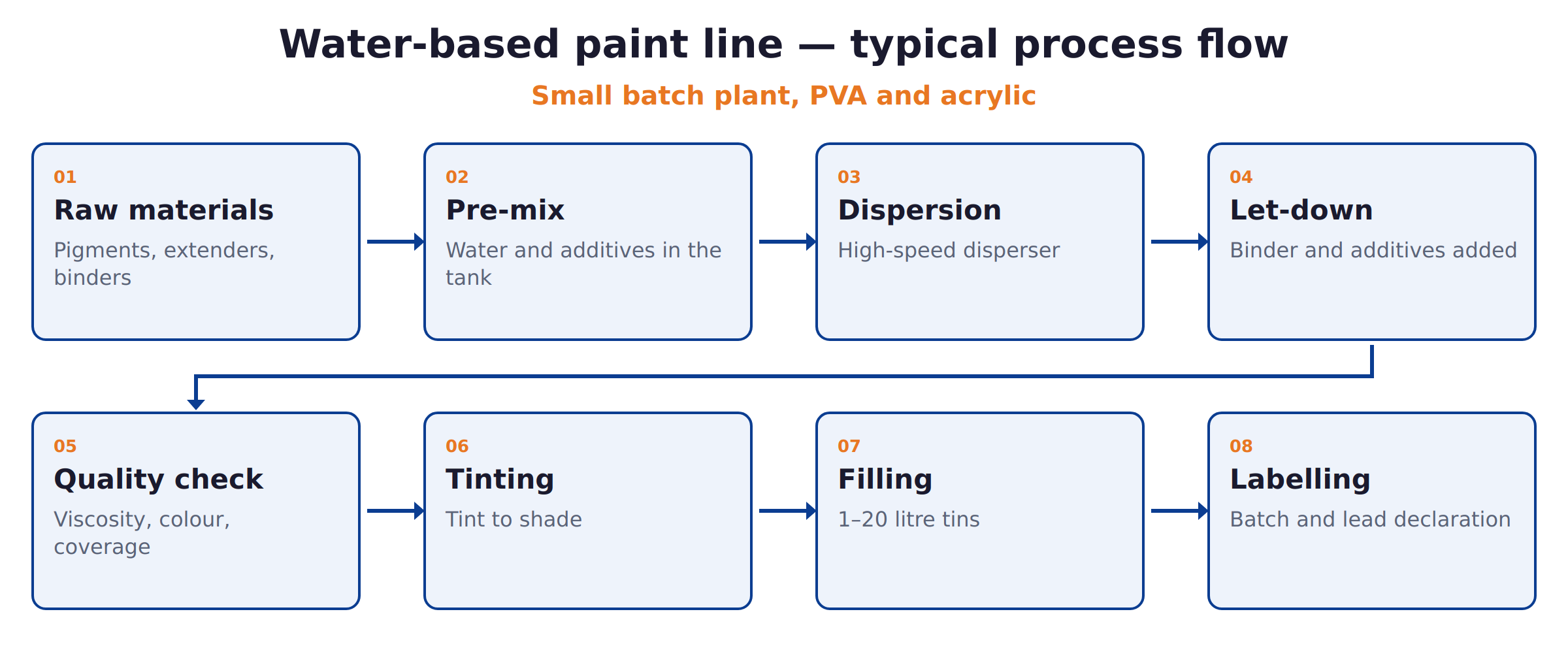
Paint is a recipe: binder, pigments, extenders, additives and water mixed, dispersed and let down to the right viscosity. A disperser and a tank make paint; a formulation that meets a grade and sells is what makes money. That is why South Africa's local kits and franchise packages, which sell formulations and training with the equipment, are serious alternatives for a first business.
Ask any supplier three things:
- Which products the equipment makes, such as PVA, acrylic, primers or textured coatings, in what batch sizes.
- How dispersion is achieved, with a disperser alone or with a mill for finer grinds.
- What quality control is included, because a grade claim needs test evidence.
What to check in the supplier
Dispersion and milling
High-speed dispersers handle most PVA and many acrylics. Finer, glossier products need bead or basket mills. Ask for the tip speed, motor power and the grind fineness the equipment reaches.
Filling and batch records
Paint is sold by volume in tins and buckets. Ask for filling accuracy at each pack size and whether the filler records batch numbers.
Wash water and solvents
Water-based plants produce wash water with pigment and binder; solvent-based products need explosion-protected equipment and separate storage. Ask how the plant handles wash water and whether the equipment is rated for solvents.
Where to find paint equipment suppliers
- The South African Paint Manufacturing Association (SAPMA) says it regulates more than 90% of paint made in South Africa and runs technical training for people entering the industry.
- Coatings and chemicals trade shows feature mixing and filling equipment; confirm current dates with organisers.
- Working plants: visit one making products and volumes like yours.
- China: most dispersers, mills and paint fillers sold in Africa are made in China. Our supplier audit checklist covers the checks to make before paying.
Paint equipment suppliers are not named on this page.
How to choose: a 10-point checklist
- Products and grades defined, with batch sizes.
- Litres per shift, demonstrated at handover.
- Dispersers sized for your batches.
- Milling for fine and gloss products.
- Let-down and storage tanks in stainless steel.
- Filtering and filling, with pack sizes and accuracy.
- Tinting, if you sell colours.
- Laboratory: viscosity, density, fineness and drawdown tests.
- Wash water handling, and solvent rating if needed.
- Installation, commissioning on your formulations, and training.
Ten questions to ask
- Which paints and grades will this equipment make?
- What batch size and litres per shift?
- What tip speed and motor power does the disperser have?
- Is a mill needed for my products, and is it included?
- What filling accuracy at 1, 5 and 20 litres?
- What lab equipment is included?
- How is wash water handled?
- Is the equipment rated for solvents, if I make enamels?
- Is installation, commissioning and training included?
- Which paint plant runs this equipment, and could I visit it?
Comparing paint plant quotes
| Section | What each quote should state |
|---|---|
| Raw material handling | Bag tipping, liquid storage, pumps |
| Dispersion | Dispersers, tanks, motor power |
| Milling | Bead or basket mill, fineness |
| Let-down and storage | Tanks, agitators, capacity |
| Filtering and filling | Filters, filler, pack sizes, accuracy |
| Tinting | Tinting system, colour range |
| Laboratory | Test equipment for your grades |
| Wash water | Collection and treatment |
| Installation and training | Engineer days, formulation trials |
| Owner's scope | Building, bunded floor, power, permits |
Before weighing up totals, bring the quotes to one scope; the same-scope comparison explains the steps.
Common mistakes
- Buying equipment without a formulation. The paint does not sell.
- No lab. You cannot prove a grade or lead compliance.
- Lead-containing raw materials. Pigments and driers must be lead-free.
- Ignoring wash water. Pigment and binder go down the drain.
- Solvent products on standard equipment. Fire and explosion risk.
Paint equipment prices in 2026
Indicative, in USD, from our paint factory cost guide:
| Purchase | Capacity | Indicative price (2026) |
|---|---|---|
| Single disperser or mixing unit | 500–1,000 litres a batch | About US$2,000–8,000 per machine ex-works |
| Small water-based paint line | A few batches a shift | About US$10,000–80,000 ex-works |
| Complete PVA and acrylic plant | Several products, tinting, automatic filling, lab | Quoted per configuration |
Rules and duty for paint in South Africa
- Lead limit. The Regulations Relating to Lead in Paint or Coating Materials, 2024, made under the Hazardous Substances Act, set a 90 ppm lead limit from 17 May 2025 and labelling requirements from 17 May 2026.
- Declarations. A declaration of compliance is needed for the first production batch and after any change of materials.
- Non-compliance is real. A study released in November 2025 tested 66 paints from 24 brands sold in Durban and found that half the brands sold at least one paint above 90 ppm.
- Product standard. SANS 1586:2021 covers emulsion paints and sits behind most PVA and acrylic specifications and tenders.
- Worker safety. Dispersers and mills are driven machinery under the OHS Act; dust from pigments and extenders must be controlled.
- Duty-free equipment. Mixing and dispersing machines (8479.82), filling machines (8422.30) and steel tanks (7309.00) are free of general duty. VAT vendors recover the 15% import VAT; see the import duty guide.
Where CISH fits
CISH is a turnkey paint plant company. We specify dispersers, mills, tanks, filling and lab equipment from audited factories in China against your products and formulations, ship and clear them, and install and commission the plant with litres per shift demonstrated on your recipes, and your team trained. We suit paint makers scaling to several products. For a first disperser and tank, a local kit or fabricator is often the better choice.
Frequently asked questions
Who sells paint manufacturing equipment in South Africa?
Local businesses selling paint-making kits and franchise packages, local fabricators, Chinese factories selling direct, and turnkey companies that set up complete paint plants.
How much does paint making equipment cost?
As an indication for 2026, a single disperser costs about US$2,000–8,000, and a small water-based paint line about US$10,000–80,000 ex-works.
Is there a lead limit for paint in South Africa?
Yes. Since 17 May 2025, paint may contain no more than 90 ppm lead, with labelling requirements from 17 May 2026 and a declaration of compliance for the first batch.
Which standard applies to PVA paint?
SANS 1586 covers emulsion paints and is the usual reference for PVA and acrylic grades in specifications and tenders.
Is paint machinery duty-free?
Mixing and dispersing machines, filling machines and steel tanks are free of general duty in SARS's 2026 tariff. Import VAT of 15% applies.
Does CISH sell single dispersers?
No. We supply complete paint plants, installed and commissioned. For a first disperser and tank, a local kit or fabricator is usually the better route.