At any scale the product must be safe: groundnuts are prone to aflatoxin, and R1145 of 2004 sets limits of 10 µg/kg total aflatoxin (5 µg/kg for B1) for ready-to-eat foods, with new mycotoxin regulations (R.7091 of 2026) taking effect 24 months after publication. You also need a food premises that meets R638 with a Certificate of Acceptability and labels that meet R146, including the peanut allergen. About half of South African groundnuts go into peanut butter, and local supply falls short of demand, so plan your nut supply first.
Step 1: choose your starting scale
| Small business | Factory line | |
|---|---|---|
| Output | Tens of kilograms to a few hundred a day | 300–700 kg an hour |
| Equipment | Small roaster, blancher, colloid mill or grinder, hand or semi-automatic filling | Roaster, cooler, blancher, colour sorter, two-stage grinding, mixing, automatic filling and capping, labelling |
| Investment | Small single machines | About US$20,000–90,000 ex-works for the core line; about US$120,000–300,000 landed for a complete line |
| Customers | Markets, delis, local shops, online | Wholesalers, retailers, private label, institutions |
| Testing | Aflatoxin tests on every batch of nuts | Incoming nut testing, batch records, retained samples |
Step 2: secure peanut supply
The SA Groundnut Forum estimates average local production at about 50,000–55,000 tonnes against domestic demand of about 84,000 tonnes a year, with about 52% used for peanut butter and the rest eaten directly; the gap is imported. Buy from shellers or traders who supply certificates of analysis for aflatoxin, moisture and grade, and store nuts cool and dry. Prices move with the harvest and imports, so plan stock for several months.
Step 3: control aflatoxin
Aflatoxins are produced by moulds on groundnuts and are the main safety risk in peanut butter. Under R1145 of 2004, groundnuts intended for further processing are considered contaminated above 15 µg/kg total aflatoxin, and ready-to-eat foods above 10 µg/kg total or 5 µg/kg for aflatoxin B1. R.7091 of 2026 repeals R1145 and comes into force 24 months after publication. Controls:
- Buy tested nuts and test each lot again on arrival.
- Sort out damaged, discoloured and mouldy kernels, by hand at small scale or with an optical colour sorter in a factory.
- Store nuts dry and cool.
- Test finished product regularly and keep retained samples.
Step 4: licences and labels
- Food premises: your premises must meet R638 of 2018, and you need a Certificate of Acceptability from your municipality before you start.
- Labels: R146 of 2010 sets labelling rules, including the product name, ingredients, the peanut allergen declaration, net quantity, batch, dates and your details.
- Business and tax: register your company, and for VAT once you pass the threshold.
- Retail: supermarkets usually ask for a food safety audit or certification, barcodes and product liability insurance.
Step 5: equipment and costs
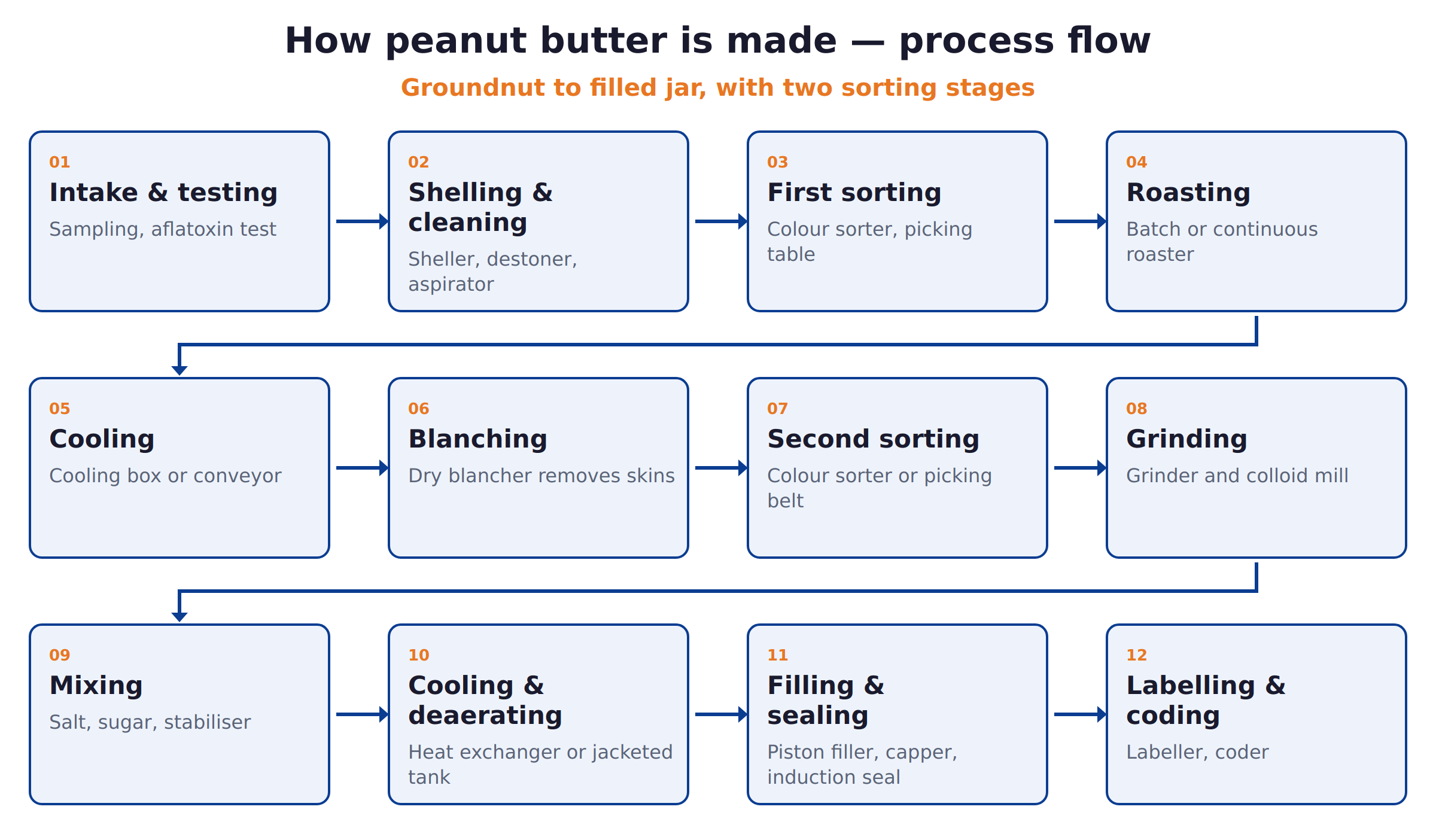
| Purchase | What it does | Indicative price (2026) |
|---|---|---|
| Small single machines | Roaster, blancher, grinder, filler for a small business | Small; priced machine by machine |
| Roasting-to-butter core line | Roasting, cooling, blanching, grinding, mixing | About US$20,000–90,000 ex-works for 300–700 kg/h |
| Complete line, landed | Adds shelling, colour sorting, filling, capping and labelling | About US$120,000–300,000 landed for 300–500 kg/h |
Our peanut butter machine price guide breaks the equipment down, and how peanut butter is made explains each step. Retail peanut butter imported under 2008.11.11 carries a 20% general duty, which helps local makers compete; most of the machines enter duty-free.
Step 6: work out cost per jar
Add nuts (usually the largest cost), salt, sugar, stabiliser or oil if used, jars, lids, labels, cartons, power for roasting and grinding, labour, testing, rent, transport and loan repayments. Compare with shelf prices for smooth and crunchy jars in your target stores, and leave margin for retailer terms.
Step 7: sell
Start with the channel you can reach: markets and delis for natural and speciality butters, local shops and wholesalers for value packs, and retailers or private label once you can supply consistently. Bakeries, school feeding suppliers and institutions buy in bulk.
Worked example: from markets to a factory
A peanut butter maker in Gauteng sells natural and honey peanut butter at markets and to delis, about 150 kg a week, made in a rented food kitchen with a small roaster and a colloid mill. A regional wholesaler offers a listing for 2 tonnes a month. The business leases a small food factory, gets its Certificate of Acceptability, and installs a 300 kg/h roasting, blanching and grinding line with a semi-automatic jar filler and labeller. It contracts a sheller for tested nuts, adds hand sorting and an aflatoxin test on every lot, and moves to an automatic filler a year later. The figures are illustrative.
Common mistakes
- Buying untested nuts.
- No sorting: a few mouldy kernels can make a batch fail.
- Grinding too hot: oil separates and flavour suffers.
- Wrong labels: missing allergen or net quantity.
- Scaling before the customer is confirmed.
Product range and shelf life
Most brands start with smooth and crunchy in 400 g jars, then add bulk tubs for bakeries and food service and flavoured or natural versions for speciality stores. Natural peanut butter, made only from peanuts and salt, separates oil on standing; stabilised versions stay mixed but need an extra ingredient on the label. Test shelf life on your own product in your chosen jar, and watch for oil separation, rancid flavour and colour change over the months. Glass jars look premium but break and cost more to ship; PET jars are lighter. Whatever you choose, the jar, lid and liner must seal well, because oxygen and moisture shorten shelf life.
Roasting and grinding quality
Roasting sets the flavour and colour: under-roasted nuts taste raw, over-roasted nuts taste bitter. Keep roast time and temperature consistent and record them for every batch. Grinding must reach a smooth texture without overheating the paste, so cool it before filling. Consistency from jar to jar is what keeps shops reordering.
Where CISH fits
We supply complete peanut butter lines, cleaning, roasting, cooling, blanching, colour sorting, grinding, mixing, filling, capping and labelling, from audited factories in China, sized to your output. CISH ships, clears, installs and commissions the line on your nuts, and trains your team. For a small roaster or grinder, a local supplier is usually the better buy.
Frequently asked questions
How much does it cost to start a peanut butter business?
A small business can start with small single machines. A factory core line of 300–700 kg/h costs about US$20,000–90,000 ex-works, and a complete 300–500 kg/h line about US$120,000–300,000 landed.
What licence do I need to make peanut butter?
A Certificate of Acceptability for your food premises under R638, and labels that meet R146.
What are the aflatoxin limits for peanut butter?
Under R1145 of 2004, ready-to-eat foods may not exceed 10 µg/kg total aflatoxin or 5 µg/kg aflatoxin B1. New mycotoxin regulations take effect 24 months after their 2026 publication.
Where do I buy peanuts?
From local shellers and traders, or imports. Ask for aflatoxin certificates and test each lot.
How much of South Africa's groundnuts go into peanut butter?
About 52%, according to the SA Groundnut Forum.
Does CISH sell small peanut butter machines?
We supply complete lines. For a small single machine, a local supplier is usually better.