Each step has its own machine: sheller, colour sorter, roaster, cooler, blancher, colloid mill, mixer and filler. CISH supplies, installs and commissions complete peanut butter lines from roasting to filled jars.
The process at a glance
| Step | What happens | Machine |
|---|---|---|
| 1. Intake and testing | Groundnuts received, sampled and tested for aflatoxin and moisture | Sampling equipment, lab |
| 2. Shelling and cleaning | Shells removed; stones, dust and foreign matter taken out | Sheller, destoner, aspirator |
| 3. First sorting | Damaged, shrivelled and discoloured kernels removed | Colour sorter, picking table |
| 4. Roasting | Kernels heated to develop flavour and colour | Batch or continuous roaster |
| 5. Cooling | Roast stopped quickly | Cooling box or cooling conveyor |
| 6. Blanching | Red skins and hearts removed | Dry blancher with peeling rollers |
| 7. Second sorting | Burnt, unblanched or mouldy kernels removed | Colour sorter or picking belt |
| 8. Grinding | Kernels ground to a paste in one or two stages | Grinder and colloid mill |
| 9. Mixing | Salt, sugar, stabiliser or oil added; crunchy pieces for crunchy butter | Mixing tank with agitator |
| 10. Cooling and deaerating | Butter cooled before filling | Heat exchanger or jacketed tank |
| 11. Filling and sealing | Jars filled, capped and sealed | Piston filler, capper, induction sealer |
| 12. Labelling and coding | Labels and batch codes applied | Labeller, coder |
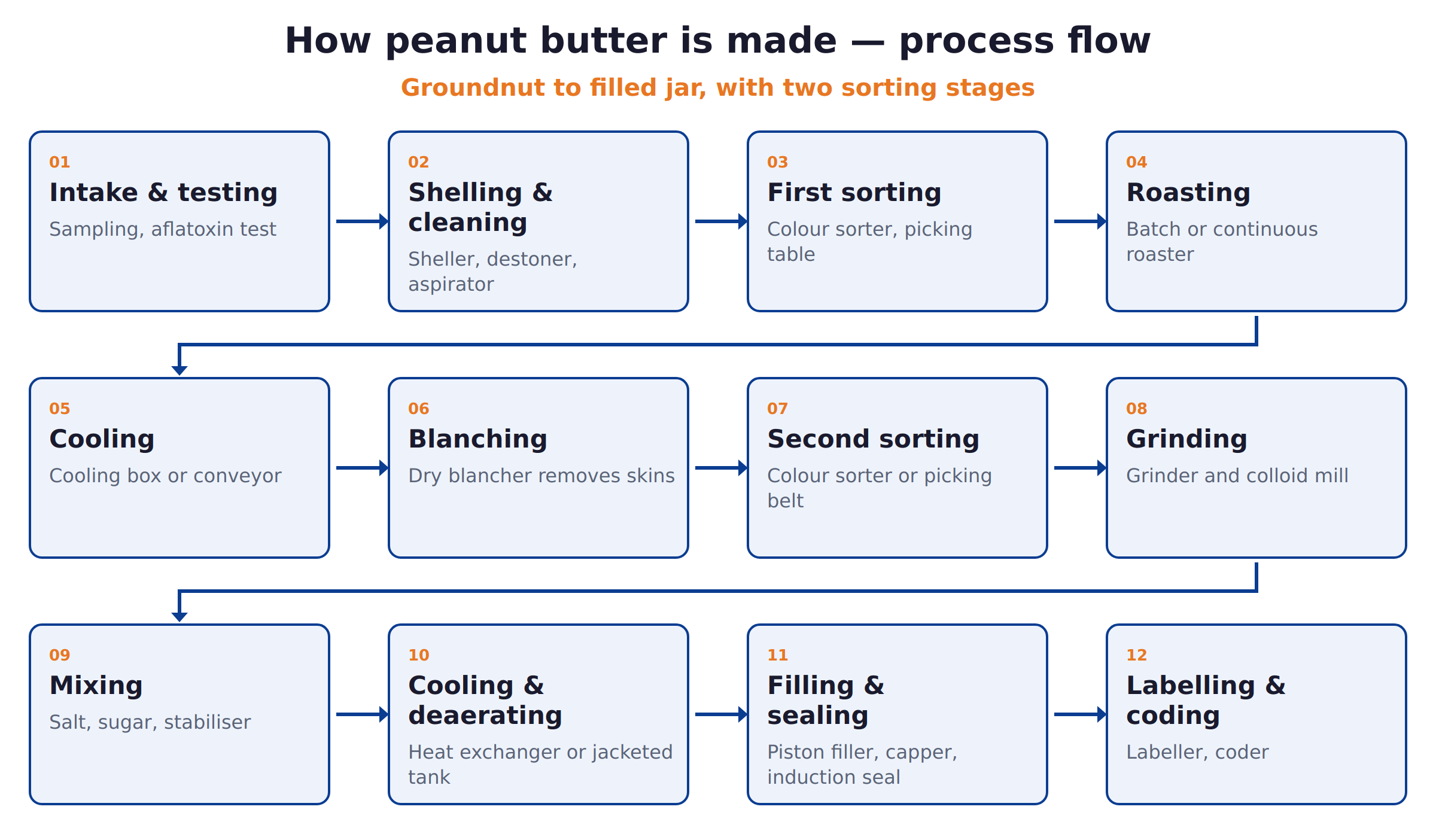
Step by step
1–3. Intake, shelling and first sorting
Good peanut butter starts with good groundnuts. Each lot is sampled and tested before it is processed, because aflatoxin, produced by moulds that grow on poorly dried or damaged nuts, cannot be removed by roasting. If you buy groundnuts in shell, a sheller removes the shells, then destoners and aspirators clean out stones and dust. A colour sorter or picking table removes shrivelled, broken and discoloured kernels, which carry most of the aflatoxin risk.
4–5. Roasting and cooling
Roasting develops the flavour and colour of peanut butter. Batch roasters suit small runs and give flexibility; continuous roasters give an even roast at volume. Roast time and temperature are set for your kernels and the colour you want. Kernels must then be cooled quickly, because they keep roasting from their own heat.
6–7. Blanching and second sorting
Blanching removes the thin red skins, and often the small hearts, which make butter bitter and dark. Dry blanchers rub the roasted kernels between rollers and blow the skins away. A second sort, by colour sorter or on a picking belt, removes burnt, unblanched and mouldy kernels before they reach the mill.
8. Grinding
Grinding turns kernels into butter. Many lines grind in two stages: a coarse grind, then a fine grind in a colloid mill, which sets the smoothness. Grinding generates heat, so mills are often water-cooled. For crunchy butter, chopped kernels are added after grinding.
9–10. Mixing and cooling
Salt, sugar and a stabiliser (to stop oil separating) are mixed in if your recipe uses them; some brands sell 100% peanut butter with nothing added. The butter is then cooled before filling. Filling hot butter increases oil separation in the jar.
11–12. Filling, sealing and labelling
Peanut butter is thick, so piston fillers are used. Jars are capped, often induction-sealed for tamper evidence and freshness, then labelled with ingredients, allergen information and a batch code for traceability.
Batch or continuous processing?
| Batch processing | Continuous processing | |
|---|---|---|
| Roasting | Drum roaster loaded and emptied in batches | Belt or drum roaster with constant flow |
| Typical scale | Up to a few hundred kilograms an hour | Several hundred kilograms an hour and up |
| Flexibility | Easy to change roast and recipe | Best for long runs of one product |
| Consistency | Depends on the operator | More even colour and flavour |
| Labour | More hands per tonne | Fewer operators |
Small brands and co-ops usually start with batch roasting and a continuous grinding section, then move to a continuous roaster when one product runs most of the day.
Food safety: where the controls sit
| Hazard | Where it is controlled |
|---|---|
| Aflatoxin | Buying, lot testing, colour sorting before and after roasting |
| Foreign matter (stones, metal, glass) | Cleaning, magnets, metal detection before filling |
| Salmonella and other bacteria | Roasting, hygienic design, separation of raw and roasted areas |
| Allergen labelling | Labels and cleaning between products |
| Oil separation and rancidity | Stabiliser choice, cooling, sealing and storage |
The premises must meet R638 of 2018 and hold a Certificate of Acceptability, and labels must follow R146 of 2010.
Aflatoxin limits in South Africa
Under R1145 of 2004, peanuts intended for further processing are deemed contaminated above 15 µg/kg total aflatoxin, and ready-to-eat foods above 10 µg/kg total, of which B1 above 5 µg/kg. New Regulations relating to Maximum Levels of Mycotoxins in Foodstuffs (R.7091 of 2026) were published on 6 February 2026; they repeal R1145 and take effect 24 months after publication. A line bought today should be designed for sorting and lot testing that meets the new table.
From process to line
| Scale | What it looks like | Indicative price (2026) |
|---|---|---|
| Small batches | Batch roaster, peeler, small grinder, hand filling | Modest; often bought locally |
| Core line | Roasting, cooling, blanching, sorting, grinding, mixing at 300–700 kg/h | About US$20,000–90,000 ex-works |
| Complete line from groundnuts in shell | Adds shelling, colour sorting, jar filling and sealing, 300–500 kg/h | About US$120,000–300,000 landed |
See our peanut butter machine price guide for what each quote should include.
Why the process matters for a South African business
South Africa's groundnut demand of about 84,000 tonnes a year is larger than the local crop of around 50,000–55,000 tonnes, according to the SA Groundnut Forum, and about 52% of the groundnuts used locally go into peanut butter. That makes peanut butter a large, steady market, but one where buyers judge on taste, smoothness, oil separation and food safety. Each step above contributes to those.
Common mistakes
- Skipping the second sort. Burnt and mouldy kernels reach the mill.
- Leaving skins on. Butter tastes bitter and looks dark.
- Over-heating in the mill. Flavour suffers and oil separates.
- Filling hot. Oil rises in the jar.
- No batch codes. Recalls become impossible to manage.
Where CISH fits
CISH supplies, installs and commissions complete peanut butter lines from audited factories in China, from shelling and colour sorting to roasting, blanching, grinding, mixing and jar filling, with the line commissioned on your groundnuts and your operators trained.
If you plan to sell it, our guide to starting a peanut butter business in South Africa covers scale, premises and buyers.
Frequently asked questions
How is peanut butter made?
Groundnuts are shelled, cleaned and sorted, roasted, cooled and blanched to remove the skins, sorted again, ground into a paste, mixed with salt, sugar or stabiliser if used, cooled and filled into jars.
What machine grinds peanut butter?
Usually a grinder followed by a colloid mill, which sets the smoothness. Mills are often water-cooled because grinding generates heat.
Why are peanuts blanched?
To remove the red skins and hearts, which make peanut butter bitter and dark.
How is aflatoxin controlled?
By buying well-dried groundnuts, lot testing, and sorting out damaged and discoloured kernels before and after roasting. Roasting does not remove it.
Why does oil separate in peanut butter?
Natural peanut butter separates over time. Stabilisers, cooling before filling and good sealing reduce it.
How much does a peanut butter line cost?
A roasting and butter core line for 300–700 kg an hour costs about US$20,000–90,000 ex-works in 2026; a complete line with shelling and filling about US$120,000–300,000 landed.
How long does roasting take?
It depends on the roaster, the kernels and the colour you want; batch roasts typically take somewhere between a quarter of an hour and three quarters of an hour. Set the profile in trials on your own groundnuts.
Do I need a laboratory?
You need a reliable way to test each lot for aflatoxin and moisture, either an on-site rapid test or an accredited external lab, and records that match lots to finished batches.