Choose a line by kilograms an hour of finished butter and the sorting that keeps aflatoxin out. CISH supplies, installs and commissions complete peanut butter lines; for a single grinder, a local dealer is the better buy.
Peanut butter machine prices, 2026
| What you buy | Typical output | Indicative price (2026) | Fits |
|---|---|---|---|
| Single machines: batch roaster, peeler, colloid mill, small filler | Small batches | A modest purchase, often bought locally | Farm stalls, markets, trial batches |
| Roasting and peanut butter core line | 300–700 kg/h | About US$20,000–90,000 ex-works | Processors buying sorted kernels |
| Complete line with shelling, colour sorting and filling, landed | 300–500 kg/h | About US$120,000–300,000 | Brands and co-ops starting from groundnuts in shell |
| Larger automated plant | Tonnes per hour | Quoted per configuration | National brands |
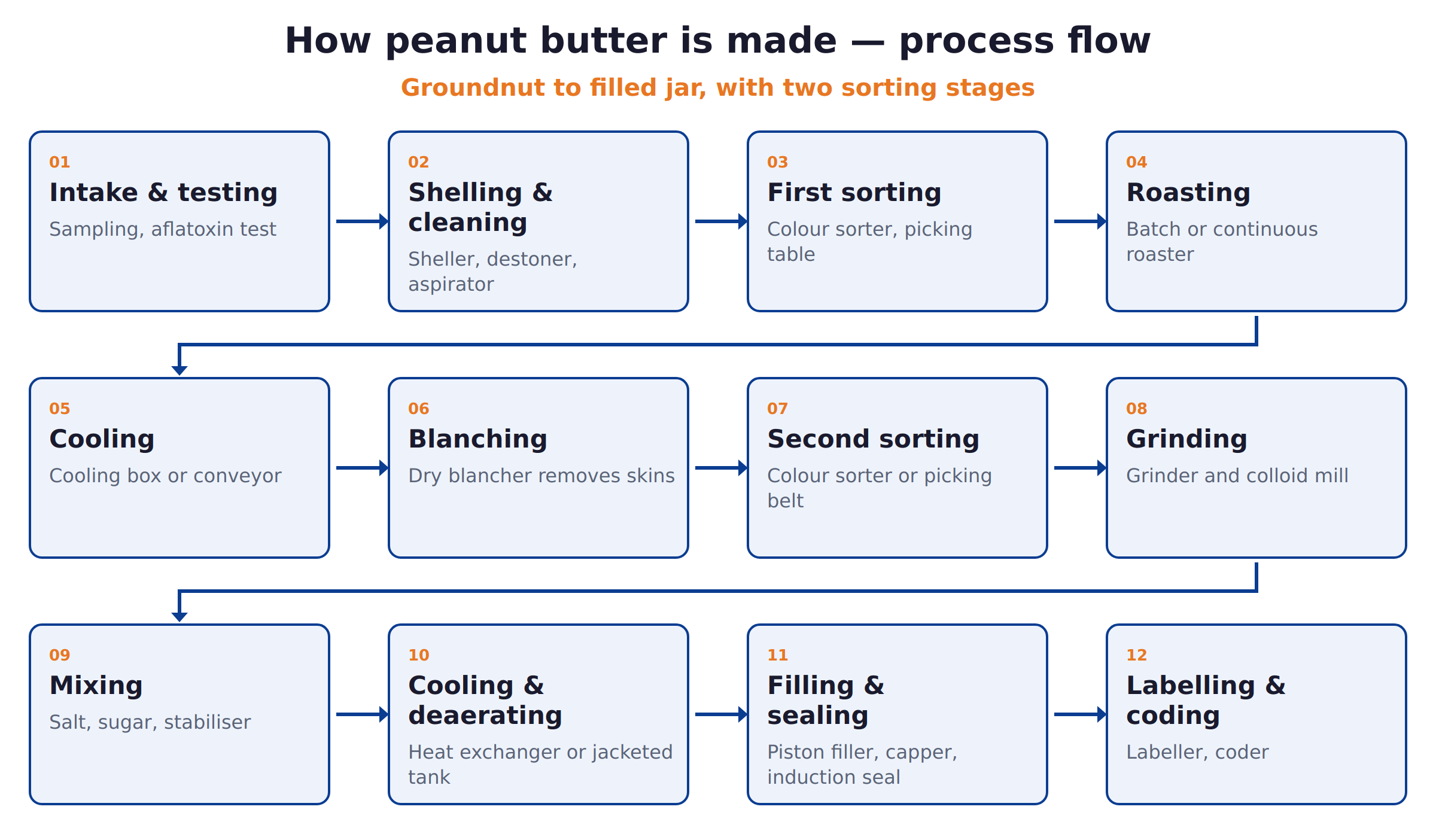
The core line covers roasting, cooling, blanching (skin removal), sorting of blanched kernels, grinding and mixing. Shelling, colour sorting, jar filling, capping, labelling and the building come on top unless the quote says otherwise.
What the price leaves out
| Item | Why it matters |
|---|---|
| Shelling and cleaning | Needed if you buy groundnuts in shell |
| Colour sorting | Removes discoloured and damaged kernels, the main aflatoxin control |
| Aflatoxin testing | Lot testing before processing and on finished butter |
| Jar filling and capping | Piston fillers for thick paste, cappers, induction sealing |
| Labelling and coding | Batch codes for traceability |
| Building and hygiene | Premises that pass R638 and earn a Certificate of Acceptability |
| Installation and training | Setting roast profiles and mill gaps |
Roast, blanch, grind: where quality is made
- Roasting develops flavour and colour; a continuous roaster gives even colour at volume, a batch roaster suits small runs.
- Cooling and blanching stop the roast and remove the red skins; skins left in give a bitter, dark butter.
- Sorting after blanching removes burnt, mouldy or damaged kernels.
- Grinding in one or two stages, often with a colloid mill, sets smoothness; crunchy butter adds chopped kernels.
- Mixing adds salt, sugar and stabiliser if your recipe uses them, then the butter is cooled before filling.
Each of these steps has its own machine, and each is a place where a cheap line cuts corners.
Smooth, crunchy or 100% peanut?
| Product | What the line needs | Watch out for |
|---|---|---|
| Smooth | Two-stage grinding with a colloid mill | Mill temperature and fineness |
| Crunchy | A chopper or granulator adding kernel pieces after grinding | Even distribution of pieces |
| 100% peanut, no additives | Same grinding, no stabiliser dosing | Oil separation; buyers accept stirring |
| Stabilised with salt and sugar | Dosing and mixing tank | Accurate dosing and labelling |
Most brands make smooth and crunchy on one line. Decide the range before ordering, because a chopper and dosing system are easier to include from the start than to add later.
Landed cost in South Africa
| Cost item | How to plan |
|---|---|
| Equipment ex-works | From the factory in China |
| Freight and insurance | Usually one or two containers |
| Duty | Food processing machinery (8438.80) and filling machines (8422.30) carry no general duty |
| VAT | 15% on the customs value plus 10% plus duty, reclaimable by VAT vendors |
| Clearing and transport | Agent fees, port charges, delivery |
| Installation and commissioning | Engineer days, roast and grind trials on your groundnuts |
| Building and services | Food-grade finishes, power, compressed air |
See our import duty guide for the calculation.
Worked example: a co-op making peanut butter
An illustration only:
| Item | Assumption |
|---|---|
| Raw material | Groundnuts in shell from members |
| Line | Shelling, colour sorting, roast-blanch-grind, jar filling at about 300 kg/h |
| Price | About US$120,000–300,000 landed |
| Products | Smooth and crunchy in 400 g and 800 g jars |
| Food safety | Lot testing for aflatoxin, sorting records, R638 premises |
| Buyers | Local retailers and school feeding suppliers |
The market is real: domestic demand is larger than the local crop, and about half of the groundnuts used locally go into peanut butter.
How to compare quotes
- Kilograms an hour of finished butter.
- Roaster type, heating and roast control.
- Blancher and skin removal efficiency.
- Sorting: colour sorter or picking table after blanching.
- Grinding stages and fineness.
- Mixing and cooling before filling.
- Filling, capping and sealing for your jars.
- Installed power and compressed air.
- Installation, commissioning on your groundnuts, and training.
- Warranty and spare parts for mills and fillers.
Mistakes we see
- Buying a grinder and calling it a line. Roasting, blanching and sorting make the product.
- No colour sorting. Aflatoxin risk rises.
- Filling hot butter. Oil separates in the jar.
- No lot testing. You cannot prove compliance.
- Ignoring the new mycotoxin regulations.
South African facts that shape a peanut butter business
- A market short of local nuts. The SA Groundnut Forum put average crops at about 50,000–55,000 tonnes against domestic demand of about 84,000 tonnes a year.
- Peanut butter is the main use. About 52% of groundnuts used locally go into peanut butter and 48% into the direct edible market.
- Aflatoxin limits today. Under R1145 of 2004, peanuts for further processing above 15 µg/kg total aflatoxin, and ready-to-eat foods above 10 µg/kg (B1 above 5 µg/kg), are deemed contaminated.
- New regulations coming. R.7091 of 2026, published on 6 February 2026, repeals R1145 and takes effect 24 months after publication; a line bought now will run under both.
- Food premises. The plant must meet R638 of 2018 and hold a Certificate of Acceptability.
- Import competition. Retail peanut butter (2008.11.11) carries 20% general duty, but enters free from the EU and UK and EFTA.
Where CISH fits
CISH supplies, installs and commissions complete peanut butter lines from audited factories in China: shelling, colour sorting, roasting, blanching, grinding, mixing and jar filling, with the import into South Africa arranged and the line commissioned on your groundnuts, and your operators trained. For a single grinder or roaster, a local dealer is often the better choice, and we will say so.
For the process from roasting to filling, see how peanut butter is made.
For licences, aflatoxin control and selling, see how to start a peanut butter business.
Frequently asked questions
How much is a peanut butter machine in South Africa?
Single machines are a modest purchase. A roasting and peanut butter core line for 300–700 kg an hour costs about US$20,000–90,000 ex-works, and a complete 300–500 kg an hour line about US$120,000–300,000 landed in 2026.
What machines do I need to make peanut butter?
A roaster, cooler, blancher, sorting, a grinder or colloid mill, a mixer and a jar filler, plus shelling and colour sorting if you buy groundnuts in shell.
What is the aflatoxin limit for peanut butter?
Under R1145 of 2004, ready-to-eat foods above 10 µg/kg total aflatoxin (B1 above 5 µg/kg) are deemed contaminated. New regulations, R.7091 of 2026, take effect 24 months after February 2026.
Is there duty on peanut butter machines?
Food processing and filling machinery carry no general duty in SARS's 2026 tariff. Import VAT of 15% applies and VAT vendors reclaim it.
Is there a market for local peanut butter?
Domestic groundnut demand of about 84,000 tonnes a year exceeds the local crop, and about half goes into peanut butter.
Does CISH sell single peanut butter grinders?
No. We supply complete peanut butter lines. For a single grinder, a local dealer is usually the better route.
How many people does a small peanut butter line need?
A 300–500 kg an hour line usually runs with a small team per shift: intake and sorting, roasting and grinding, filling and packing, plus someone responsible for quality and lot testing.
Can I start by buying sorted kernels instead of groundnuts in shell?
Yes. Buying shelled, sorted kernels with test certificates lets you start with a core line and add shelling and colour sorting later.