Profit depends on how many bricks you get from a bag of cement while still meeting strength, curing properly, and delivering to building sites nearby. Buyers on formal housing and NHBRC-enrolled homes expect masonry that meets SANS 1215.
What will you make?
| Product | Standard | Typical buyers |
|---|---|---|
| Cement stock bricks (solid) | SANS 1215 | Home builders, informal and RDP-type housing, boundary walls |
| Maxi bricks | SANS 1215 | Builders who want fewer units per wall |
| Hollow blocks (140 mm, 190 mm) | SANS 1215 | Commercial and industrial walls, faster building |
| Paving blocks and interlocking pavers | SANS 1058 | Driveways, municipal paving, malls |
| Kerbs | SANS 927 | Roads and municipal work |
| Fired clay bricks | SANS 227 | A different, larger investment: clay pit, kiln and fuel |
Start with one or two products that local builders buy every week, and add pavers once the yard runs well.
Step 1: Find your buyers
Bricks are heavy and cheap per unit, so most sales are within a short delivery distance. Talk to builders, hardware stores, contractors and housing developers in your area. Government housing is a large buyer through its contractors: Human Settlements' 2026/27 budget was R26.972 billion with a target of 39,058 housing units, against 23,027 delivered in 2025/26. Contractors on formal projects and homes enrolled with the NHBRC expect masonry that meets the relevant SANS standard.
Step 2: Site, water and materials
- A level, well-drained yard for production, curing and stacking. Fresh bricks need space to cure for days before they can be stacked and sold.
- Water for mixing and curing; a borehole or municipal supply.
- Cement from a reliable supplier, delivered by the bag or in bulk to a silo.
- Aggregates: sand, crusher dust and stone of consistent grading. Changes in aggregate change strength.
- Road access for trucks delivering materials and taking bricks out.
- Zoning that allows the activity.
Step 3: How many bricks from a bag of cement?
This is the number that decides profit, and it must be balanced against strength. The figures below are an example only.
Take a hollow block of 390 × 140 × 190 mm, about half of which is solid concrete. Its concrete volume is about 0.0052 m³, and at a density of about 2,100 kg/m³ the block weighs about 11 kg. If cement is roughly one-ninth of the dry mix, each block contains about 1.2 kg of cement, so a 50 kg bag makes in the region of 40 blocks.
Use less cement and you make more blocks per bag, but they may fail the strength the buyer needs. The right mix comes from trial batches tested for compressive strength, not from a rule of thumb. SANS 1215 sets the requirements for concrete masonry units, including strength classes and dimensions; test your blocks at a laboratory and keep the results.
Step 4: Curing: the step most yards get wrong
Blocks gain strength as cement hydrates, which needs moisture. Fresh blocks should be kept damp and out of direct sun and wind for the first days, by covering them with plastic sheeting or spraying them, before they are stacked. Selling blocks too early, before they have gained strength, causes breakages and complaints. Plan yard space for several days of production.
Step 5: Choose the machines
| Scale | Machine | Indicative price (2026) |
|---|---|---|
| Manual or egg-laying machine | Mobile machine laying blocks on the ground; mixer; wheelbarrows | About US$8,000–40,000 per machine; a complete small yard under about US$80,000 |
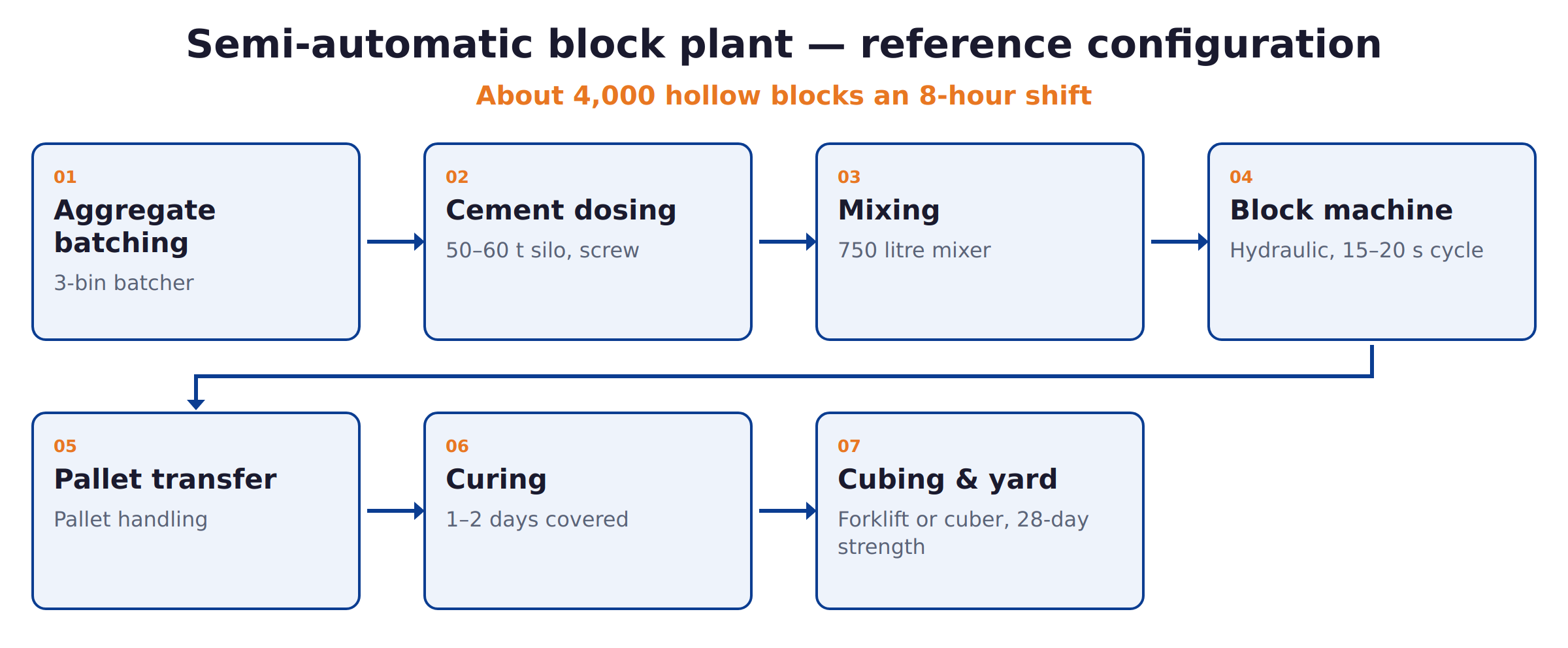
| Semi-automatic plant | Stationary machine on pallets, batching, mixer, conveyors, curing area | About US$120,000–450,000 landed and commissioned |
| Fully automatic plant | Automatic batching, block machine, stacker, curing chambers, cuber | About US$600,000–1.5 million or more, civils extra |
Egg-laying machines need a large flat slab but little capital. Stationary pallet machines make more consistent blocks at higher output. Weigh-batching rather than counting buckets is the single biggest step up in consistency. Brick and block machines (8474.80) carry no general import duty; used machines need an ITAC import permit.
Step 6: Plan the money
| Cost block | Notes |
|---|---|
| Machine and mixer | From the table above |
| Yard and slab | Concrete slab, drainage, curing area, fencing |
| Water and power | Borehole or connection; three-phase supply for stationary plants |
| Delivery vehicle | Flatbed or crane truck |
| Materials stock | Cement and aggregates for weeks of production |
| Pallets | For stationary machines and for delivery |
| Labour | Operators, mixer, curing and loading crews |
| Testing | Laboratory strength tests |
Step 7: Sell and deliver
Builders buy on price, strength, size accuracy and on-time delivery. A crane truck that can offload on site wins business. Keep test results to show contractors, and consider certification against SANS 1215 through an accredited certification body once your process is stable; the Concrete Manufacturers Association represents precast and block producers and lists SANS specifications.
Worked example: from manual yard to semi-automatic plant
A yard making 2,000–3,000 blocks a day on an egg-laying machine might find that its customers want more consistent blocks and faster delivery. Moving to a stationary pallet machine with weigh-batching, a pan mixer and a curing area could lift output several times on the same labour, while improving strength consistency. The yard would then need three-phase power, a larger materials stock and a second delivery vehicle. The figures are illustrative; plan your own around confirmed customers.
From a delivered project: A regional developer asked for a 12,000 blocks-a-day automatic plant; sized to real off-take, the plant built was about 6,500 blocks a day over two shifts, online in 22 weeks and at 78% effective utilisation within three months. Read the block and paver plant case study.
Common mistakes
- Cutting cement to make more blocks per bag until blocks fail.
- No curing. Blocks lose strength and break in transport.
- Inconsistent aggregates. Strength varies from day to day.
- No strength tests. You cannot answer a contractor's question.
- Too small a yard for curing and stock.
- Buying an automatic plant before having steady customers.
Where CISH fits
We supply complete block and brick plants for yards moving beyond manual production: batching, block machine, conveyors, stacking and curing, from audited factories in China, sized to your products and daily output. CISH ships and clears the plant, installs and commissions it with output and block quality demonstrated, and trains your team. For a first manual or egg-laying machine, a local supplier is usually the better buy.
Concrete roof and floor tiles use similar materials; see how to start a tile manufacturing business.
Frequently asked questions
How much does it cost to start a brick making business in South Africa?
As an indication for 2026, a manual or egg-laying machine costs about US$8,000–40,000, and a complete small yard can come in under about US$80,000. A semi-automatic plant costs about US$120,000–450,000 landed and commissioned.
How many blocks can I make from one bag of cement?
As an example, about 40 hollow 140 mm blocks from a 50 kg bag, but the right mix must come from strength tests. Using less cement than the strength requires causes failures.
Which standard applies to cement bricks and blocks?
SANS 1215 covers concrete masonry units, including strength and dimensions. SANS 1058 covers paving blocks.
Do I need a licence to make bricks?
You need a site zoned for the activity, and usual business and tax registrations. Builders on formal projects will expect blocks that meet SANS 1215.
How long must cement blocks cure?
They should be kept moist and protected for the first days before stacking, and gain strength over weeks. Your mix and climate decide the exact time.
Does CISH supply manual brick machines?
No. We supply complete block plants. For a manual machine, a local supplier is usually better.