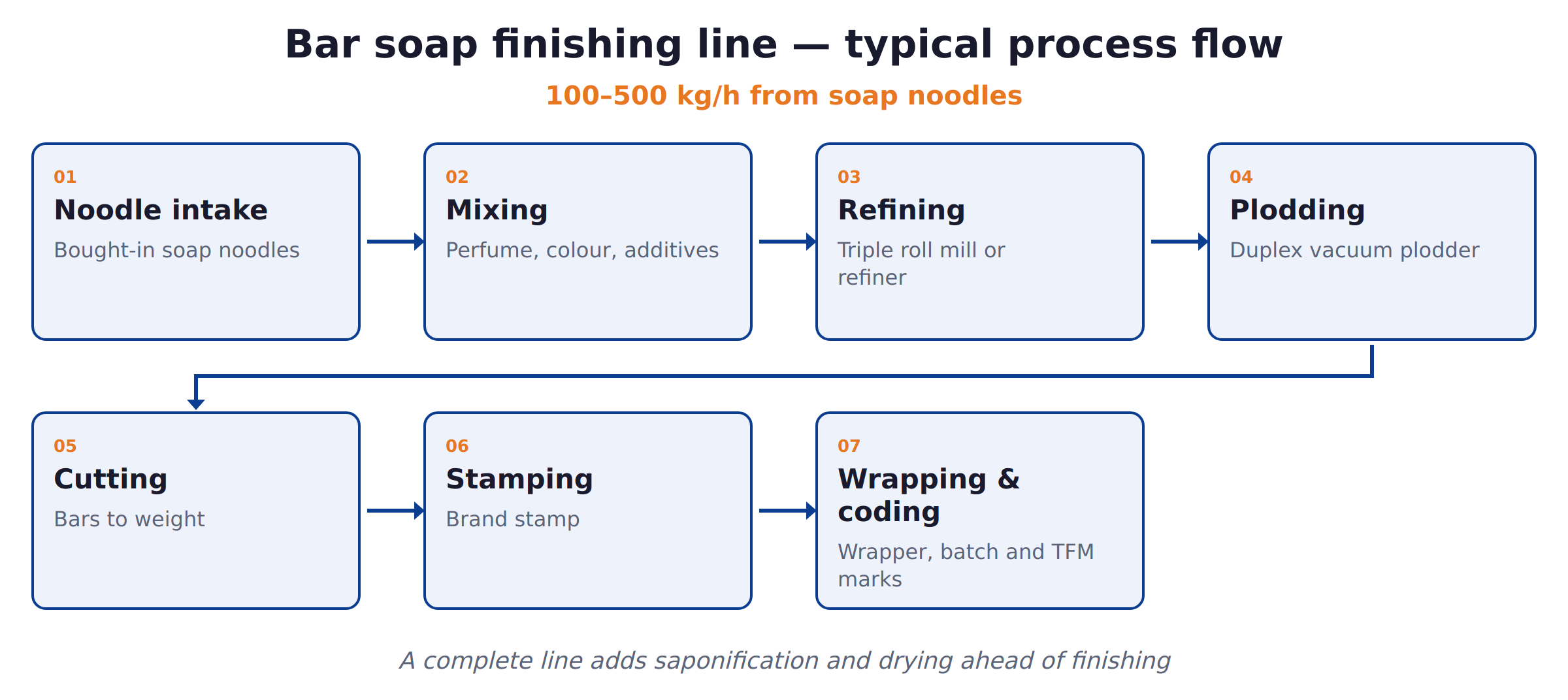
Handmade cold-process soap mixes oils with caustic soda in small batches, poured into moulds and cured for weeks; it needs little equipment and sells as a premium product at markets, boutiques and online. A finishing plant buys ready-made soap noodles and turns them into bars by mixing in perfume and colour, refining, plodding, stamping and wrapping; as an indication for 2026, a finishing line of about 100–500 kg an hour costs about US$20,000–100,000. Imported soap and soap noodles (heading 3401) carry a 20% general duty, free from the EU, UK, EFTA and SADC; crude palm oil carries 10%, and caustic soda 20% unless from SADC. Toilet soap is a cosmetic under the Foodstuffs, Cosmetics and Disinfectants Act, and all packs need net quantity marking.
Step 1: choose your level
| Handmade cold-process | Noodle finishing | Full saponification | |
|---|---|---|---|
| Raw materials | Oils, butters, caustic soda, fragrance | Soap noodles, perfume, colour, additives | Palm, coconut and other oils or tallow, caustic soda |
| Equipment | Mixers, moulds, cutters, curing racks | Mixer, refiner, plodder, cutter, stamper, wrapper | Saponification and drying, then finishing |
| Output | Kilograms a day | 100–500 kg an hour | 300–1,000 kg an hour |
| Investment | Small | About US$20,000–100,000 | About US$150,000–400,000 |
| Market | Premium, boutique, online | Toilet and laundry bars for shops, wholesalers, hotels | Own brands and private label at volume |
Most commercial bar soap makers start with noodle finishing, because buying noodles removes the hardest chemistry.
Step 2: raw materials and duties
Soap noodles and finished soap fall under heading 3401, with a 20% general duty when imported, free from the EU, UK, EFTA and SADC. Crude palm oil (1516.20.90) carries 10%, and caustic soda (2815) 20% with SADC origin free. ITAC's Report 739 (December 2024) dealt with a rebate on palm oil used to make soap, available under specific permits when the product is not available in SACU. Compare local and imported noodle prices delivered, and test each delivery for moisture and total fatty matter.
Step 3: rules and labels
- Toilet soap is a cosmetic under the Foodstuffs, Cosmetics and Disinfectants Act 54 of 1972. Draft regulations on the labelling, advertising and composition of cosmetics (R.1469 of 2017) propose label items including the product name, the responsible person's address, net content, batch number and ingredients in INCI names; check their current status and follow them as good practice.
- Laundry bars are household products; label them with net weight, use instructions and your details.
- Net quantity: all prepackaged soap must show net weight under the Legal Metrology markings rules (SANS 289).
- Caustic soda is hazardous: store it safely, train staff, and provide protective equipment in line with your duties under the OHS Act and the hazardous chemical agents regulations.
Step 4: equipment and costs
| Purchase | Use | Indicative price (2026) |
|---|---|---|
| Cold-process equipment | Small batches | Small |
| Soap noodle finishing line | Mixing, refining, plodding, cutting, stamping | About US$20,000–100,000 for 100–500 kg/h |
| Wrapping machine | Flow wrap or pleat wrap | Priced per configuration |
| Complete saponification and finishing line | Soap base from oils | About US$150,000–400,000 for 300–1,000 kg/h |
Our soap and detergent line cost guide breaks down each band. Mixing, plodding and wrapping machinery generally enters duty-free.
Step 5: premises and power
A finishing plant needs a clean building with three-phase power, a dry store for noodles and packaging, a perfume store, a curing or cooling area, and space for finished stock. A saponification plant also needs steam or thermal oil, oil storage tanks and a caustic soda area. Keep water and drains in mind for cleaning.
Step 6: the numbers
Cost per bar is mostly noodles or oils, then perfume, colour, packaging, labour, power, rent and delivery. Bar weight accuracy matters: small overweights across thousands of bars add up. Compare with shelf prices for laundry bars and toilet soaps in your target stores and allow for retailer and wholesaler margins.
Step 7: sell
Laundry bars sell through spaza shops, wholesalers and supermarkets; toilet soaps through retail, pharmacies, hotels and lodges (guest soaps), and private label. Handmade soaps sell at markets, boutiques and online. Hotels and institutions buy in bulk on contract.
Worked example: from handmade to bars
A handmade soap maker in the Western Cape sells cold-process bars at markets and to boutiques. A lodge group asks for 30,000 guest soaps a month and a wholesaler for laundry bars. She keeps the handmade range and sets up a noodle finishing line of about 200 kg an hour with a mixer, triple-roll mill, duplex plodder, cutter, stamper and a flow wrapper, buying toilet and laundry noodles. Labels show net weight, batch and ingredients. The figures are illustrative.
Common mistakes
- No net weight on the pack.
- Unsafe caustic soda handling.
- Buying noodles without testing.
- Soap that sweats or cracks: wrong perfume level or moisture.
- Starting with saponification before having customers.
Quality checks
Test soap for moisture and total fatty matter, which show how much real soap the bar contains, and for free alkali, which must be low so the soap does not irritate skin. Check bar weight on a calibrated scale and inspect bars for cracks, sweating and colour. Keep a retained sample from each batch with the noodle lot and the perfume batch.
Packaging
Laundry bars are often sold unwrapped or shrink-wrapped in multipacks; toilet soaps are flow-wrapped, pleat-wrapped or boxed. Guest soaps for hotels are small and need fast wrapping. Choose packaging that protects the bar from moisture and keeps the perfume in, and print the net weight, batch and your details on every pack.
Staff and skills
A finishing line needs a mixer operator, a plodder and stamper operator, packers and someone responsible for quality and perfume dosing. Train staff on caustic soda safety even in a noodle plant, because cleaning chemicals and some additives are also hazardous.
Fragrance and colour
Perfume is one of the most expensive ingredients in toilet soap. Buy fragrances made for soap, dose them by weight, and test how they hold up in the bar over a few weeks, because some fragrances fade or discolour. Laundry bars usually carry a light, clean fragrance; toilet soaps sell on scent, so test them on customers first.
Storage
Store noodles, perfume and packaging in a cool, dry place, and finished soap away from sunlight, which can fade colours and fragrances.
Where CISH fits
We supply complete soap lines, noodle finishing, saponification, cutting, stamping and wrapping, from audited factories in China, sized to your soaps and output. CISH ships, clears, installs and commissions the line on your materials, and trains your team. For cold-process equipment, a local supplier is usually the better buy.
Frequently asked questions
How much does it cost to start a soap making business?
Handmade soap needs little equipment. A noodle finishing line costs about US$20,000–100,000 and a full saponification line about US$150,000–400,000, as an indication for 2026.
What are soap noodles?
Ready-made soap base in pellet form, which a finishing line turns into bars with perfume and colour.
Is there import duty on soap noodles?
Soap under heading 3401 carries a 20% general duty, free from the EU, UK, EFTA and SADC.
Is soap a cosmetic in South Africa?
Toilet soap is a cosmetic under the Foodstuffs, Cosmetics and Disinfectants Act; laundry soap is a household product.
What must be on a soap label?
At least the product name, net weight, your details and batch; for toilet soap, follow the draft cosmetic labelling rules, including ingredients.
Does CISH supply soap lines?
Yes, complete finishing and saponification lines with commissioning and training.