The rules that matter most are honest labels with the correct quantity, safe handling of caustic and acid raw materials, and care with germ-killing claims, because a product sold as a disinfectant is regulated more strictly than a plain cleaner. CISH supplies, installs and commissions complete detergent plants for producers ready to scale.
Liquids or powder?
| Liquid detergents and cleaners | Blended washing powder | Spray-dried washing powder | |
|---|---|---|---|
| Products | Dishwashing liquid, laundry liquid, softener, cleaners, hand soap | Laundry powder from bought-in base and additives | Industrial laundry powder |
| Process | Mix in tanks, adjust, fill | Weigh, blend, pack | Make slurry, spray-dry in a tower, post-dose, pack |
| Equipment | Mixing tanks, pumps, filler, capper, labeller | Ribbon or plough mixer, packing machine | Tower, furnace, slurry system, dust control |
| Indicative equipment cost (2026) | About US$20,000–60,000 for a mixing and filling set | About US$3,000–45,000 for a blending set | Quoted per configuration |
| Fits | First businesses and growing brands | Small and regional powder brands | Large producers |
Step 1: Choose products and customers
Decide which products you will sell and to whom. Households buy through spazas, wholesalers and supermarkets; businesses such as cleaning companies, schools, hospitals, hotels and car washes buy in 5 L and 25 L containers. Institutional buyers are often easier to start with: fewer, larger orders and less shelf competition, but they want consistent quality and reliable delivery.
Step 2: Get formulations right
Liquid detergents are mostly water with surfactants, the active cleaning ingredients, plus salt to thicken, a preservative, fragrance and colour. The amount of active surfactant decides cleaning power and cost. You can work with a chemist, buy tested formulations, or use formulations from raw material suppliers. Test every formula for:
- Cleaning performance against products your customers already use.
- Viscosity and appearance after weeks on the shelf.
- Stability at hot and cold temperatures.
- Preservation, so bottles do not grow mould or smell.
- pH, for skin contact and surface safety.
Step 3: Labels and claims
- Quantity. Pre-packed products must show the correct quantity under the Legal Metrology Act, which brings in SANS 289. Fill accurately and check regularly.
- Hazard information. Concentrated cleaners, bleach and products with caustic or acid need hazard warnings, safe use instructions and first aid information.
- Cosmetic or cleaner. A hand soap or body wash applied to the body is a cosmetic under the Foodstuffs, Cosmetics and Disinfectants Act; household cleaners are not, and the label rules differ.
- Germ-killing claims. A product that claims to disinfect or kill germs is regulated as a disinfectant, with stricter requirements, and some products need approval from the National Regulator for Compulsory Specifications before sale. Do not print "kills 99.9% of germs" unless the product is tested and approved for that claim.
Step 4: Premises and safety
- Building: clean, with a washable floor, drains to a sump, and separate storage for raw materials and finished goods.
- Water: in quantity; softened or treated water gives more stable products.
- Chemical handling: caustic soda, acids and concentrated surfactants burn skin and eyes. The Regulations for Hazardous Chemical Agents under the OHS Act apply: safety data sheets, protective equipment, eye-wash stations and training.
- Spills and effluent: contain spills and ask the municipality about discharging wash water.
- Fire: some fragrances and solvents are flammable; store them correctly.
- Zoning for light industrial use.
Step 5: Choose the equipment
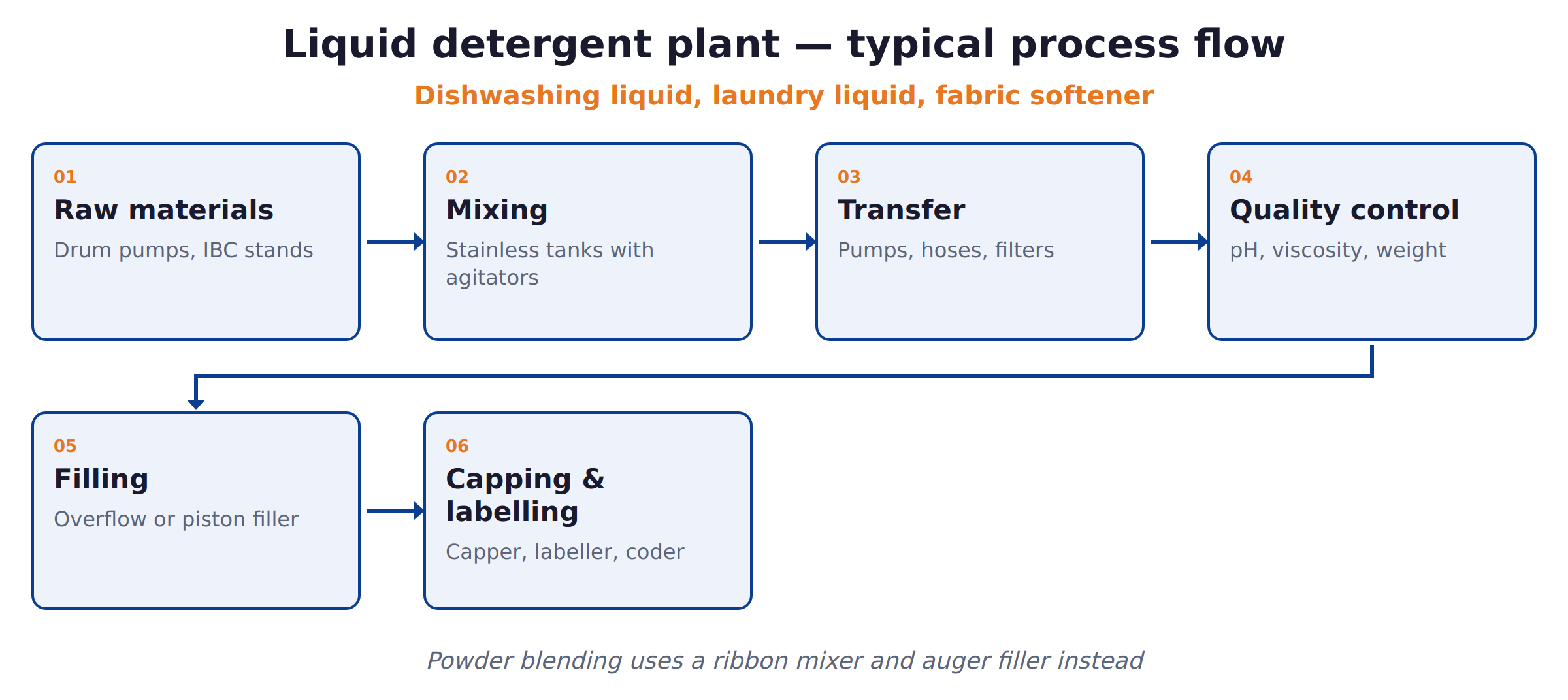
| Stage | Liquid plant | Powder blending plant |
|---|---|---|
| Raw material handling | Drum pumps, IBC stands | Bag tipping, sieving |
| Mixing | Stainless tanks with agitators, heating if needed | Ribbon or plough mixer |
| Transfer | Pumps, hoses, filters | Screw conveyor |
| Filling | Piston or overflow filler for foaming liquids | Auger or cup filler, or form-fill-seal packer |
| Closing and labelling | Capper, labeller, coder | Sealer, coder |
| Quality control | pH meter, viscometer, scale | Scale, moisture checks |
Foaming products such as dishwashing liquid fill best on bottom-up overflow or piston fillers with diving nozzles; our guide to types of filling machines explains why.
Indicative, in USD, from our soap and detergent line cost guide:
| Purchase | Capacity | Indicative price (2026) |
|---|---|---|
| Washing-powder blending set | 50–500 kg batches | About US$3,000–45,000 |
| Liquid detergent mixing and filling set | Batch tanks of a few hundred litres; small filler | About US$20,000–60,000 |
| Spray-dried washing-powder tower | Tonnes per hour | Quoted per configuration |
Mixing machines and fillers carry no general import duty. Caustic soda imports carry 20% general duty, with exemptions for some origins such as SADC; check the duty on each raw material you import.
Step 6: Work out cost per litre
Raw materials and packaging are most of the cost. Price each ingredient per kilogram, calculate each formula per litre, and add the bottle, cap, label, filling labour, power, water and delivery. Compare with what wholesalers and institutions pay, not the shelf price. Higher active content costs more but often wins repeat institutional business.
Step 7: Sell
| Channel | What they want |
|---|---|
| Spazas and small shops | Affordable sizes, reliable delivery, cash terms |
| Wholesalers and distributors | Margin, volume, steady supply, credit terms |
| Supermarkets | Barcodes, supplier registration, consistent quality, promotional support |
| Institutions and cleaning companies | 5 L and 25 L packs, performance, price per use, tenders |
A realistic first year
- Start with three products that sell together, for example dishwashing liquid, an all-purpose cleaner and a laundry liquid.
- Fix formulations and test them for performance and stability over a few weeks.
- Set up a small unit with two or three stainless tanks, a pump, a semi-automatic filler, a capper and a labeller, plus safety equipment for caustic and acids.
- Sell 5 L and 25 L packs to cleaning companies, schools and small businesses first; their orders are larger and steadier.
- Add consumer packs of 750 ml and 1 L for spazas and wholesalers once you can supply reliably.
- Add washing powder blending when customers ask for it.
Keep batch records from the first day: date, formula, quantities, pH and viscosity. They are how you fix complaints and how larger buyers judge you.
Common mistakes
- Diluting to cut cost. Customers notice quickly.
- No preservative. Products spoil on the shelf.
- Disinfectant claims without approval.
- No safety equipment for caustic and acids.
- Wrong filler for foaming products.
- Ignoring fill accuracy. Short-filled bottles break pack rules.
Where CISH fits
We supply complete detergent plants for producers ready to scale: mixing tanks, transfer, filling, capping, labelling and powder blending or packing, from audited factories in China, matched to your products and daily output. CISH ships and clears the plant, installs and commissions it with output demonstrated, and trains your team. For a first set of tanks and a small filler, a local fabricator or dealer is usually the better route.
Adding bar soap to liquids? See how to start a soap making business in South Africa.
Frequently asked questions
How much does it cost to start a detergent business in South Africa?
As an indication for 2026, a liquid detergent mixing and filling set costs about US$20,000–60,000 ex-works, and a washing-powder blending set about US$3,000–45,000.
Do I need a licence to make detergents?
You need suitable, correctly zoned premises and the usual business registrations. Labels must show the correct quantity and hazard information, and disinfectant claims bring stricter rules.
Is a hand soap a cosmetic in South Africa?
Yes. A product applied to the body for cleansing is a cosmetic under the Foodstuffs, Cosmetics and Disinfectants Act.
Can I say my cleaner kills 99.9% of germs?
Only if the product is tested and meets the requirements for a disinfectant, including approval where required. Otherwise, sell it as a cleaner.
What equipment do I need to make dishwashing liquid?
Stainless mixing tanks with agitators, pumps, a filler suitable for foaming liquids, a capper and a labeller, plus a pH meter and viscometer.
Does CISH supply small detergent mixers?
We supply complete detergent plants. For a first set of tanks, a local fabricator or dealer is usually better.