Many spices are imported: dried and ground chillies and paprika under 0904.21 and 0904.22 carry a 25% general duty, free from the EU, UK and SADC, while turmeric under 0910.30 is free. Either way you need a Certificate of Acceptability under R638, labels that meet R146 with allergens declared in blends, correct net quantity marking, and attention to mycotoxins, which new regulations (R.7091 of 2026) will tighten. CISH supplies, installs and commissions complete spice grinding, blending and packing lines.
Step 1: repack or grind?
| Repacking | Grinding and blending your own | |
|---|---|---|
| What you buy | Ground spices and ready blends in bulk | Whole spices, salt, herbs, flour and other blend ingredients |
| Equipment | Scale or auger filler, sealer, labeller | Cleaning, drying, grinding, sifting, blending, filling |
| Investment | Low | Higher |
| Margin | Lower; you compete on brand and price | Higher; you control quality and recipes |
| Risk | Quality depends on your supplier | You control cleaning and grinding, but must test more |
| Fits | New brands, market and shop sales | Growing brands, private label, food service |
Many businesses repack first to learn the market, then grind the spices that sell most.
Step 2: source spices
Chillies, paprika, pepper, cumin, coriander, turmeric, cinnamon and others come from importers or direct from producing countries. Check the tariff line for each: under Schedule 1, dried and ground capsicum (0904.21, 0904.22) carries a 25% general duty with EU, UK and SADC origin free, and turmeric (0910.30) is free. Ask suppliers for certificates of analysis covering moisture, microbiology, mycotoxins and pesticide residues, and keep samples of each lot.
Step 3: licences and labels
- Food premises: your premises must meet R638 of 2018, and you need a Certificate of Acceptability from the municipality.
- Labels: R146 of 2010 requires the product name, ingredients in descending order, allergen declarations where blends contain allergens (for example wheat flour or soya), net quantity, batch, dates and your details.
- Net quantity: packs must show the net quantity under the Legal Metrology markings rules (SANS 289), and actual contents must meet the tolerance.
- Mycotoxins: spices such as chilli and paprika can carry aflatoxins and ochratoxin A. R.7091 of 2026 sets maximum levels for mycotoxins in foodstuffs and comes into force 24 months after publication.
- Retail: supermarkets usually ask for a food safety audit, barcodes and product liability insurance.
Step 4: equipment and costs
| Purchase | Use | Indicative price (2026) |
|---|---|---|
| Scales and band sealer | Hand repacking | Small |
| Semi-automatic auger filler | Accurate powder filling into jars and pouches | About US$1,000–10,000 |
| Grinding set | Small mill with sifter, 50–500 kg/h | About US$1,000–5,000 |
| Ribbon blender | Blending recipes | Priced by size |
| Complete line | Cleaning, drying, sterilising, grinding, blending, filling, coding | Quoted per configuration |
Our spice grinding machine price guide shows the grinding options, and types of packaging machines explains fillers and form-fill-seal machines for sachets and pouches.
Step 5: dust, cleaning and allergens
Grinding spices makes fine dust that irritates the lungs and eyes and can be a fire and explosion risk in enclosed spaces. Fit dust extraction at grinders, sifters and fillers, provide masks, and keep the area clean, in line with your duties under the OHS Act. Clean equipment between strong spices and between blends with and without allergens, and plan production so allergen blends run last.
Step 6: cost per pack
Add the spice, packaging (sachet, jar, lid, label), labour, power, testing, rent, transport and retailer margins. Small packs cost more in packaging per gram than large packs, but sell at higher prices per kilogram. Compare your cost per 100 g with shelf prices in your target stores.
Step 7: sell
Spices sell through markets, spaza shops, butchers (braai and biltong spices), supermarkets, wholesalers, restaurants and caterers. Butchers and food processors buy blends in 1 kg and 5 kg bags; retail buyers want attractive small packs. Private label packing for retailers or butchers can keep a line busy.
Worked example: a braai spice brand
A small business in Durban repacks a braai spice blend into 200 g shaker jars and sells to butchers and two independent supermarkets. It wants better margins and a consistent recipe. It moves into a small food unit, gets its Certificate of Acceptability, buys whole coriander, pepper and chilli plus salt, and installs a grinding set with a sifter, a ribbon blender, a semi-automatic auger filler and a capper. It sends each new batch for microbiology tests, keeps retained samples, and declares the allergen in one blend that contains wheat flour. Later it adds a small VFFS machine for sachets sold in spaza shops. The figures are illustrative.
Common mistakes
- No certificates of analysis from suppliers.
- Grinding without dust extraction.
- Inaccurate fills: hand scooping gives over- and under-weight packs.
- Missing allergen declarations in blends.
- Damp storage: spices cake and grow mould.
Drying, cleaning and microbial control
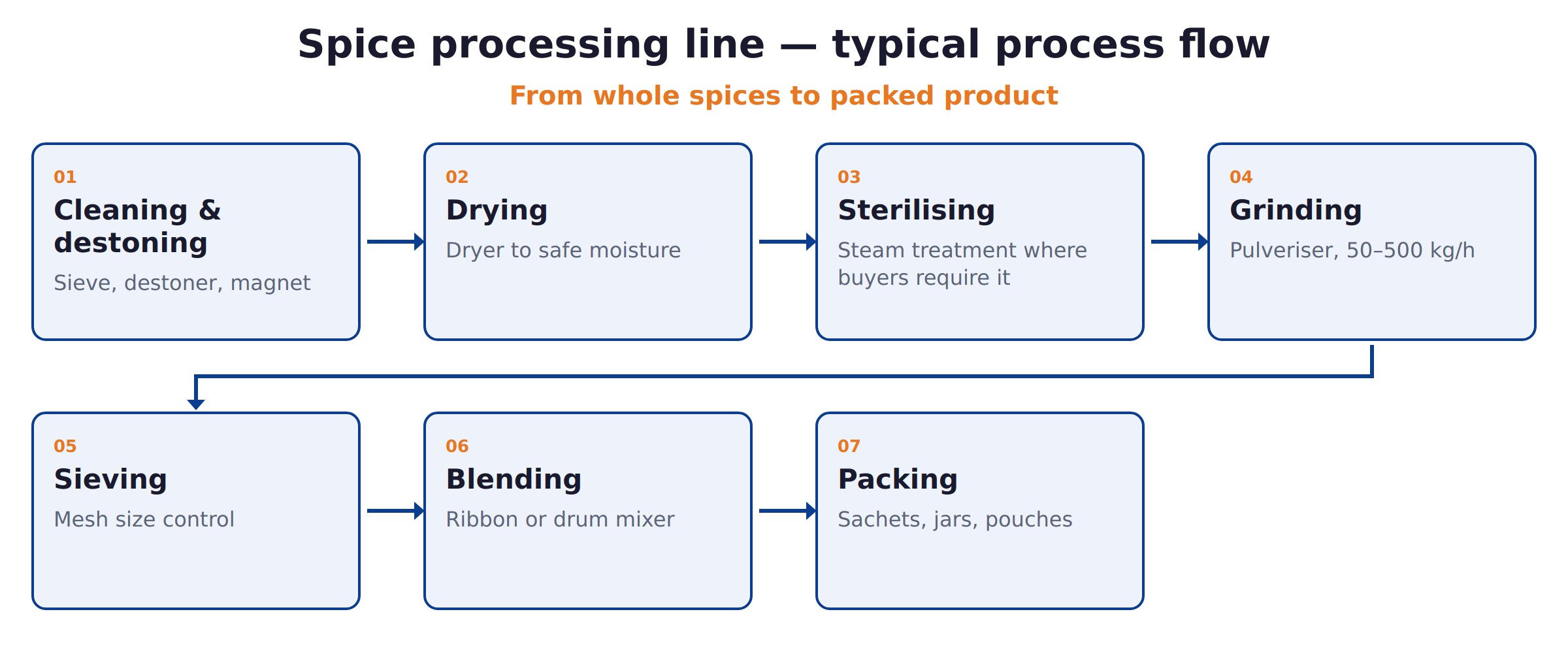
Whole spices arrive with stones, dust, stalks and sometimes insects. Clean them by sieving, aspiration and destoning before grinding, and dry any that arrive damp. Spices can carry high bacterial counts from the field; many processors buy spices that have been steam-treated by the supplier, or add steam sterilisation once volumes justify it. Test finished products for microbiology regularly, especially products sold ready to eat, such as spices sprinkled on snacks and meat after cooking.
Blending accuracy
A blend sells on taste being the same every time. Weigh each ingredient for every batch on a calibrated scale, mix for a set time in a ribbon blender, and take a sample for a taste and colour check before packing. Keep the recipe card, the batch weights and the ingredient lot numbers together, so you can trace any complaint back to its source.
Choosing packs
Small sachets suit spaza shops and impulse sales; shaker jars suit supermarkets; refill pouches and 1 kg bags suit butchers and caterers. Choose barrier packaging that keeps aroma in and moisture out, and print the batch and best-before date on every pack.
Storage
Store whole and ground spices in sealed containers in a cool, dry, dark room, off the floor and away from strong smells. Ground spices lose aroma faster than whole spices, so grind in batches that match sales, and rotate stock so the oldest is sold first.
Where CISH fits
We supply complete spice lines, cleaning, drying, grinding, sifting, blending and packing, from audited factories in China, sized to your spices and packs. CISH ships, clears, installs and commissions the line on your products, and trains your team. For a single sealer or small filler, a local supplier is usually the better buy.
Frequently asked questions
How do I start a spice business in South Africa?
Start by repacking with a scale or auger filler in a certified food premises, then add grinding and blending for your best sellers.
What licence do I need to sell spices?
A Certificate of Acceptability for your premises under R638, and labels that meet R146 and the net quantity rules.
How much is a spice grinding machine?
As an indication for 2026, a grinding set for 50–500 kg/h costs about US$1,000–5,000. Complete lines are quoted per configuration.
Is there import duty on spices?
It depends on the spice. Dried and ground chillies and paprika carry a 25% general duty, free from the EU, UK and SADC; turmeric is free.
Do spice blends need allergen labels?
Yes, where they contain allergens, for example wheat flour or soya.
Does CISH supply spice lines?
Yes, complete grinding, blending and packing lines. For a single small machine, a local supplier is usually better.