Concrete roof tiles are made from sand, cement and pigment, pressed on a tile machine, and cured; a concrete roof tile plant is a concrete products yard that serves builders and housing projects. Cement and terrazzo floor tiles are pressed from cement, sand, marble or stone chips and pigment, cured, then ground and polished; they suit a smaller workshop serving builders, schools and commercial floors. Ceramic and porcelain tiles are made by pressing clay and minerals, glazing and firing them in long kilns at very high temperatures: that is heavy industry, with large investment, gas and power supply, raw material quarries and national distribution, and is not a first business. Every tile business depends on consistent raw materials, proper curing or firing, testing, and builders who reorder.
Step 1: three kinds of tile business
| Concrete roof tiles | Cement and terrazzo floor tiles | Ceramic and porcelain tiles | |
|---|---|---|---|
| Raw materials | Sand, cement, pigment | Cement, sand, marble or stone chips, pigment | Clays, feldspar, sand, glazes |
| Process | Press, cure, coat | Press, cure, grind, polish | Mill, press, dry, glaze, fire in a kiln |
| Energy | Low; curing needs moisture | Moderate; grinding and polishing | Very high; gas-fired kilns |
| Scale | Yard or small factory | Workshop to small factory | Large industrial plant |
| Investment | Priced per configuration | Priced per configuration | Major industrial project |
| Buyers | Builders, housing developers, roofers | Builders, schools, commercial floors | Retailers, builders' merchants, national distribution |
Step 2: concrete roof tiles
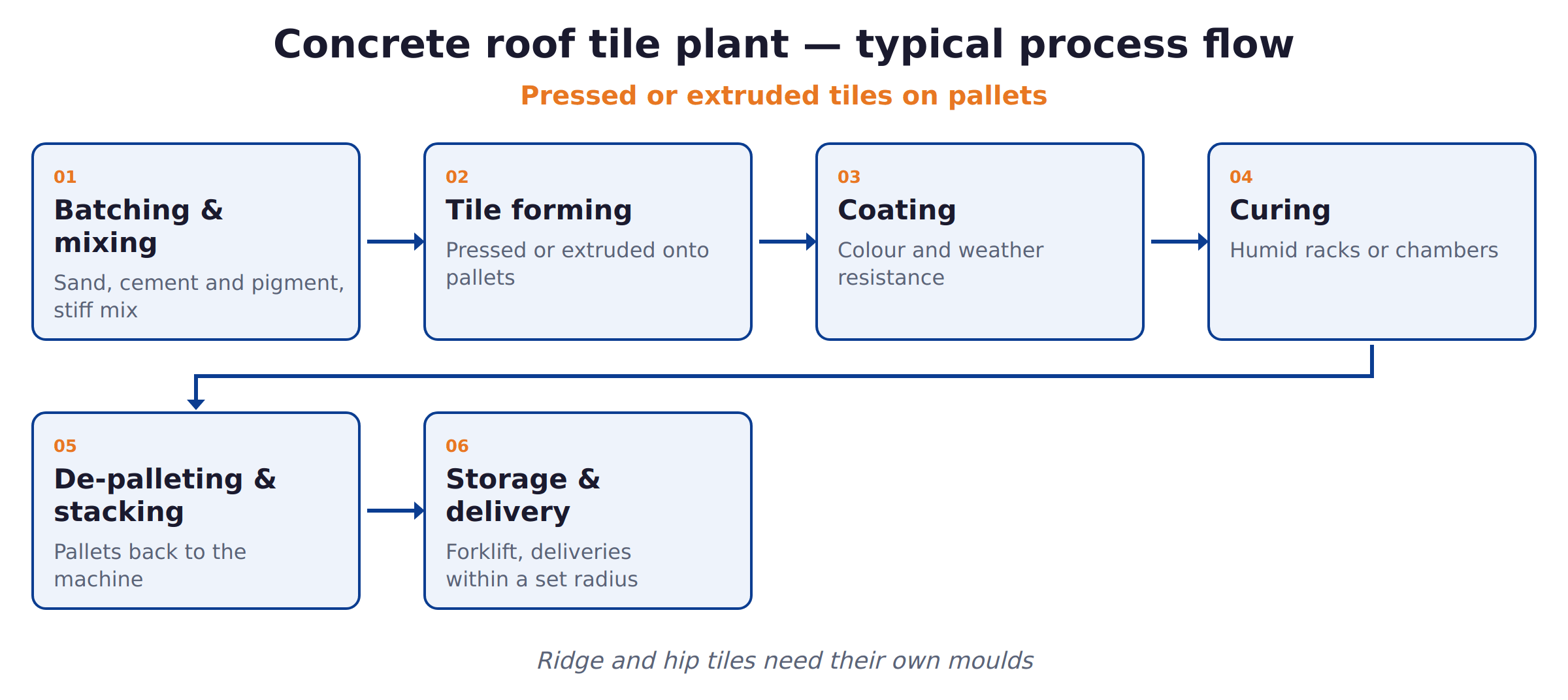
Concrete roof tiles are pressed from a stiff mix of sand, cement and pigment onto pallets, then cured in a humid space so the cement gains strength. Many plants add a coating for colour and weather resistance. A small plant uses a semi-automatic tile machine with manual handling; larger plants use automatic extrusion-type machines with curing chambers and stacking. Ridges and hip tiles need their own moulds. Concrete roof tiles are heavy, so delivery distance matters, and your market is builders and developers within a reasonable radius. Our guide to roof sheet and roof tile machines explains where tile machine prices sit.
Step 3: cement and terrazzo floor tiles
Cement floor tiles are pressed with a coloured top layer and a backing layer, cured, and sometimes sealed. Terrazzo tiles add marble or stone chips to the top layer and are ground and polished after curing to show the chips. The equipment includes a mixer, a hydraulic tile press with moulds for each size, curing racks, and grinding and polishing machines. Terrazzo suits schools, hospitals, shops and public buildings where hard-wearing floors matter.
Step 4: why ceramic tiles are a different scale
Ceramic and porcelain tiles need raw material preparation (ball mills, spray dryers), large hydraulic presses, dryers, glazing lines and roller kilns over a hundred metres long fired at very high temperatures, plus sorting and packing. The plant runs around the clock, needs gas and large power supply, and sells nationally to compete with imports. It is a major industrial project for experienced investors, not a first business. If you want to be in the ceramic tile market without a kiln, consider distribution, tile adhesive and grout manufacturing, or installation.
Step 5: materials and quality
- Sand: clean, graded and consistent; test for clay and silt content.
- Cement: consistent type and supplier; store dry.
- Pigments: iron oxide pigments in measured doses for even colour.
- Water: clean, measured for each batch.
- Curing: keep tiles moist and protected for the curing period; poor curing gives weak tiles.
Test tiles for strength, water absorption and dimensions at an accredited laboratory. Builders working on homes enrolled with the NHBRC need materials that meet the relevant standards and the designer's specification, so keep test reports.
Step 6: equipment and the yard
For concrete roof tiles or cement floor tiles you need a covered production area, a mixer and batching, the tile press or machine, moulds or pallets, curing space (racks or chambers), stacking and storage, forklift handling and delivery vehicles. Plan for three-phase power; Eskom's standard tariff rose 8.76% for 2026/27, so efficient motors and good scheduling help. Complete lines are priced per configuration because output, automation and curing systems vary.
Step 7: selling
Roof tiles sell to builders, housing developers, roofing contractors and homeowners building or reroofing, often as a complete roof with ridges, battens and fixing. Floor tiles sell to builders, contractors, schools and public works, and through builders' merchants. Samples, a display area and quick quotations help. Many tile makers also sell related products such as tile adhesive, grout and paving; our tile adhesive plant cost guide shows bands for a related line, where a simple mixing station starts at about US$5,000–40,000 ex-works as an indication for 2026.
The numbers
Cost per square metre is cement (often the largest share), sand, pigment, labour, power, pallets or moulds, breakage, curing space, delivery and finance. Breakage in handling and delivery can be significant; good stacking and packing reduce it. Price per square metre, or per tile with ridges counted separately.
Worked example: a roof tile yard in the Eastern Cape
A builder in Mthatha buys concrete roof tiles from a supplier hours away and pays for transport. He sets up a yard with a semi-automatic roof tile machine, a pan mixer, pallets, curing racks under shade cloth and a forklift, and sells tiles, ridges and battens to local builders and homeowners. He has tiles tested for strength and water absorption, and later adds a coating line for colour. The figures are illustrative.
Safety
Cement dust, moving presses, grinding machines and heavy pallets are the main hazards. Guard machines, provide dust masks, eye protection and gloves, and train forklift drivers, as the OHS Act requires.
Common mistakes
- Choosing ceramic tiles as a first business.
- Poor curing that gives weak tiles.
- Inconsistent sand and colour between batches.
- No test reports for builders.
- Ignoring breakage in handling and delivery.
Moulds, pallets and colours
Each tile profile or size needs its own moulds or pallets, and a yard needs enough pallets for several days of curing. Count pallets in your budget, because running out stops production. Offer a small range of colours that sell, rather than many, to keep pigment stock and changeovers low. Keep a colour sample board and record pigment doses for every batch so repeat orders match earlier ones.
Delivery and breakage
Tiles are heavy and break if handled badly. Stack them on pallets with spacers, strap them, and use a truck with a crane or forklift for site deliveries. Count breakage on every delivery for the first months, find where it happens, and fix packing or handling before it eats your margin.
Where CISH fits
We supply concrete roof tile and cement and terrazzo tile lines, mixing, pressing, curing, grinding and polishing, from audited factories in China, sized to your products and square metres. CISH ships, clears, installs and commissions the line on your materials, and trains your team. For a single small tile press, a local supplier is usually the better buy.
Frequently asked questions
What is the easiest tile business to start?
Concrete roof tiles or cement floor tiles, which need far less investment and energy than ceramic tiles.
How are concrete roof tiles made?
A mix of sand, cement and pigment is pressed into shape, cured in humid conditions and often coated.
Can I start a ceramic tile factory?
Ceramic tile plants are major industrial projects with kilns, large power and gas supply, so they are not a first business.
How much does a tile machine cost?
Concrete roof tile machines and lines are priced per configuration because output, automation and curing vary widely.
Do tiles need testing?
Yes. Builders need tiles that meet standards for strength, water absorption and dimensions.
Does CISH supply tile lines?
Yes, concrete roof tile and cement tile lines with commissioning and training.