Ice machines in South Africa come from refrigeration dealers who sell cube ice makers for bars and shops, refrigeration contractors who build ice rooms, Chinese factories that sell block, tube and flake ice plants direct, and turnkey companies that set up a complete bagged-ice plant. Bagged ice is food, so the plant needs a Certificate of Acceptability, drinking-quality water and labelled bags, and new plants should avoid R22 refrigerant.
Who sells ice machines
Restaurants and bars, fish and meat processors, events companies and entrepreneurs starting a bagged ice business all ask for ice machines, but they need very different equipment. Four kinds of supplier answer them.
| Supplier type | What they sell | Price | Who answers for output | Best fit |
|---|---|---|---|---|
| Refrigeration dealer | Cube and nugget ice makers, bins, small flake units | Moderate | The dealer, per machine | Bars, restaurants, shops |
| Refrigeration contractor | Ice storage rooms, condensing units, installation and service | Depends on scope | The contractor, for its installation | Storage and service around an ice machine |
| Chinese factory, direct | Block ice (brine or direct cooling), tube ice and flake ice plants, often containerised | Lowest on the quote | You, after delivery | Buyers with refrigeration technicians |
| Turnkey ice plant company | Water treatment, ice machine, storage, bagging and sealing, commissioned | Between direct and dealer | The turnkey company, at agreed tonnes per day | Bagged ice businesses and processors |
Pick the ice type before the supplier
| Ice type | Typical use | What to know |
|---|---|---|
| Cube ice | Drinks, retail bags | Clear and slow to melt; small machines are easy to buy locally |
| Tube ice | Retail bags, drinks, events | Hollow cylinders, good for bagging at volume |
| Block ice | Fishing, rural cooling, crushing | Brine or direct-cooling machines; long freeze times |
| Flake ice | Fish, meat, bakeries, concrete cooling | Soft and quick to cover product; not for drinks bags |
A supplier strong in one type may be weak in another. Ask for references running the type you will sell.
What to check in the supplier
Output at your temperatures
Ice machine capacity falls as ambient and water temperatures rise. Rated tonnes per day are often stated at mild conditions. Ask for output at your summer air and water temperatures, which is when you sell most ice.
Refrigerant and technicians
Equipment that uses HCFC-22 (R22) may not be imported, and HCFC supply is capped at a small share of the baseline from 2026. Choose a plant on a current refrigerant, and make sure registered refrigeration technicians can service it. Refrigeration work must be done by authorised persons registered with SAQCC Gas.
Water and hygiene
Ice for consumption is food. The water should meet SANS 241 drinking water quality, usually with filtration and UV or other treatment, and the ice room and bagging area must be cleanable.
Where to find ice machine suppliers
- Refrigeration and air-conditioning associations list registered contractors and authorised persons.
- Food and hospitality trade shows feature cube ice makers and dealers; check current dates with organisers.
- Existing ice plants: visit one running the ice type and output you plan.
- China: most block, tube and flake ice plants sold in Africa are made in China. Our supplier audit checklist covers what to check before a deposit.
This page does not list or rank ice machine sellers.
How to choose: a 10-point checklist
- Ice type matched to your buyers.
- Tonnes per day at your summer conditions, demonstrated at handover.
- Refrigerant that can legally be serviced for the plant's life.
- Water treatment to drinking-water quality.
- Ice storage for two to three days of sales.
- Bagging and sealing with labels.
- Power supply and the running cost per tonne of ice.
- Hygiene: stainless food-contact parts, cleanable room.
- Installation, commissioning and training in the price.
- Local service by registered refrigeration technicians.
Not sure which ice to make? Our guide to block, tube and flake ice matches each type to its buyers.
Ten questions to ask
- What output does the machine give at 35 °C air and 25 °C water?
- Which refrigerant does it use, and can it be serviced locally?
- What kWh does it use per tonne of ice?
- What water treatment is included?
- How much ice storage do I need, and is it included?
- Is a bagging and sealing machine included?
- Who installs and commissions it, and are they registered?
- What does the warranty cover?
- How fast can a technician reach my site?
- Which ice plant in South Africa runs this machine, and may I visit?
Comparing ice plant quotes
| Section | What each quote should state |
|---|---|
| Water treatment | Filtration, UV or other treatment, capacity |
| Ice machine | Type, tonnes per day at stated conditions, refrigerant |
| Condensing | Air or water cooled, ambient limits |
| Storage | Ice room size, temperature, insulation |
| Bagging | Bag sizes, sealing, labelling |
| Power | Installed kW and kWh per tonne |
| Installation and commissioning | Engineer days, test at full output |
| Training and service | Operator training, service plan |
| Owner's scope | Building, power connection, water supply, permits |
Fill the gaps in each quote before comparing totals. Our same-scope comparison explains the method.
Common mistakes
- Sizing for winter output. Summer demand peaks when machines make least ice.
- Buying an R22 plant. It may not be imported, and gas will get scarcer.
- No storage. Production cannot follow weekend and holiday peaks.
- Untreated water. Cloudy or unsafe ice loses buyers.
- Ignoring power cost. Electricity is the largest running cost per tonne.
Ice machine and ice plant prices in 2026
Indicative, in USD, from our ice machine price guide:
| Purchase | Capacity | Indicative price (2026) |
|---|---|---|
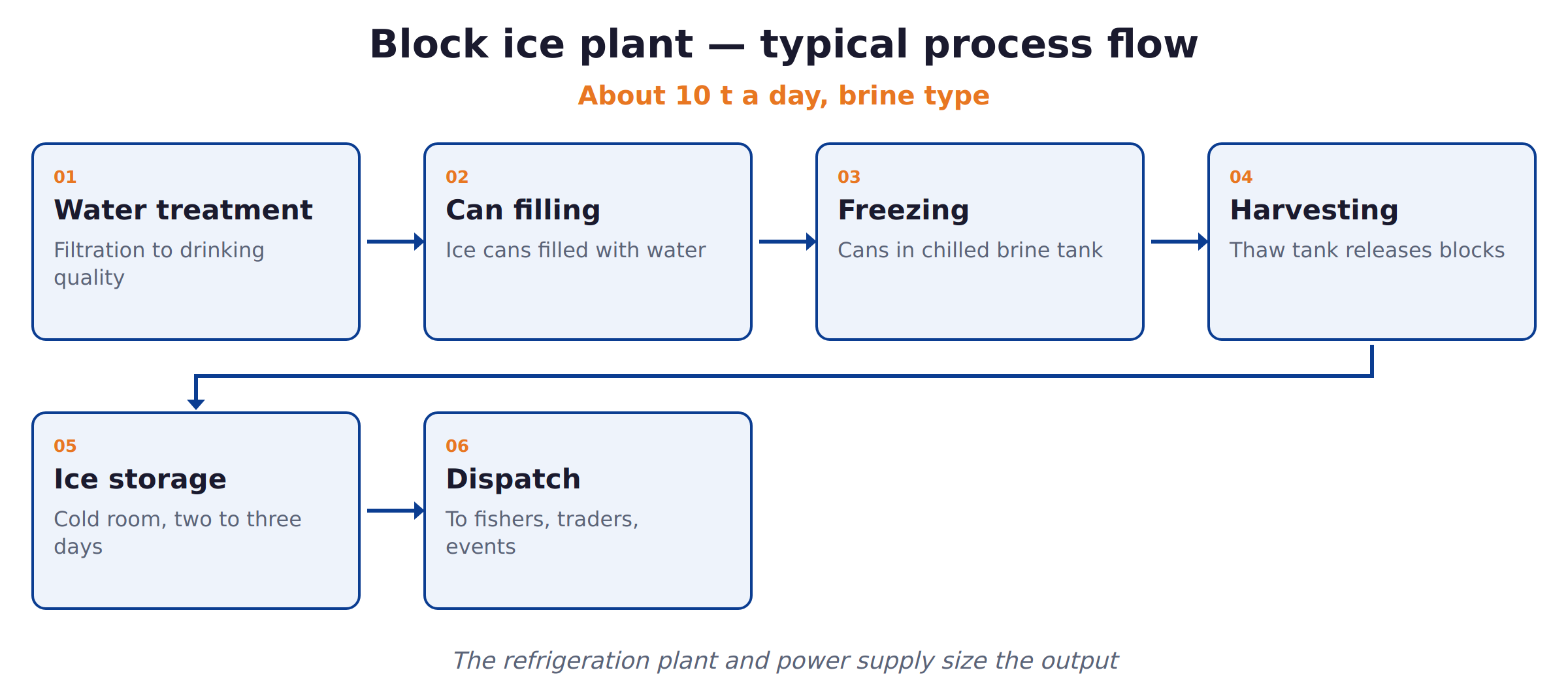
| Block ice machine, brine type | About 10 t/day | About US$10,000–45,000 ex-works |
| Tube or flake ice plant | 5–30 t/day | Quoted per configuration |
| Cold room for ice storage | Two to three days of sales | Chiller and freezer rooms from about US$15,000 installed |
| Complete bagged ice plant | Water treatment, ice, storage, bagging | Quoted per configuration |
South African facts that shape the decision
- Ice is a foodstuff. An ice plant is a food premises under R638 of 2018 and needs a Certificate of Acceptability.
- Water quality. Use water that meets SANS 241, with treatment where the source needs it.
- Labels. Bagged ice sold in retail is a prepacked foodstuff under R146 of 2010.
- Refrigerant phase-out. HCFC-22 equipment may not be imported, and HCFC supply is capped at 2.5% of the baseline from 2026.
- Registered installers. Refrigeration work must be carried out by authorised persons registered with SAQCC Gas.
- Power costs rise. Eskom's 2026/27 tariff increase raises the cost of every tonne of ice; efficient condensing matters.
- Import duty. Industrial refrigerating equipment (8418.69.90) is free of general duty in SARS's 2026 tariff. Import VAT of 15% applies and is reclaimable by VAT vendors; see our import duty guide.
Where CISH fits
CISH is a turnkey ice plant company. We specify block, tube or flake ice plants from audited factories in China against your ice type and summer conditions, add water treatment, storage and bagging, ship and clear them, and install and commission the plant with tonnes per day demonstrated, and your operators trained. We suit bagged ice businesses and processors that need flake ice. For a single cube ice maker, a refrigeration dealer is often the better choice.
Frequently asked questions
Who sells ice machines in South Africa?
Refrigeration dealers sell cube ice makers, refrigeration contractors build ice rooms, Chinese factories sell block, tube and flake plants direct, and turnkey companies set up complete bagged ice plants.
How much does an ice machine cost?
As an indication for 2026, a brine block ice machine of about 10 tonnes a day costs about US$10,000–45,000 ex-works. Tube and flake ice plants of 5–30 tonnes a day are quoted per configuration.
Which ice is best for selling in bags?
Tube and cube ice are the usual choices for drinks bags. Block ice suits fishing and rural cooling; flake ice suits fish and meat processing.
Do I need a certificate to sell ice?
Yes. Ice for consumption is food, so the plant needs a Certificate of Acceptability under R638 of 2018, and bags must be labelled.
Can I buy an ice machine that uses R22?
Equipment using HCFC-22 may not be imported, and HCFC supply is being phased down. Choose a plant on a current refrigerant.
Does CISH sell cube ice makers for bars?
No. We supply complete ice plants. For a single cube ice maker, a refrigeration dealer is usually the better route.