Before choosing a supplier, decide the ice your customers buy (block, tube or flake), size the plant on your daily sales in the hot season, and check the refrigerant and the electricity it will use.
Ice making machine prices, 2026
| What you buy | Capacity | Indicative price (2026) | Note |
|---|---|---|---|
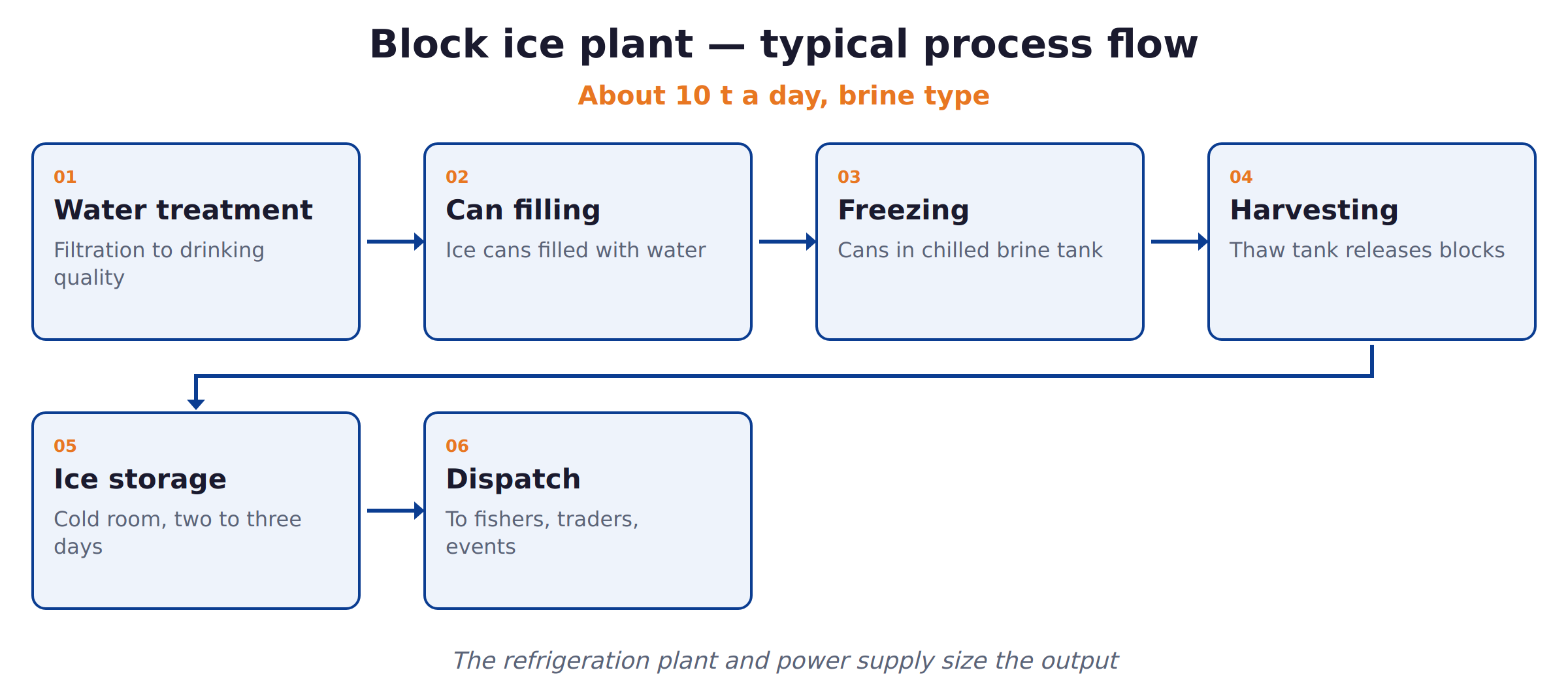
| Block ice machine, brine type | About 10 t/day | About US$10,000–45,000 ex-works China | Containerised units with storage at the top of the range |
| Tube ice or flake ice plant | 5–30 t/day | Quoted per configuration | Price depends on ice type, condensing and storage |
| Cold room for ice storage | Sized to two to three days of sales | Chiller and freezer rooms from about US$15,000 installed | See our cold room price guide |
| Complete ice plant | Water treatment, ice machine, storage, bagging | Quoted per configuration | Building, power and delivery vehicles extra |
Shop, bar and restaurant ice makers are a different product, sold by catering dealers; this page is about ice plants.
Block, tube or flake: what each is for
| Ice type | Who buys it | Strengths | Watch out for |
|---|---|---|---|
| Block ice | Fisheries, fresh produce transport, informal retail, events | Melts slowly; simple to store and transport | Brine systems need corrosion care; blocks need crushing for some uses |
| Tube ice | Bagged ice for retail and drinks | Clear, hard, bags well | Higher machine cost; needs good water |
| Flake ice | Fish, poultry, meat processing, concrete cooling | Cools fast, mixes with product | Melts quickly; used on site rather than sold |
Choose by your customers, not by the machine. A bagged-ice business for supermarkets and liquor stores is a tube ice business; a fishery supplier is often a block or flake business.
Who sells ice plants, and why prices differ
Ice plants come from refrigeration contractors who build plants locally, agents of imported ice machine brands, Chinese factories selling block, tube and flake machines direct, and turnkey companies that deliver the whole plant. Prices differ because of what is included: condensing type (air-cooled or water-cooled with a cooling tower), refrigerant, whether ice storage and bagging are included, and whether installation and commissioning are part of the price. The checklist in our cold room suppliers guide applies to the refrigeration side of an ice plant too.
The cheap machine versus the plant that sells ice
A machine on a listing makes ice in a factory test. A plant that sells ice also needs:
- Water treatment so that ice meets drinking water quality.
- Ice storage for two to three days of hot-season sales, because ice is made continuously but sold in peaks.
- Crushing, bagging and sealing for retail.
- A freezer room or ice bin that keeps bags hard.
- Delivery in insulated vehicles.
Most of the cost difference between a cheap machine and a working business is in these items.
What moves the price
- Tonnes per day at your ambient: ice machine output falls on hot days; size on summer conditions.
- Ice type: tube ice machines cost more per tonne than block machines of the same output.
- Condensing: water-cooled plants are efficient but need a cooling tower and water; air-cooled are simpler.
- Refrigerant: choose one that can be serviced in South Africa for the plant's life.
- Storage and bagging: often as much again as the machine.
- Electricity: ice is mostly electricity; Eskom's standard tariffs rose 8.76% from April 2026, so ask for kWh per tonne of ice.
Where the money goes
On a complete ice plant, the ice machine itself is typically less than half the project. Freight and import, building or container works, electrical supply, water treatment, storage, bagging, installation and commissioning make up the rest. A plant that saves on storage sells less ice on the hottest days, when demand and price peak.
Choose by scenario
| Situation | Usual choice |
|---|---|
| New bagged-ice business | Tube ice plant with water treatment, bagging and a freezer room |
| Fishery or fresh produce supplier | Block or flake ice plant with storage near the landing or packhouse |
| Abattoir or poultry processor | Flake ice plant integrated with chilling |
| Existing ice business expanding | Second machine plus more storage, sized to peak days |
| Events and informal retail | Block ice with simple crushing |
How to compare ice plant quotes
Ask every supplier for: ice type and size, output in tonnes per day at your summer ambient and water temperature, refrigerant, condensing type, electricity use per tonne, water treatment, storage capacity and temperature, bagging and sealing, installation and commissioning, and warranty. Then add what is missing. The suppliers guide explains how to put quotes on the same basis.
South African rules that affect an ice plant
- Food premises. Ice for consumption is food; the plant is a food premises under R638 of 2018 and needs a Certificate of Acceptability.
- Water quality. Use water that meets SANS 241 for drinking water, with treatment where the source needs it.
- Labels. Bagged ice sold in retail is a prepacked foodstuff under R146 of 2010.
- Refrigerant. HCFC-22 equipment may not be imported and HCFC supply is capped at 2.5% of the baseline from 2026, so avoid R22 plants.
- Registered installers. Refrigeration work is done by authorised persons registered with SAQCC Gas.
- Import duty. Industrial refrigerating equipment (8418.69.90) is free of general duty in SARS's 2026 tariff; import VAT of 15% applies and VAT vendors reclaim it. See the import duty guide.
Configurations and lead times
Block ice machines are often supplied containerised, ready to connect. Tube and flake plants are built to order, then shipped; sea transit from China to Durban is typically about 22–30 days. A plant with water treatment, storage and bagging can be commissioned within weeks of arrival if the site, power and water are ready.
Where CISH fits
CISH supplies, installs and commissions complete ice plants from audited factories in China: water treatment, block, tube or flake ice machines, storage, crushing and bagging, sized on your hot-season sales and handed over at a stated output. We do not sell shop or bar ice makers; a catering dealer is the right supplier for those.
For who sells ice machines, see ice machine suppliers in South Africa.
Planning the business side? See how to start an ice business.
Which ice should you make? Our comparison of block, tube and flake ice matches each type to its buyers.
Frequently asked questions
How much is an ice making machine in South Africa?
For an industrial block ice machine of about 10 tonnes a day, listings run about US$10,000–45,000 ex-works China in 2026. A complete ice plant with water treatment, storage and bagging is quoted per configuration.
Which ice is best for a bagged ice business?
Tube ice is usually best for bagged retail ice: it is clear, hard and bags well. Block ice suits fisheries and transport; flake ice suits processing.
How big should an ice plant be?
Size it on your daily sales on the hottest days of the year, plus two to three days of storage, at your summer ambient temperature.
How much electricity does an ice plant use?
Ice is mostly electricity. Ask each supplier for kWh per tonne of ice at your ambient; it varies with machine type and condensing.
Do I need a certificate to sell ice?
Yes. Ice for consumption is food, so the premises need to meet R638 of 2018 and hold a Certificate of Acceptability, and bagged ice must be labelled.
Is there import duty on ice machines?
Industrial refrigerating equipment (8418.69.90) is free of general duty in SARS's 2026 tariff. Import VAT of 15% applies.
Does CISH sell small ice makers?
No. We supply complete ice plants. For shop, bar or restaurant ice makers, a catering dealer is the right supplier.