Imported sausages carry 40% duty or 240 cents a kilogram, which protects local producers. CISH supplies, installs and commissions complete meat processing lines.
Sausage line prices, 2026
| What you buy | Capacity | Indicative price (2026) | Note |
|---|---|---|---|
| Sausage line, grinder to smokehouse | About 200–500 kg/h | About US$9,000–50,000 ex-works China | Low end is basic manual stuffing; high end adds vacuum filling, linking and a larger smokehouse |
| Industrial line with vacuum filler, linker and cooking | 1,000 kg/h and above | Quoted per configuration | Polony, viennas and cooked ham need cooking and chilling |
| Cold rooms for meat and product | Sized to your throughput | Chiller rooms from about US$15,000 installed | See our cold room price guide |
Prices are listing prices before freight, duty, VAT and installation.
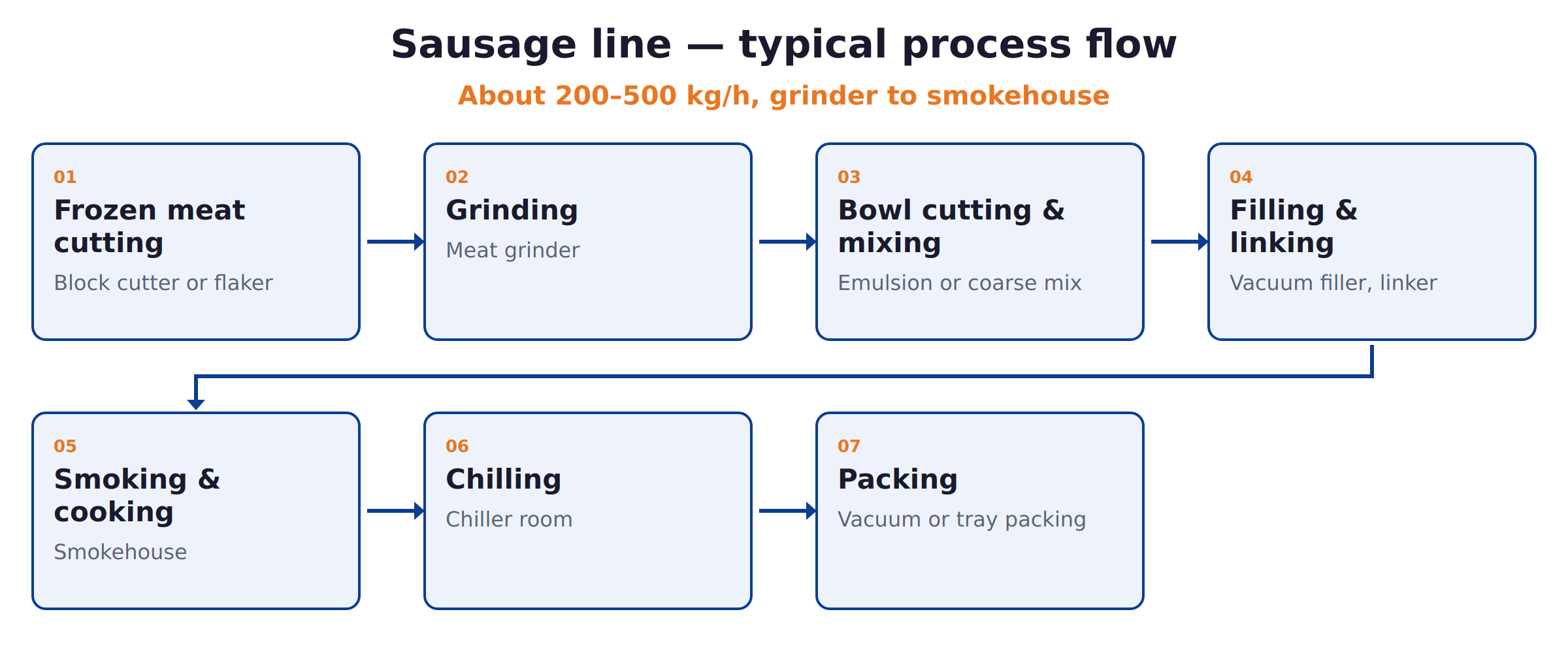
What a sausage line contains
- Frozen meat cutter or flaker for frozen blocks.
- Meat grinder (mincer) with plates for different coarseness.
- Bowl cutter for emulsified products such as viennas and polony.
- Mixer, ideally vacuum, for spices, brine and binders.
- Filler (stuffer): hydraulic for small plants, vacuum filler for higher output and portion accuracy.
- Linker or clipper for portioning.
- Smokehouse or cooking cabinet for smoked and cooked products.
- Chilling and packing: cooling showers, vacuum packing, labelling.
Boerewors and fresh sausages need the first steps and a filler; smoked and cooked products need the whole line, and a cooked-product area separated from raw.
Who sells meat processing equipment, and why prices differ
Butchery equipment dealers sell mincers, fillers and small bowl cutters for shops and butcheries. Agents of European meat-processing brands sell high-end vacuum fillers, bowl cutters and smokehouses. Chinese factories sell complete lines direct at much lower prices. Turnkey companies design and commission the whole processing plant. Prices differ mostly on the filler (hydraulic or vacuum), the bowl cutter size and speed, and the smokehouse.
The cheap set versus the plant that passes inspection
A low-priced line makes sausages. A plant that sells processed meat to retailers has separated raw and cooked areas, temperature-controlled rooms, cleanable stainless equipment, documented cooking and chilling, and traceable batches. South Africa's 2017–18 listeriosis outbreak, which WHO linked to a processed meat product and the manufacturer's processing environment, caused 978 confirmed cases and 183 known deaths. Since then, processed meat plants are held firmly to their food safety systems.
What moves the price
- Products: fresh sausage and boerewors only, or smoked, cooked and emulsified products too.
- Filler type: vacuum fillers cost more but portion accurately and reduce air in the product.
- Throughput in kilograms per hour.
- Smokehouse: size, automatic programmes, cooking and showering.
- Packing: vacuum packing, labelling, metal detection.
- Hygiene design and materials.
Where the money goes
In a processed meat plant the line is often a minority of the cost. Cold rooms and freezers, the building with separated zones and food-grade finishes, drainage and effluent, refrigeration, electrical supply, installation and commissioning take most of it.
Choose by scenario
| Situation | Usual choice |
|---|---|
| Butchery making boerewors | Mincer, mixer and hydraulic filler from a butchery dealer |
| New processor supplying shops | 200–500 kg/h line with vacuum filler, smokehouse and cold rooms |
| Abattoir adding processing (expansion) | Processing line next to the slaughter line, with separate cooked area |
| Processor moving into polony and viennas | Bowl cutter, cooking and chilling, quoted per configuration |
How to compare sausage line quotes
Ask each supplier for: output per hour of each product, frozen meat handling, grinder plates, bowl cutter volume and speeds, mixer type, filler type and portion accuracy, linker, smokehouse programmes and capacity, chilling, packing, materials, installation and commissioning with your recipe, and warranty. Then add the cold rooms and building work each quote leaves out.
Running costs to plan for
The purchase price is the start. A sausage plant's monthly costs include:
- Meat and fat, by far the largest cost, bought frozen or fresh to a specification.
- Casings, natural or collagen, and their storage.
- Spices, binders and brine ingredients.
- Refrigeration: cold rooms and freezers run around the clock.
- Smokehouse energy: electricity, gas or wood chips, depending on the unit.
- Cleaning chemicals and water, with effluent that carries fat and protein.
- Packaging film and labels.
- Labour per shift, which falls sharply when a vacuum filler and linker replace hand stuffing.
Ask each supplier for the line's electricity use and staffing at full output, so you can cost a kilogram of finished sausage before you buy.
Choosing a supplier for a wider meat line? See meat processing equipment suppliers in South Africa.
Making dried meat rather than sausages? See how to start a biltong business, from the meat source to drying rooms.
Ten questions to ask a sausage line supplier
- What output per hour will you guarantee for each of my products?
- Is the filler hydraulic or vacuum, and how accurate is portioning?
- What size is the bowl cutter, and at what speeds does it run?
- Can the line handle frozen meat blocks?
- What smokehouse programmes are included, and how is cooking temperature recorded?
- What cleaning does each machine need, and how long does it take?
- What electricity, water and compressed air does the line use?
- Who installs and commissions it, with my recipe and casings?
- What does the warranty cover, and which wear parts come with the line?
- Which processor runs your line, and may I visit?
South African rules that shape a sausage plant
- HACCP for processed meat. The HACCP regulations (R908 of 2003), amended in June 2018, apply to processed meat manufacturers.
- Compulsory specification. Processed meat products must meet the compulsory specification VC 9100.
- Product rules. Processed meat products are classified, packed and marked under R1283 of 2019, raw processed meat products under R2410 of 2022, and boerewors and sausage have their own regulation (R2718); brine injection is covered by R55 of 2015.
- Food premises and labels. The plant needs to meet R638 of 2018 and a Certificate of Acceptability, and products are labelled under R146 of 2010.
- Strong tariff protection. Imported sausages (1601.00.90) carry general duty of 40% or 240 cents per kilogram in SARS's 2026 tariff, including from the EU, UK and EFTA; they are free only from SADC.
- Duty-free machinery. Machinery for preparing meat (8438.50) is free of general duty; import VAT of 15% applies and VAT vendors reclaim it. See the import duty guide.
Configurations and lead times
Standard 200–500 kg/h lines are built to order and shipped in one container; sea transit to Durban takes about 22–30 days. Plan the building, cold rooms and electrical supply while the line is built, and commission with your own recipes and casings.
Where CISH fits
CISH supplies, installs and commissions complete meat processing lines from audited factories in China, from frozen-meat handling to smoked, cooked and packed product, with cold rooms sized to the line and commissioning on your recipes. We suit processors supplying shops and retailers, and abattoirs adding processing. For a mincer and filler for a butchery, a local butchery equipment dealer is the better choice.
Frequently asked questions
How much does a sausage making machine cost in South Africa?
For production, a 200–500 kg/h line from grinder to smokehouse is listed at about US$9,000–50,000 ex-works China in 2026. Industrial lines above 1,000 kg/h are quoted per configuration.
What machines do I need to make boerewors commercially?
A mincer, a mixer and a filler, with cold storage and a food-grade room. For smoked or cooked products you also need a bowl cutter, a smokehouse and a separated cooked area.
Is a vacuum filler worth it?
For commercial output, usually yes: it portions accurately, reduces air in the product and runs faster than a hydraulic stuffer.
What regulations apply to sausage production in South Africa?
The HACCP regulations as amended in 2018 for processed meat, the compulsory specification VC 9100, product regulations including R1283 and the boerewors and sausage regulation, the food premises regulations R638 and labelling under R146.
Is there import duty on sausages?
Yes. Sausages (1601.00.90) carry 40% or 240 cents per kilogram general duty in SARS's 2026 tariff, including from the EU, UK and EFTA.
Does CISH sell single mincers or fillers?
No. We supply complete meat processing lines. For a single machine, a butchery equipment dealer is the better route.