How much clean product you get from a tonne of bales depends mostly on bale quality: clean, sorted bottle bales often yield in the region of 70–85%, dirty film much less.
The process at a glance
| Step | What happens | Machine |
|---|---|---|
| 1. Receiving and storage | Bales weighed, graded and stored dry | Weighbridge, forklift, covered yard |
| 2. Bale breaking | Bales opened and loosened | Bale opener |
| 3. Sorting | Wrong polymers, colours, metals and rubbish removed | Sorting belt, magnets, optional optical sorter |
| 4. Pre-washing and label removal | Dirt, sand and labels removed from whole bottles | Trommel, label remover, pre-washer |
| 5. Size reduction | Plastic cut into flakes or pieces | Crusher, granulator or shredder |
| 6. Washing | Flakes scrubbed, often hot, then separated by density | Friction washers, hot wash tank, float-sink tank |
| 7. Drying | Water removed | Centrifugal dryer, hot-air dryer, squeezer for film |
| 8. Pelletising | Flakes melted, filtered and cut into pellets | Extruder, melt filter, pelletiser |
| 9. Packing | Flakes or pellets bagged in bulk bags | Silo, bagging station |
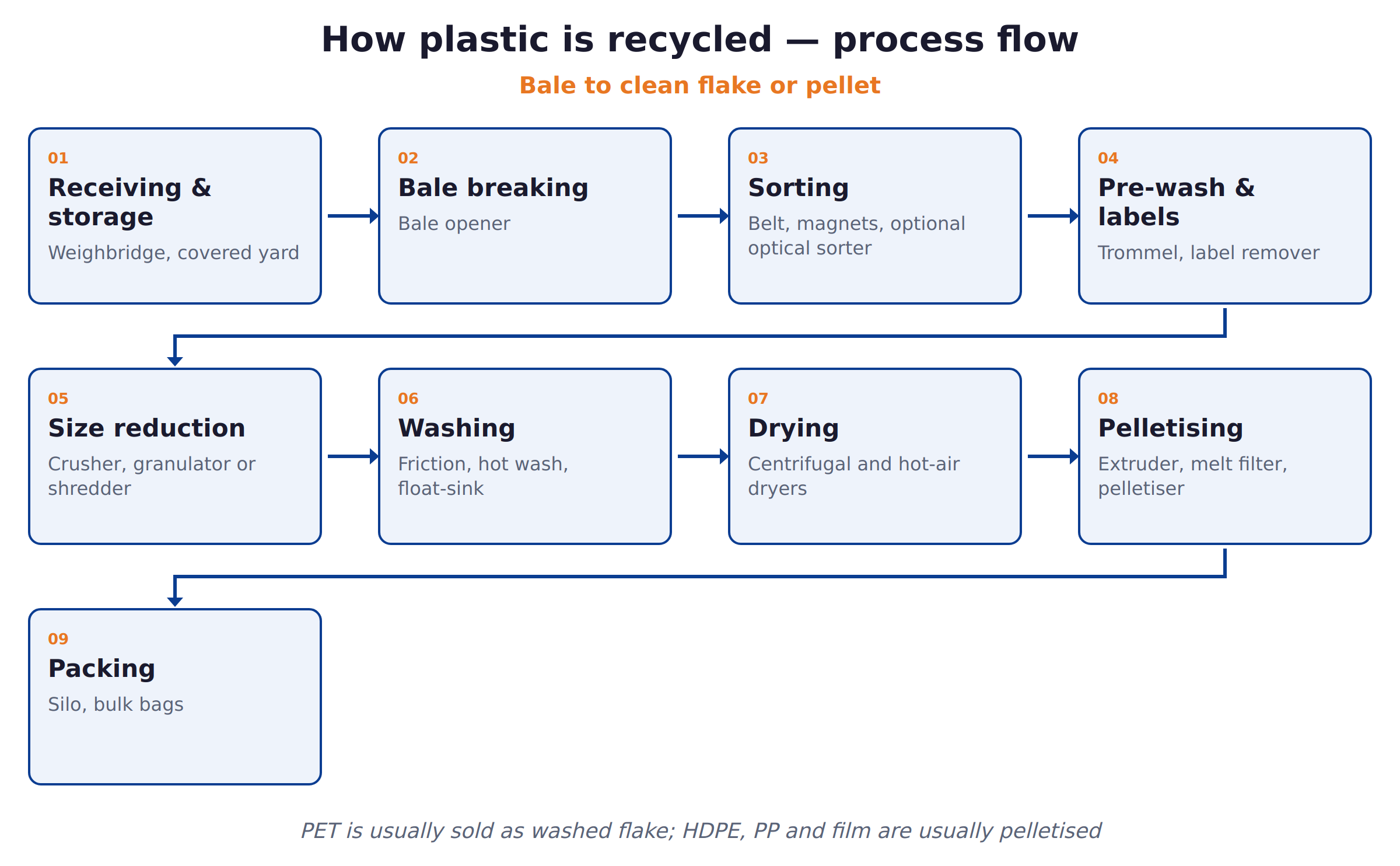
Step by step
Sorting: where quality is decided
Recyclers buy plastic in bales from collectors, buy-back centres and waste companies. A bale of "PET" can contain PVC bottles, coloured bottles, caps, labels, sand and liquid. Every one of those reduces yield or contaminates the product: a small amount of PVC in PET, for example, can spoil a whole batch of pellets. So the plant starts with bale breaking and a sorting belt where workers, and on larger plants optical sorters, remove the wrong material.
Label removal and pre-washing
For bottles, a trommel screens out loose dirt and a label remover strips sleeves before grinding. Removing labels while bottles are whole is much easier than separating label fragments from flakes later.
Size reduction
Rigid plastics such as bottles, crates and drums go through a crusher or granulator, often with water, to make flakes of around 10–15 mm. Film and bags go through a shredder or film crusher. The blades and screens wear quickly on dirty material, so plan for regular sharpening.
Washing and separation
Flakes are scrubbed in high-speed friction washers. For food-grade PET, a hot wash with caustic removes glue and residues. Float-sink tanks then use density: PET sinks, while polyolefin caps and labels float off. This is where the different plastics in a mixed stream are finally separated.
Drying
Centrifugal dryers spin off most of the water, followed by hot-air pipes. Film is often squeezed and partly melted in a squeezer dryer, because thin film holds water.
Pelletising
Many buyers want pellets rather than flakes. The pelletising line feeds clean, dry flakes into an extruder that melts them, a melt filter that removes the remaining fine contaminants, and a cutter that makes pellets. Vacuum degassing removes moisture and volatile compounds. Pellets are easier for converters to use in injection moulding, blow moulding and film blowing.
Which plastic follows which route
| Plastic | Typical source | Usual product | Notes |
|---|---|---|---|
| PET | Beverage bottles | Washed flake; sometimes pellets | Hot wash for higher grades; PVC and colour sorting critical |
| HDPE | Milk bottles, detergent bottles, crates | Pellets | Colour sorting decides the selling price |
| PP | Caps, crates, buckets, woven bags | Pellets | Often mixed with HDPE in float-sink; separate if buyers require |
| LDPE and LLDPE film | Shrink wrap, bags, agricultural film | Pellets | Washing and drying film is harder; yields lower |
Yields: how much you get from a tonne of bales
The yield is the clean product you sell divided by the bales you bought. It is the number that decides whether a recycling plant makes money, and it depends far more on what you buy than on which machine you install.
As a guide to what we see:
- Clean, sorted bottle bales often yield in the region of 70–85% clean flake, after caps, labels, moisture and dirt are removed.
- Mixed or dirty bottle bales yield less and need more sorting labour.
- Post-consumer film can lose a large share of its bale weight to moisture, dirt and other materials, especially agricultural film.
- Clean post-industrial scrap from factories can yield close to its full weight, which is why many recyclers start there.
Treat these as indicative. Ask every supplier to state the yield their line achieves on a sample of your bales, and test a few tonnes before you commit to a supply contract.
What a recycling plant costs
Indicative, in USD, from our plastic recycling machine price guide:
| Purchase | Capacity | Indicative price (2026) |
|---|---|---|
| Single shredder or granulator | Per machine | Low tens of thousands of US dollars |
| Complete washing line | 300–1,000 kg/h | About US$120,000–350,000 ex-works |
| PET bottle flake washing line | About 500 kg/h | About US$150,000–200,000 ex-works |
| Pelletising line added | Per line | About US$80,000–120,000 more |
| Landed and installed | Any of the above | Typically 25–45% more than ex-works |
Water, power and waste
Washing lines use water continuously and produce dirty water with sand, paper pulp and residues. Most plants recirculate water through settling tanks and filters, and many need a trade-effluent permit to discharge. Hot washing and pelletising use a lot of power: size the electrical supply for the whole line, including the extruder heaters. Labels, caps that cannot be sold, sand and sludge must be disposed of legally.
The rules that shape the process
- Waste licence. Under the Waste Act listing (GN 921 of 2013), recycling of general waste on an operational area above 500 m² needs a basic assessment and a waste management licence, unless the recycling is part of a factory's own production process.
- Norms for sorting and shredding. Sorting, shredding, grinding, crushing, screening or baling of general waste on 1,000 m² or more must comply with national norms and standards.
- Demand from bag makers. Plastic carrier bags and flat bags in South Africa must contain at least 75% post-consumer recycled content since 2025, rising to 100% from 1 January 2027, which supports demand for recycled film pellets.
- EPR. Packaging producers fund collection and recycling through EPR schemes under the 2020 regulations.
- The market. Plastics SA reported that 485,000 tonnes of plastic were recycled in South Africa in 2025, a recycling rate of 30.1%.
Common mistakes
- Buying a line before testing your bales. Yield and contamination decide the business.
- No label removal on a bottle line. Label fragments end up in the product.
- Skipping the melt filter. Converters reject pellets with specks.
- Undersized water treatment. The plant stops when water quality drops.
- Treating film like bottles. Film needs different shredding and drying.
- No buyer agreed in advance. Know who buys your flake or pellets, and at what specification.
Where CISH fits
We specify complete recycling lines, from bale opening to bagged flake or pellets, from audited factories in China against your plastic and your buyers' specification. We ship and clear the line, install it, commission it on your bales with the output and yield measured, and train your operators. If you only need a single shredder for clean factory scrap, a local machine dealer is usually the better route.
Frequently asked questions
What are the steps in plastic recycling?
Sorting, label removal and pre-washing, shredding or grinding, washing and float-sink separation, drying, and pelletising. Some plants sell washed flakes and skip pelletising.
What machines are used to recycle plastic?
Bale openers, sorting belts, label removers, crushers or shredders, friction washers, float-sink tanks, centrifugal and hot-air dryers, and an extruder with a melt filter and pelletiser.
What is a good yield for PET bottle recycling?
Clean, sorted bottle bales often yield in the region of 70–85% clean flake. Dirty or mixed bales yield less. Test your own bales before buying.
Do I need a licence for a plastic recycling plant?
In many cases. Recycling general waste on more than 500 m² needs a waste management licence, and sorting and shredding on 1,000 m² or more must meet national norms and standards.
Should I sell flakes or pellets?
PET is often sold as washed flake. HDPE, PP and film are usually sold as pellets, which most converters prefer.
How much does a plastic recycling line cost?
As an indication for 2026, a complete washing line for 300–1,000 kg/h costs about US$120,000–350,000 ex-works, and a pelletising line about US$80,000–120,000 more.